

Letter from the Editor
On May 25, 2014, I was five months into another Afghanistan deployment when the rumor mill began grinding about a special guest coming to speak to us. Was it the President? Secretary of Defense? Some musician? Odds were leaning towards POTUS. Meanwhile, I was working really hard at not giving a shit.
I always made a habit of skipping such things. I was there for the war, not a selfie with a comedian or cheerleaders, actual or political. I saw morale, welfare, and recreation efforts in a warzone as distractions. I didn’t want to be someone who needed a distraction for, as a Ranger friend said to me in 2010, as we watched a 5K run pass us on Bagram’s Disney Drive after another all-nighter in the JOC, “Standing here? Judging these people? This is the best thing I’ll do all day.” Yeah, it was a bit of a pose, but after twenty years, more than half of it spent watching people in their late teens and early twenties lay it all on the line, I was tired of politics and bloviation by politicians and their choruses of multi-millionaire cable news twits. Little has changed in that regard.
Regardless, curiosity got the better of me, and at the last minute, I joined a very long line. Marines, much less Navy SEALs like the one standing next to me in line, were relatively rare at Bagram, with most of us in Helmand Province. Our desert utilities stood out in a sea of Army OCP and ACU patterns, attracting the attention of a man carrying a clipboard and wearing a headset who pointed at me and said, “Hey! You guys come with me!” I grabbed our Army friends and unironically said, “Follow me!”
We all followed Clipboard Guy through a metal detector, got wanded by a guy in civilian clothes who looked like he could take me and the SEAL while eating french fries, and were led into the waiting aircraft hangar where Clipboard Guy took us onto a stage, directing us to a set of bleachers behind which hung an American flag larger than any ever unfurled for Toyotathon.
As I looked out at the growing crowd of servicemembers apparently judged insufficiently telegenic, an officious young woman came out, also bedecked in a headset and carrying a clipboard, to tell us we would be on live television and not to pick our noses. I immediately wanted to pick my nose, roll it up, and throw it at her, but I didn’t because I felt like she was already sneering enough at us unwashed savages, and I didn’t want to confirm her assumptions.
That night, there was indeed music from a big-name country singer/insurance salesman. There were indeed speeches from various important people, the names of whom have faded in the mists of time. And there was indeed the President of the United States of America.
I shook hands with a President for the first time that night, as did about 4,000 other servicemembers. I didn’t vote for the man, but I felt respected in that he took time to connect with me, with all of us, literally. Still, I don’t like being a prop, no matter who is standing in front of me, and given the way the clipboard and headset crowd treated us, it was an inescapable truth that I was a guy selected as scenery because I was wearing tan instead of green. In that moment, and perhaps others for 27 years wearing the cloth of the nation, I was a prop.
Fast forward twelve years.
The “No New Wars” president who ran on gas prices has us in at least one new war, which has me paying another dollar per gallon at the pump. Then there’s Venezuela, or the announcement that came today, as I write this, that “Cuba is next.” Take that for whatever that’s worth from a president given to, shall we say, bombast. But in CENTCOM, it’s inescapably true that the 82nd Airborne Division is on the move, two Marine Expeditionary Units are in theater, and things are exploding all over the place. It’s a war of some stripe, one for which I would have been champing at the bit at 23, professionally willing to do at 33, and resigned to at 43. If I’m honest, I would not have much use for a Marine who failed to fall somewhere on that spectrum. But at 53 and retired, I like to think I’ve learned something from the past decades about clearly defined, achievable, and consistent objectives.
However, all I can really say, and something I hear echoed from peers with years in combat is, “Can anyone explain this one?” Not in the Dr. Seuss rhymes favored by the weekend news guy currently running the most powerful military on earth, but in a coherent list of objectives, ends, ways, and means? Can I get a coherent theory of victory that survives from one press conference to another? I must ask, because I know too many dead people not to, “Are we doing the right thing? And are we doing the thing right?” It’s something one must ask when one is no longer willing, or required, to be a prop.
Which brings us to March 21, 2026, when our President and Commander-in-Chief memorialized the passing of the former FBI Director, US Attorney, and Vietnam combat-wounded and decorated Marine Robert F. Mueller with the words, “Robert Mueller just died. Good, I’m glad he’s dead. He can no longer hurt innocent people!” People assure me that the guy whose hand I shook hated, and that the guy who used a dead servicemember as a prop to sell newsletter subscriptions loves, the military. I don’t know either of them, so I can’t say. Far too many Americans have forgotten that it’s fine to say nothing when you have nothing good to say. Not least our current President.
In 2026 America, loyalty certainly seems to come in different forms. Mine is not, never was, and never will be, blind fealty to any man. Mine comes in questioning the wisdom of actions taken by people who were never willing to place themselves where blood and shit and steel were the currency of the day. Because my loyalties still lie, and always will, with those who were, and those who did, and even more importantly, those who are. I will always remember what it felt like to be at the edge of the Empire.
And I will never forget that I was just a prop.
Maybe you disagree. Maybe you feel the same way. Tell us how and why you feel here. This volume is poetry-heavy. In an era in which truth has become fungible, a meaningless word attached to internet missives designed for one audience, poetry always tells the truth. But so can essay, and Marine Major Benjamin Van Horrick, Editor in Chief of The Connecting File, offers a brave one below. You can be a truth teller. Send yours to lethalmindsjournal.submissions@gmail.com.
Fire for Effect,
Russell Worth Parker
Editor in Chief - Lethal Minds Journal
Dedicated to those who serve, those who have served, and those who paid the final price for their country.
Lethal Minds is a military veteran and service member magazine,
dedicated to publishing work from the military and veteran communities.
Two Grunts Inc. is proud to sponsor Lethal Minds Journal and all
of their publications and endeavors. Like our name says we share a
similar background to the people behind the Lethal Minds Journal, and
to the many, many contributors.

Just as possessing the requisite knowledge is crucial for success,
equipping oneself with the appropriate tools is equally imperative. At
Two Grunts Inc., we are committed to providing the necessary tools to
excel in any situation that may arise.

Our motto, “Purpose-Built Work Guns. Rifles made to last,” reflects
our dedication to quality and longevity. With meticulous attention to
manufacturing and stringent quality control measures, we ensure that
each part upholds our standards from inception to the final rifle
assembly.

Whether you seek something for occasional training or professional
deployment, our rifles cater to individuals serious about their
equipment. We’re committed to supporting The Lethal Minds Journal and
its readers, so if you’re interested in purchasing one of our products
let us know you’re a LMJ reader and we’ll get you squared away.

Stay informed. Stay deadly.

-Matt Patruno
USMC, 0311 (OIF)
twogruntsinc.com
support@twogruntsinc.com
In This Issue
Across the Force
Give the Company Gunny Three Drones: Heavy-Lift UAVs and the Future of Infantry Sustainment
The Written Word
A Standard Not Met
Bosnia – The Landmine Road 1997/8
Poetry and Art
Ben Cantwell Art
Operator
The Fox
Fisher, Cat and Artic Warfare
All Secure
Across the Force
Written work on the profession of arms. Lessons learned, conversations on doctrine, and mission analysis from all ranks.
Give the Company Gunny Three Drones: Heavy-Lift UAVs and the Future of Infantry Sustainment
Thomas Schueman
From submarines to IEDs, friendly logistical efforts have always been targeted by the enemy. But resupply is now contested to the point that every convoy can expect contact. Forward units will not be able to rely on traditional log trains or sling-loaded resupply from heavy-lift helos – not in a battlespace saturated with FPVs, loitering munitions, persistent ISR, and cheap precision fires.
The Marine Logistics Groups (MLG) have made real, measurable progress in integrating autonomous systems into their formations. They are experimenting, fielding, innovating, and learning fast. And while the MLG should continue this effort in earnest, a concurrent effort must commence to implement uncrewed logistics at the infantry battalion level and below. Specifically, each infantry company should be equipped with three heavy-lift UAV systems that the Company Gunny can employ to resupply platoons and squads with chow, water, and ammo.
If a company can move even 50% of its sustainment via UAV, its material readiness in the trenches and patrol bases will be substantially higher than if it had to rely on traditional means for 100% of its support. The combat power and morale boost after a successful resupply enable Marines to continue operating and fighting under austere conditions.
A platform already exists in the Marine Corps’ inventory to stitch together the last mile of logistics. The Marine Corps’ Tactical Resupply UAS (TRUAS) program fielded the TRV-150, which carries up to 150 lbs, flies at ~67 mph, and has a 43-mile range. Besides carrying water, fuel, batteries, chow, and ammo, the TRV-150 offers the modularity to carry lethal payloads, which provides significant benefit to Marines operating at the forward line of troops.
The Marine Corps should resist the urge to engineer a new training pipeline, as the TRV-150 operates similarly to other program-of-record quadcopters. Eventually, each infantry company should have a dedicated drone team attached to it, but until then, Marines cross-trained at TALSA or who are Basic Drone Operators can fulfil the requirement.
The MLG’s great work has already demonstrated the utility of a heavy-lift UAV for tactical resupply. It is now a matter of pushing the equipment to the appropriate echelon. The Corps’ focus on drone dominance and pushing lethality down to the infantry squad is a critical endeavor, but a squad of Marines armed to the teeth with FPVs but out of batteries does not increase lethality. Today’s battlefield requires more than a highback HMMWV. Give the Company Gunny the tools he needs to support the Lance Corporal. Equip each infantry company with three heavy-lift UAVs.
The Written Word
Fiction and Nonfiction written by servicemen and veterans.
A Standard Not Met
Major Benjamin Van Horrick
“Company staff, take charge of your platoons and carry out the plan of the day!”
I had been waiting months for those words, but as the three SNCOs took control of my life for the next five weeks, fear seized my body at the sound of the sergeant instructor. We rushed outside to where we had left our gear and dumped everything issued to us onto the searing asphalt. Within moments, the frenzy jumbled our neatly labeled items from the packing list. Our sergeant instructor’s profane, withering barrage tore through the mayhem.
I had considered a career in the military during high school and even began a preliminary application to the Naval Academy. But the allure of playing Division III football at Kenyon College outweighed my desire to pursue an appointment to a service academy.
But in November 2004, I sat in a seminar as Marines entered Fallujah a second time for Phantom Fury. The debate about political theory felt not only distant but also hollow.
When I expressed this to fellow students, each told me we were special for attending Kenyon. They spoke as though those in Iraq were only there because they did poorly in school and signed up at the prodding of a slick recruiter.
“But you have a future,” they told me.
As if the kids in Fallujah didn’t.
Other recruiters pumped kids full of promises of exotic adventures and bonuses. Marine recruiters offered hard work, commitment, and discipline.
Screaming turned our throats raw and focused our timid voices into a commanding presence. In the chow hall, we held trays at 45 degrees, elbows locked—a posture we would later mimic with weapons during close order drill. We sat with our backs straight, heels together, feet at 45 degrees, mirroring how we stood in formation. The tray was the rifle. The chow hall was the parade deck.
Here, rules governed everything and were enforced without negotiation: a standard met or not. Within days, the staff began dismissing candidates for violating integrity. Another lied about the number of repetitions on the obstacle course and was sent to plead his case before the commanding officer. The candidate failed and was then sent home.
Within two weeks, I began struggling. On the obstacle course, I did not execute the proper technique. Despite repeated instructions to use my feet, I used only my arms.
“You look like Donkey Kong, candidate!” yelled a sergeant instructor.
Each time a sergeant instructor corrected me, I acknowledged the correction. I told myself I understood. What I couldn’t admit was that understanding something and actually changing because of it are two entirely different things.
Negative counselings piled up.
Eight days before graduation, I faced the company board on the toughest day: roused at 0100 for a 13-mile hike, an MRE for breakfast, then the Small Unit Leadership Exam (SULE) as part of a five-man “stick.” We ran five miles with steep features, leading obstacles—moving wounded, transporting ammo, carrying a rifle and full canteens, leaving us exhausted. At the conclusion, I scrambled to prepare for the board: a lukewarm shower, a quick shave (I cut myself).
I entered the cool room, where the company staff was assembled, feeling a chill as I began sweating through my undershirt. Here in the confined office, even with eight other Marines, the lack of heat and humidity shocked my already fried body.
I trembled as I reported. “Good afternoon, sir. Candidate Van Horrick reports as ordered.”
The board was impersonal and sterile. To keep my bearing, I stood straight and fixed my focus on the company commander. My vision narrowed as my heart pumped faster. I fought to stay another day, but the board members viewed the proceedings as routine as shaving or putting on their boots. I heard my platoon commander’s voice reciting my poor physical performance and failing academic tests, then recommending my dismissal. The platoon commander’s clinical recitation of facts was nothing like the sergeant instructor’s corrections, which I had come to accept. He was a prosecuting attorney. The sergeant instructor had been a teacher.
“Sir,” I said, my voice steadier than I expected, “I know my performance hasn’t met the standard. But I want to lead Marines.”
“Candidate Van Horrick, you can’t seem to lead yourself, and you’re a danger to others.”
“Sir, I want to serve.”
The company First Sergeant shot back, “Then get hired at TSA, Candidate Van Horrick.”
The Company Commander recommended my dismissal. My instinct was to argue. But the Marines in this room had watched me for five weeks. They knew me better than my classmates, my professors, and myself. I would see the OCS commanding officer the next day. Five weeks of my life compressed into five minutes of deliberation.
The senior sergeant instructor took me into his office. His rounded features and powerful presence had shaped the platoon. He said he respected every candidate who attempted to become a Marine officer. This man had corrected every candidate with the same exacting, unhurried care, as though each of us was worthy of his time. He offered his office if I needed to cry, not wanting to embarrass me in front of the platoon. “Be honest with the colonel about your shortcomings, express your desire to stay,” he advised.
Mid-afternoon, under a green tent, we waited hours for calls with our OSOs. I sat beside candidates who blamed others, while others simply resigned themselves to their dismissal. Some I had made fun of weeks before; now we were equals, fighting for another day. Each yearned to return to cleaning rifles and squad bays. My Officer Selection Officer reassured me that desire would go far. Yet I doubted desire alone would succeed. That night, I prayed the rosary for thirty minutes, studied half-heartedly for the close order drill written exam, and penned reasons why I should remain at OCS. A short, serene sleep followed. At 0430, I awoke with rare peace. We marched to the mess hall under a golden July sunrise.
Those facing dismissal waited the better part of the day, watching platoon commanders present cases against us. None of us was ready to become Marine officers. On the grinder, I saw my platoon taking the close order drill exam.
I would have given anything to be there.
Five days after my dismissal, after a flight cancellation, I lay on the hard, cold floor, invisible to fellow travelers, who were indifferent to my failure.
I kept replaying the board, the First Sergeant’s voice, the five minutes. What I didn’t have yet was what to do about it.
The Marines who dismissed me cared more about who I might become than those who had told me I was special.
Kenyon had taught me to interrogate every assumption. OCS taught me that interrogating a standard while you’re failing to meet it is just a more sophisticated form of excuse-making.
Bosnia – The Landmine Road 1997/8
Joseph P. Bell
Night driving in Bosnia had a way of getting inside your head.
The roads were narrow and broken, twisting through dark farmland and villages that had been scarred by years of war. Our HMMWV bounced along slowly, the suspension groaning under the weight of our gear.
We kept the speed down. Fully loaded, the old truck barely pushed forty-five miles an hour anyway.
The headlights carved a narrow tunnel through the darkness. Everything beyond their beams disappeared into the black.
Every so often, we noticed small piles scattered along the side of the road. In the dark, it was hard to tell what they were—rocks maybe, or piles of dirt pushed aside by road crews.
Nobody said much about them.
Then we reached an intersection on the road between Srebrenica and Sarajevo.
A farmer appeared from the darkness, pushing a wheelbarrow.
He walked straight toward the road as if we weren’t even there.
At first, we thought he was just crossing with tools or supplies. But as he came closer, the headlights lit up the contents of the wheelbarrow.
Landmines.
The thing was full of them.
We started yelling immediately.
“Stop! Stop! Get away from those!” Weapons were brought to the ready.
The farmer didn’t seem concerned in the slightest. He walked calmly to the edge of the road, tipped the wheelbarrow forward, and dumped the mines into a pile beside the pavement.
We squinted, heads on chests, ducking behind the frame of the light skinned HMMWV, seeking purchase behind anything that would lessen the coming explosions.
Silence.
The farmer shrugged his shoulders and turned back toward his field like it was just another chore on the farm.
For a moment, nobody said anything.
Then it hit us.
Those piles we had been passing along the road all night weren’t rocks.
They were mines.
The Bosnian war had left the countryside littered with them—plastic anti-personnel mines, artillery shells, unexploded ordnance hidden just beneath the soil.
Invisible killers waiting for someone to take the wrong step.
From that point on, every time we dismounted, we moved slowly and deliberately. Every step across an open field carried the same thought in the back of our minds.
One wrong move could be the last one you ever make.
Bosnia had been at war for years. The scars were everywhere—destroyed homes, empty villages, and entire fields that nobody dared to walk across.
The hatred that fueled the conflict was just as real.
I had seen a lot during my time in the Marine Corps, but that moment on that dark road drove something home in a way I had never experienced before.
War doesn’t always end when the shooting stops.
Sometimes it just waits quietly in the ground.
Poetry and Art
Poetry and art from the warfighting community.
Ben Cantwell Artwork
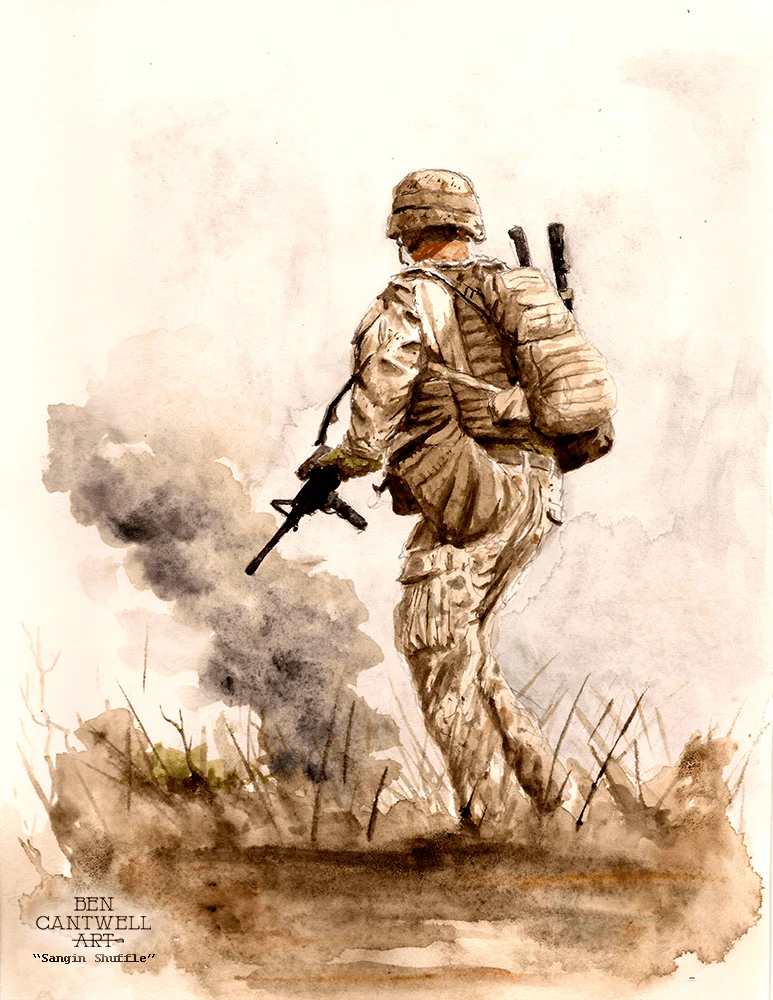
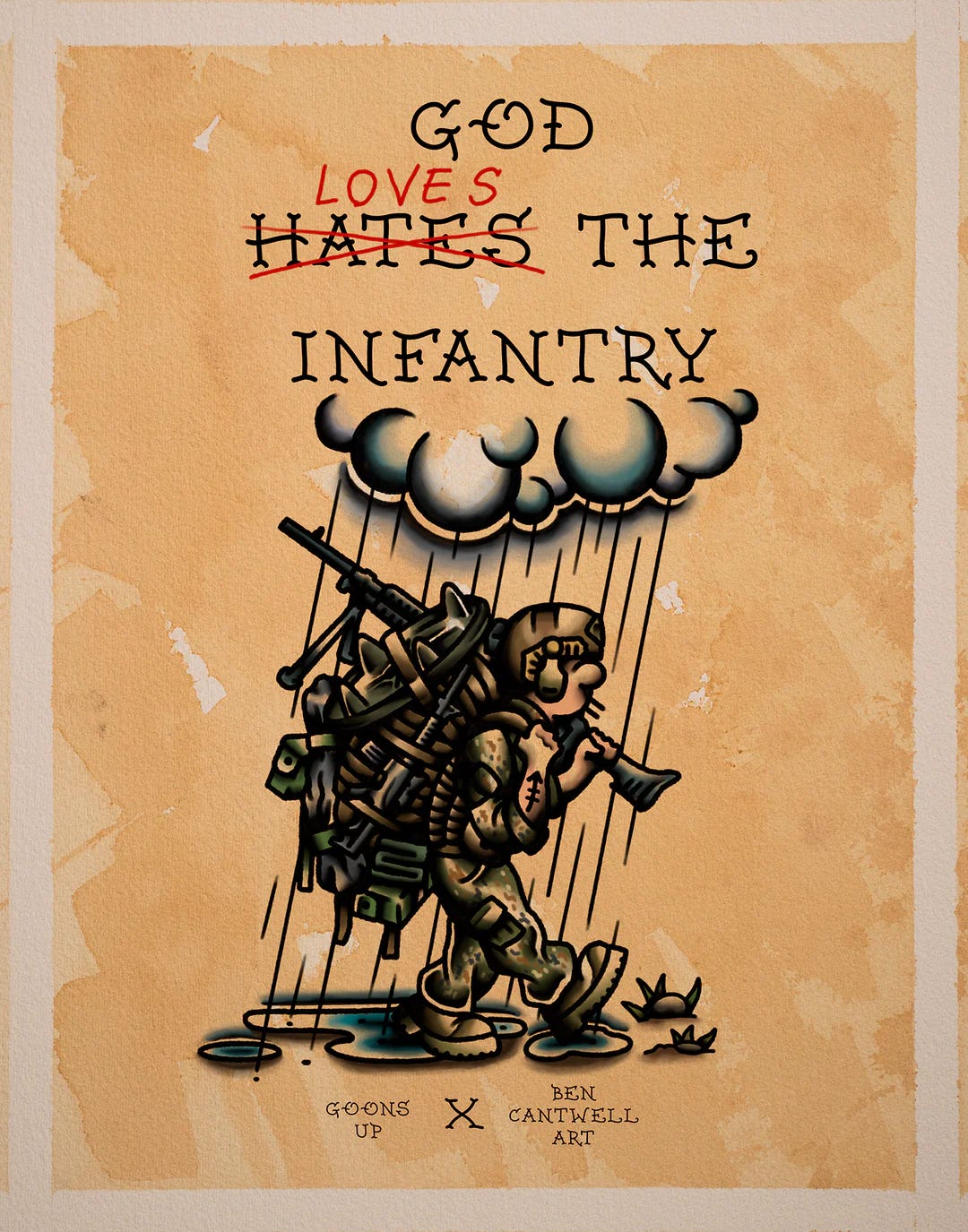
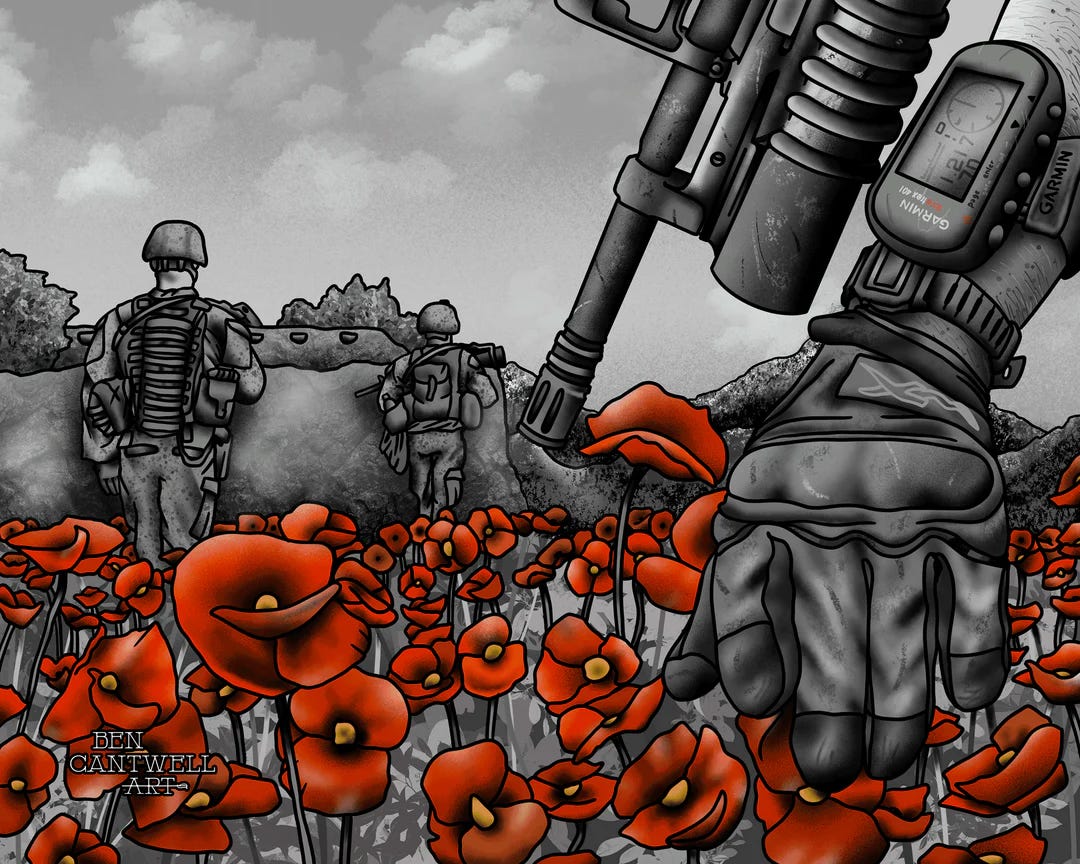
Ben Cantwell Art was founded by Marine infantry veteran Ben Cantwell, who began creating artwork in the barracks, informally designing tattoo-style pieces for fellow service members. What started as a creative outlet steadily developed into a business around 2017, built on a foundation of traditional tattoo-inspired design, military influence, and an appreciation for craftsmanship. Over time, his work has gained a loyal following among veterans, first responders, and supporters drawn to its clean style, traditional American work and authentic roots.
Today, Ben Cantwell works as a full-time Firefighter Paramedic in California and finds time to offer a range of original artwork across apparel, prints, and select goods. His production is 100% based in the US, and he maintains a strong connection to the veteran/first responder community. The brand also supports charitable efforts focused on veteran/first responder well-being and awareness. In addition to the core collection, Ben takes on a limited number of custom projects per month, creating tailored designs for individuals, organizations, and brands seeking distinctive, purpose-driven artwork. His work and contact info can be found on Instagram and on his website, BenCantwellArt.com.
Operator
Emma Blunt

The thumping in my ears
draws my focus to my chest.
Milliseconds of delay between
my heartbeat and fear.
What if I’m not listening?
What if I miss something?
Comms reign me in.
I hear it, I acknowledge.
I know what to do.
Slow is smooth, smooth is fast.
Call it out …
She tells me my voice
was calm and relaxed.
Soothing under pressure.
I laugh … the current that
almost pulled me under.

The Fox
Cora Reichert

He is one in a line of glittering headlights,
his huff-puff Halliburton heart stacked
with still-locked luggage and trigger fingers
like soft white woodpiles, sinking into a
clearing in his memory. He runs a red,
replaying the thunk of a skull on his
bumper, the small bright body slack as a
loogie, falling away at fifty miles an hour.
He shot a kid in Al-Anbar once. A bright
stain on the berm with an RPG askew,
shrinking in the rearview. He feels the kick
in his shoulder, and cold hands slime the
wheel with the cost of health insurance.
Stupid animal. What his sergeant said in
Al-Anbar, and what he tells himself now.
Steer into the center of your lane. Stop
looking behind you for the smallness of it.

Fisher, Cat and Artic Warfare
Evan Young Weaver

The Fisher is no cat,
yet a fisher, a hunter, a killer,
a trapper, a stalker, a climber,
a gutter, long toothed believer.

You are a screamer.
My favorite blood curdling proclaimer.
The best companion for northern ice nights.
I love the diamond stars and sudden fright.

Excitement to eat or tactic to defeat?
Two animals fed; your belly, my beast.
That scream is a treat, a reward for
patience and my luck some nights.

I saw you twice in waning light, but,
dozens of nights I, hearing, you.

All Secure
Larry Boggs

They said all secure
like it meant something solid,
like the world could be locked down
with three syllables and a radio click.

But I’ve lived long enough to know
nothing stays secure.
Not the ground under your feet,
not the men and women beside you,
not the pieces of yourself
you swore to keep intact.

I was there—
close enough to smell the war,
close enough to hear the rotors
but not the one pulling the trigger
or dragging a brother to safety.

Some think that should make it easier.
It doesn’t.
You carry a different kind of weight—
the kind that whispers when all is quiet.
You were there, but you didn’t do enough
to hurt this much.

Some think time patches things up.
It doesn’t.
It just teaches you how to walk
with the weight.
It’s the forever ruck.

Guilt, that old familiar shadow,
is always in the corner of your mind
asking why you made it home
when better men didn’t.

So, when someone says all secure now,
I nod, but inside I know better.
The world shifts, memory ambushes.
Guilt can be managed, but it doesn’t go away.

With age, I’ve learned
all secure is a hope, not a truth,
and some of us have been hoping
for a very long time.
——————————
This ends Volume 45, Edition 1, of the Lethal Minds Journal (01APRIL2026)
The window is now open for Lethal Minds’ forty-sixth volume, releasing May 01, 2026.
All art and picture submissions are due as PDFs or JPEG files to our email by midnight on 20 APRIL 2026.
All written submissions are due as 12-point font, double-spaced, Word documents to our email by midnight on 20 APRIL 2026.
lethalmindsjournal.submissions@gmail.com
Special thanks to the volunteers and team that made this journal possible.
Great put-together this month. I look forward to Lethal Minds in my inbox. I thought it might be a good idea if y'all did a monthly reading clip/get to know the editors kind of thing. Something titled like "On the Footlocker" or something like that (instead of "On the Nightstand") which could feature a paragraph or a few sentences about what military-related books y'all are currently reading. Just an idea. Stay lethal!