

Letter from the Editor
I often think of the military and its surrounding community as a culture apart. But we’re not. We are just a reflection of the culture we serve. That makes it easy to get cynical about military service because we live in a cynical time, one in which an entire economy is built on negative attention. Daily, I swipe my phone, as addicted as anyone, to see people at their worst, shouting their dyspeptic takes, mining our collective unhappiness for views and likes.
Accordingly, we have a universe of net denizens who add and detract from the culture in various measures. I’ve even noticed that the angrier and edgier my thoughts become here, the more eyes Lethal Minds Journal finds. It’s sad that to feel bad feels good to so many of us. It’s even more sad that in the attention economy, making people feel bad works to my advantage
But in the moments that tell the truth, hidden amongst hot takes about things generally above any pay grade the offeror ever occupied, or ever will (and here I must confess that you can occasionally find me on cable news opining about issues I never dealt with), is a separate thread, that of a longing for “the boys.” If it’s possible, I use “the boys” as broadly as possible, as a sobriquet for all servicemembers, men and women, but it seems to be more overt amongst what some call the male loneliness epidemic.
I see people who could not run out of sight declaring themselves ready for “one more run with the boys in Iran.” I see perhaps more self-aware folks telling each other to check on the boys, something important in a community in which the words “died suddenly” impart a specific meaning more gently than “killed himself yesterday.” I am not immune. I ended my Marine Corps retirement speech quoting Colby Buzzell from his book My War: Killing Time in Iraq.
“But then again, if I ever got a call from the battalion commander saying that he was getting everyone from Second Platoon Bravo Company 1/23 INF back together, to go “Punish the Deserving” for one last tomahawk chop out there in Iraq, and that he was going to lead the way, and everyone was going, and they needed me as an M240 Bravo machine gunner again, I’d probably tell him, ‘That’s a good copy, sir. Let’s roll.’ Hell yeah.”
I had the chance to watch one more run with the boys this month. My lifetime ago, my father was a Marine officer, a first lieutenant assigned to a battalion staff. Executive Officers run unit staffs. I know, I spent a lot of time as one. My Dad’s Executive Officer was a Major named Harvey C. Barnum. Now 86 years old, in 1965 Barnum was a first lieutenant himself, in Vietnam on a ninety-day Temporary Assigned Duty from Okinawa. It was a “Hey, nothing is going on here, go get some experience, kid” kind of thing.
With just a few days in country, Barnum got into his first firefight and got a little experience. And the Medal of Honor.
My dad has talked about Harvey Barnum my whole life. A few years ago, courtesy of the same Internet I decry, Pops reached out to now-retired Colonel Harvey Barnum, who was recently kind enough to invite him, my stepmom, my brother, and me to see the Burke-class destroyer DDG USS Harvey C. Barnum be commissioned. There were 1500 people there. Folks from that day in Vietnam, other folks with whom he served over three decades, and more than a handful of his fellow Medal of Honor recipients, people I have admired for decades. Many of the men who were once raw muscle and sunburned skin needed help to get around, but come they did, many from far-off locations, to be pierside in Norfolk. They came to honor Barnum. They came for one last run with the boys.
As I watched the sailors take the ship, running up the gangplanks in their whites, at the command to “Make her come alive,” I thought about something that Maslow knew well. We need human connection, the basis for effective military units. It is the people for whom we serve. It is the people for whom we fight. And at times, it is the people for whom we die.
Yet once we’re out, we allow that connection to be torn asunder by the culture war bullshit we seem to hold on to as the answer to the question of whether someone is worth having in our lives. It’s a frailty capitalized upon by cynics in the pursuit of personal power, and it dishonors the connections we made when it mattered. I am as guilty as anyone.
We live in a time rife with bullshit. We are fed bullshit by our so-called leaders. We buy bullshit to make ourselves feel better. We spew bullshit to establish ourselves as better than someone else. It’s a perversion of the thing so many of us still claim to hold so dear, that need for human connection.
We’d all do well to think of the purest connections, those made when it mattered, the kind that bring you together on a dock in Norfolk, Virginia sixty-one years later, and honor them in how we treat one another. We could be a powerful force for good in a nation that desperately needs it, an example for the rest of the citizenry to follow, if we could only rise above the bullshit.
We try to do that here. Sometimes it angers a few readers. I am fine with that. I like it, in fact, it means we’re pushing at the edges. Feel free to tell me how I, or any of our writers, are wrong at lethalmindsjournal.submissions@gmail.com.
Fire for Effect,
Russell Worth Parker
Editor in Chief - Lethal Minds Journal
Dedicated to those who serve, those who have served, and those who paid the final price for their country.
Lethal Minds is a military veteran and service member magazine,
dedicated to publishing work from the military and veteran communities.
Two Grunts Inc. is proud to sponsor Lethal Minds Journal and all
of their publications and endeavors. Like our name says we share a
similar background to the people behind the Lethal Minds Journal, and
to the many, many contributors.

Just as possessing the requisite knowledge is crucial for success,
equipping oneself with the appropriate tools is equally imperative. At
Two Grunts Inc., we are committed to providing the necessary tools to
excel in any situation that may arise.

Our motto, “Purpose-Built Work Guns. Rifles made to last,” reflects
our dedication to quality and longevity. With meticulous attention to
manufacturing and stringent quality control measures, we ensure that
each part upholds our standards from inception to the final rifle
assembly.

Whether you seek something for occasional training or professional
deployment, our rifles cater to individuals serious about their
equipment. We’re committed to supporting The Lethal Minds Journal and
its readers, so if you’re interested in purchasing one of our products
let us know you’re a LMJ reader and we’ll get you squared away.

Stay informed. Stay deadly.

-Matt Patruno
USMC, 0311 (OIF)
twogruntsinc.com
support@twogruntsinc.com
In This Issue
Across the Force
Kriegsspiel, Battlefield Decision-Making, and the Limits of Artificial Intelligence in the Law of Armed Conflict
The Trolley Problem, Now With Drones
The Real Test of ‘Epic Fury’ Isn’t Just on the Battlefield
The Written Word
Did you ever kill anyone?
Poetry and Art
Kilroy
Will You Say My Name?
Transition and Veteran Resources
Mastery Before Meaning: Stop Telling Veterans to Find Their Passion
How Offshore Sailing Helped Me Find Peace and Purpose
Book Review
The Sarvan
Across the Force
Written work on the profession of arms. Lessons learned, conversations on doctrine, and mission analysis from all ranks.
Kriegsspiel, Battlefield Decision-Making, and the Limits of Artificial Intelligence in the Law of Armed Conflict
CPT Trevor J. Potter
I. Introduction
War remains a field where the art of judgment and the burden of moral responsibility defy reduction to mere calculations and algorithms. As Carl von Clausewitz emphasized, warfare is “the realm of uncertainty,” a spectacle in which chance, human passion, and moral gravity conspire in ways that no algorithm can predict or control.1 In the early 19th century, the Prussian military devised Kriegsspiel not simply as a game but as a demanding exercise in decision-making under uncertainty—a training tool that forced commanders to grapple with incomplete information and the ethical complexities of war.2
Today, with artificial intelligence (AI) permeating nearly every facet of military operations, there is a growing tendency to view technology as a cure-all for the vicissitudes of combat. Proponents argue that AI-driven systems can optimize battlefield decisions, reduce human error, and even enhance adherence to the Law of Armed Conflict (LOAC).3 Yet such optimism may overlook the fundamental reality that war is as much about moral discernment as it is about tactical calculation. In this essay, I explore how the lessons of Kriegsspiel remain paramount, even in the age of AI. I offer specific guidance for Judge Advocates who are duty-bound to ensure that legal and ethical constraints remain firmly under human control.
As David Foster Wallace once remarked, “The really important kind of freedom involves attention, and awareness, and discipline, and effort,” a sentiment that resonates deeply when we consider the human costs of delegating the weighty decisions of war to algorithms.4 This essay argues that while technology may illuminate our choices, it cannot replace the essential human judgment required to navigate the uncertainties of armed conflict and the imperatives of LOAC.5
II. The Pedagogics of Kriegsspiel: An Enduring Legacy
A. Historical Context and Conceptual Basics
Kriegsspiel was shaped from the accepted facts that the chaotic and unpredictable nature of warfare was intractable by purely deterministic means. Created by the Prussian military in the early 1800s, it was intended not as a competitive board game but as a simulation that replicated the “fog of war” and the ambiguity of enemy intentions.6 Unlike chess—where all variables are laid bare, and every move is deterministic—Kriegsspiel introduced a human umpire to control information, compelling officers to grapple with the ambiguity and uncertainty in real time.7
Clausewitz’s observation that “war is the continuation of politics by other means” underscores the necessity of judgment over calculation.8 The Prussian approach recognized that effective command in war was more than the sum of different odds—it showed the essential attributes of an acute sense of timing, prudence, and most importantly, the capacity to weigh moral imperatives against tactical requirements. This approach ensured that the “art” of warfare was preserved in the training of military leaders, a tradition that modern military theorists argue should remain paramount today.9
B. The Role of Human Judgment in Kriegsspiel
Kriegsspiel showed the boundaries of observed data. Over time, and alongside technical advancements in computing and information systems, Commanders learned that the “facts” of battle were variable, often complicated by the “fog” of conflicting intelligence.10 The game instilled an enduring lesson: the value of human judgment lies precisely in its ability to operate under uncertainty—a combination of theory, intuition, and moral consideration in ways that no machine ever could.11 This emphasis on human judgment over calculation is especially critical in legal contexts. Under LOAC, every decision brings moral weight, and every tactical choice must be measured against ethical requirements.12
For Judge Advocates, the history and purpose of Kriegsspiel serves as a reminder that legal oversight in war must incorporate—and champion—a uniquely human capacity for judgment. There is no doubt that technology can provide recommendations and aggregate data, but the human mind must interpret these signs within the framework of justice and ethical responsibility.13
III. The Rise of AI in Military Decision-Making
A. The Attraction of Algorithmic Precision
The military has increasingly turned to AI for its capacity to analyze vast datasets quickly and consistently. AI systems are touted for their ability to synthesize sensor data, perform real-time analysis, and propose ideal courses of action—often at speeds that outperform human deliberation.14 Proponents claim that by shifting this cognitive load away from commanders, AI can reduce human error and enhance compliance with LOAC by adhering to programmed legal constraints.15
Such a view is seductive. In an era where data is king, the notion that algorithms can “see” more, process faster, and operate without the distractions of emotion or fatigue is undoubtedly appealing.16 But this ignores the shifting dynamics of warfare—any such machine outputs are made by entities with no moral responsibility or capacity to be held accountable. You can’t court-martial a machine or a program. The automation of decision-making can deprive the essential human element that is paramount in battlefield decision making.18
B. The Limits of AI
While AI may excel at pattern recognition and rapid data processing, it cannot comprehend context in the human sense. For instance, the principle of proportionality under LOAC requires more than sheer calculation of collateral damage against military gain—it demands a careful assessment of human suffering, cultural context, and the ethical heft of decisions made in the midst of a chaotic battle.19 AI systems, however sophisticated, lack the capacity for empathy and cannot weigh the subtleties of moral judgment.20
Moreover, AI’s reliance on historical data and defined parameters can make AI totally incapable of handling novel situations or adapt to unexpected shifts in the battlefield environment.21 The inherent unpredictability of warfare—a phenomenon that Kriegsspiel was designed to simulate—remains an area where human judgment is indispensable.22 In sum; while AI may offer a facade of precision, it does so at the cost of the nuanced deliberation that is the hallmark of responsible command.23
C. The Ethical and Legal Implications
The most disturbing consequence of overreliance on AI in military operations is the steady erosion of command responsibility. LOAC rests on the premise that human beings—not machines—must be accountable for the use of force.24 When decision-making authority is spread across algorithmic systems, the chain of responsibility becomes ambiguous, raising serious legal and ethical dilemmas.25 As one legal scholar has noted, delegating moral judgments to machines risks undermining the very foundation of just warfare.26
Judge Advocates must then be especially prudent when integrating AI into operational contexts. They must ensure that while AI may assist in decision-making, it never supplants the human judgment that is foundational under LOAC.27
IV. AI and the Law of Armed Conflict: A Detailed Analysis
A. Proportionality and Distinction in an Algorithmic Systems
Proportionality and distinction are the heart of LOAC. Proportionality requires that the anticipated military advantage of an attack must not be outweighed by the potential for excessive civilian harm.28 Distinction ensures that combatants differentiate between lawful military targets and noncombatants.29 These requirements are not easily reducible to simple algorithmic recipes. They demand contextual interpretation—a process that involves not only quantitative assessments but also qualitative judgments about human life and suffering.30
An AI system may be programmed to flag targets based on sensor input and historical data; however, it cannot ascertain with moral clarity whether a particular target’s elimination would produce “collateral damage” that is ethically or legally acceptable.31 For example, an algorithm might conclude that a target is “high-value” based on its technical characteristics and predicted military impact, yet such a calculation might disregard cultural or situational nuances that would prompt a human commander to exercise restraint.32
In this regard, the role of the judge advocate is twofold. First, Judge Advocates must educate commanders on the limits of AI in making morally fraught decisions under LOAC. Second, they must advocate for operational procedures that ensure final decision-making authority remains human, maintaining the moral agency and accountability that the law demands.33
B. Command Responsibility and the Diffusion of Accountability
A central tenet of LOAC is that commanders bear ultimate responsibility for the actions of their forces.34 This doctrine of command responsibility mandates that moral and legal culpability cannot be outsourced to technological systems. When AI systems are deployed, there is a danger that the clarity of accountability will be compromised, as decisions become the product of algorithmic “black boxes” rather than careful human judgment.35
For judge advocates, the challenge is to insist upon robust accountability procedures. They must see that every decision influenced by AI is subject to rigorous legal review and that the human commander remains the ultimate arbiter of force.36 This will likely mean a detailed documentation of the decision-making process, clear delineation of the role of AI as an advisory tool, and stringent oversight.37 As one commentator on military ethics has written, the loss of accountability through technological decision making “can lead to a dangerous diffusion of responsibility that undermines the rule of law in warfare.”38
C. A Plausible Hypothetical and Theoretical Reflections
Recent military actions have shown stark illustrations of the latent hazards of AI-assisted decision-making. In one hypothetical scenario, an autonomous targeting system—designed to decrease human error—misidentified a civilian structure as a legitimate military target due to ambiguous sensor data.39 While the algorithm’s analysis stated that collateral damage was within tolerable limits, an actual human commander, with an actual brain, informed by local cultural intelligence and situational nuance, might have declined the strike.40 This example further shows that even the most sophisticated AI cannot be programmed with the moral calculus performed by a seasoned officer trained in the “art” of warfare.41
An example like this requires us to reexamine the role of technology in military operations. As mentioned above, Wallace contended that what’s really important “[is] attention, and awareness, and discipline, and effort”—qualities that are essential to understanding the full impact of a decision beyond the narrow confines of data analysis.42 The qualities Wallace lists are vital; they ensure that every act of violence is scrutinized not only for its tactical efficacy but for its broader ethical implications.43
V. Practical Guidance for Judge Advocates
Recognizing the complicated interplay between technology and human judgment, Judge Advocates must be proactive in guiding the ethical integration of AI in military operations. The following suggestions are meant to help Judge Advocates pilot this terrain to ensure that the LOAC remains a lived moral commitment rather than a set of abstract, algorithmically applied rules within a system.
Uphold the Primacy of Human Judgment and Maintain Final Decision Authority with Human Commanders
Judge Advocates must counsel commanders that while AI may assist by providing analytical support and predictive models, the ultimate decision—especially when it involves the use of lethal force—must rest with a human being. The moral and legal accountability for the decision must be clearly assigned to a person who can exercise judgment and accept ultimate responsibility.44
Incorporate Human-Centered Training and Simulation Exercises
Drawing on the legacy of Kriegsspiel, training programs should stress scenarios that require the exercise of judgment under uncertainty. By simulating complex, real-world situations that are incongruent with simple algorithmic solutions, military training can reinforce the need for careful human judgement.45 Judge Advocates should support and develop programs that merge traditional wargaming with contemporary legal and ethical challenges posed by AI.46
Develop Transparent Decision-Making Protocols
Every decision influenced by AI should be accompanied by a detailed record of the human deliberation that led to its final authorization. This includes documenting the data inputs, the advisory role of AI, and the contextual factors considered by the commander.47 This may seem cumbersome, but transparency like this will be crucial to ensure that responsibility is not spread across anonymous AI-driven systems but remains firmly with the responsible officer.48
Develop Oversight for AI Integration
Oversight committees should be established that include Judge Advocates, ethicists, and technology experts. These bodies can review the operational use of AI, assess its compliance with LOAC, and recommend corrective measures when necessary.49 By institutionalizing oversight, the military can prevent the unintentional abdication of moral responsibility in the midst of war.50
Ongoing Training on LOAC and AI Limitations
Judge Advocates should have regular training sessions with commanders to highlight the limitations of AI in interpreting legal standards. These sessions should underscore that the nuanced application of LOAC requires an understanding of context, culture, and human behavior—elements that no machine can fully grasp.51
Interdisciplinary Dialogue with Technologists and Policy-Makers
To ensure that AI systems are developed and used in ways that respect the principles of just warfare, Judge Advocates need to engage with the tech sector. This will help create AI systems that include “ethical failsafes” and built-in constraints that align with LOAC.52
Publication of Best Practices
Finally, Judge Advocates should take an active role in publishing best practices for integrating AI into military operations. By contributing to academic journals and professional forums, Judge Advocates can shape a future where technology serves as an aid to, rather than a replacement for, human judgment.53
VI. The Philosophical Dimensions: Lessons from Scruton and Wallace
A. Roger Scruton’s Aesthetic of Prudence
The British philosopher Roger Scruton was known for his insistence on the importance of prudence, beauty, and moral clarity in all human endeavors.54 His reflective style, marked by a deep appreciation for the subtle interplay of tradition and innovation, provides a valuable basis for a thoughtful integration of AI in military affairs. Scruton argued that technological progress should never come at the expense of our moral heritage; rather, it must be guided by a respect for the “uncertain, fragile, and incommensurable” dimensions of human life.55
This perspective illustrates that while AI may offer tactical advantages, it cannot—and should not—supplant the careful, morally informed decisions that have long been the domain of human commanders.56 For Scruton, the art of decision-making is as much about the cultivation of character as it is about the application of technical skill.57 Judge Advocates then must emphasize that technology is a tool—a means to sharpen, but never replace, human judgment.58
B. David Foster Wallace on the Perils of Becoming Numb
Wallace’s insights are particularly resonant when we consider the ethical dilemmas posed by AI in warfare. The seduction of seeming algorithmic exactness can lull us into a false sense of security, veiling the moral complexities that underlie every decision of war. As Wallace noted, the convenience of technology can lead to “a kind of numbness,” where the hard work of moral judgement is replaced by the effortlessness of unfeeling automated analysis.60 This “numbness” is a warning that cannot be ignored. The discipline required in giving real attention to an issue, and the effort of moral reflection are essential to prevent the dehumanizing, morally absent effects of modern technology.61
C. Integrating Philosophical Reflection into Military Practice
Both Scruton’s and Wallace’s perspectives point to a central truth: technology, for all its utility, is no substitute for the deeply human capacities of judgment, reflection, and moral courage. In military practice, this means that while AI can offer valuable insights, it must always be subject to the scrutinizing lens of human reason and ethical commitment.62 Judge advocates are uniquely positioned to champion this integration. We can share in the development of AI, and act as stewards to ensure that both legal norms and the intrinsic worth and dignity of human life remain at the center of battlefield decisions.63
VII. Toward a Human-Centered Future in Warfare
A. Reconciling Technology with Tradition
The challenge before modern militaries is to reconcile the promise of AI with the enduring lessons of Kriegsspiel. On the one hand, technology offers unprecedented capabilities in data processing and operational efficiency; on the other, the art of war demands a human touch that cannot be summarized in lines of code.64 This tension is not new—it echoes the age-old struggle between the mechanistic and the organic, between calculation and judgment.65
A human-centered approach to warfare must recognize that every decision, however informed by technology, affects actual human lives, communities, and the moral fabric of society.66 As Judge Advocates know well, the legal framework governing armed conflict is not a set of abstract rules but a living commitment to human dignity and justice.67 Staying true to this commitment in an era of digital warfare requires vigilance, humility, and an unwavering resolve of the importance of human judgment.68
B. Policy Recommendations
The following policy recommendations are offered for military leaders and judge advocates alike, to enable AI to assist effectively, without replacing actual human discernment:
Use AI as a Tool, not a Decision-Maker
AI systems should be deployed strictly as decision-support tools. The ultimate authority must always reside with human commanders, whose decisions are informed by data and a profound understanding of moral and legal imperatives.69
Create Trainings that Emphasize Moral Judgment
Military academies and training centers should incorporate simulations that mirror the uncertainties of actual combat. These exercises should stress the importance of ethical decision-making, drawing on historical examples such as Kriegsspiel to illustrate the dangers of overreliance on AI technology.70
Establish a Rigorous Review Process for AI-Assisted Decisions
Every operational decision that involves AI input should undergo a formal review process. Judge advocates must lead these reviews, ensuring that the decision-making process is transparent, that the human element is preserved, and that accountability is maintained.71
Foster Interdisciplinary Collaboration
Military institutions should create interdisciplinary working groups that include technologists, ethicists, legal experts, and experienced commanders. These groups can deliver constant oversight of AI development and how it is applied, to make sure new technology is attuned to serve—not replace—the principles of just warfare.72
Continuous Learning and Ethical Reflection
The integration of AI should be accompanied by a commitment to ongoing education about the ethical challenges of technology. Judge Advocates and commanders alike must engage in regular discussions on the moral scope of their decisions, using both historical lessons and philosophical insights.73
VIII. Conclusion
The evolution of military decision-making is not a story of technology steamrolling over tradition, but rather a story of how the human spirit—its capacity for discernment, its commitment to justice, and its willingness to shoulder moral responsibility—remains the vital core of command decision making. The legacy of Kriegsspiel is a testament to this truth. It teaches us that the uncertainties of war cannot be fully solved by even the most advanced algorithms. Those thorny, problem laden decisions in the chaos of battle demand morally informed, legally sound judgments that are fundamentally human and fundamentally accountable.
We are all now participants in an AI-driven future. That fact is inescapable. Our mission is clear in this new world: ensure that technology remains a tool—a powerful instrument of observation and proficiency—but never the arbiter of moral decisions. Judge Advocates will always have a crucial charge to uphold the principles of LOAC and insist that every act of war, no matter how informed by data, is ultimately driven by human decision.74 The art of war should remain a human art—a discipline that respects both our technological progress and our lasting moral commitments.76
The Trolley Problem, Now With Drones
Paul Webber
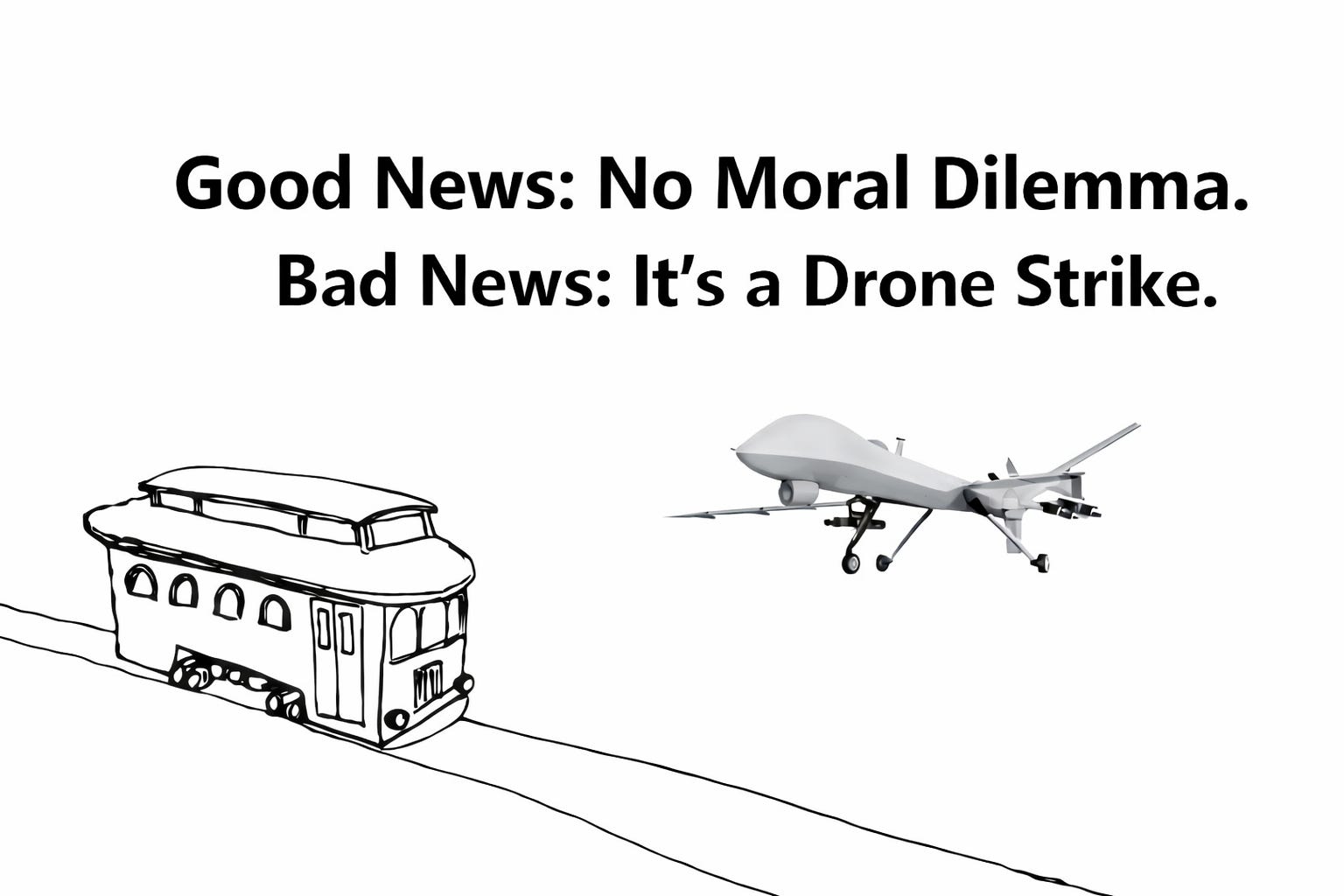
Everybody loves to bring up the trolley problem when the conversation turns to combat autonomy.
You know the one. A runaway trolley, a lever, five people on one track, one on the other, and a room full of smart people congratulating themselves for discovering that hard choices are hard.
That’s fine for philosophy class.
It is considerably less helpful when what is actually coming at you is a mix of FPVs, larger UAS, relay nodes, and a threat picture that gets worse by the second.
Because in the real world, there is no single lever. There is no neat binary choice. And there is definitely no timeout where everyone gets to sip coffee and debate ethics before the first drone gets through.
That is what makes the autonomy conversation so strange to me. We keep talking about whether autonomous systems should make decisions, when the more relevant question is much more practical:
What, exactly, have we told the system to prioritize when things get ugly?
That is the real issue.
Not whether a machine “thinks.” Not whether autonomy sounds scary in a panel discussion. But whether the priorities inside the system make operational sense when time, volume, and chaos all show up at once.
And yes, preserving human life has to sit at the top of the stack. That should not be controversial. If the system gets that wrong, nothing else matters. But the moment you say that out loud, you immediately run into the next problem:
What are you willing to give up in order to protect people?
That is where the clean ethics discussion starts to get muddy.
Are you willing to break emission control early and reveal parts of your architecture if that gives you a better chance to stop an inbound threat? Are you willing to spend an expensive effector on a cheap drone because the drone is about to do something very expensive to a human being? Are you willing to expose a sensor, burn down magazine depth, or reduce future survivability in order to win the next fifteen seconds?
That is not science fiction. That is not some future hypothetical. That is the design problem.
And it is why good weapons pairing and scheduling logic cannot just be a glorified target list. It has to manage the fight, not just the shot.
In my view, a system in automatic mode should start with a few very simple truths.
First, protect people. Always. Not as a slogan. As an actual governing constraint.
Second, attack the coordination layer when you can. If the threat is being enabled, cued, or managed through a digital radio architecture, relay node, or some other command-and-control function, then taking apart the network can matter more than taking apart any single aircraft. Killing the brain is often more useful than killing one finger.
Third, prioritize by time-to-effect, not by whichever target looks the most impressive on a slide. The platform that creates harm in ten seconds matters more than the platform that might become a problem in two minutes. That sounds obvious, but it is amazing how often people want a system to admire the taxonomy instead of solving the problem.
Fourth, win the math. Swarm and raid problems are, at their core, volume problems. If your system is not maximizing defensive carrying capacity, conserving the right effectors, and pairing assets efficiently, then you are just losing in a very organized way.
And fifth, do not show your hand too early. A lot of modern defense is not just about whether you can engage. It is about when you reveal what you can do. Signature management matters. Survivability matters. Teaching the other side about your architecture, timing, and preferences is not free.
That is the balancing act.
And this is where the trolley problem starts to break down.
Because in combat autonomy, the question is usually not “do I sacrifice one to save five?” It is more often: “If I act now, I may save these people immediately, but I may also reveal my posture, burn resources, and create greater risk for the next wave.”
That is not a lever-pull. That is risk management across time.
It is also why I think some of the public conversation around autonomy misses the mark. We tend to talk about it like the system is some mysterious black box making moral choices on its own. In reality, the system is doing exactly what it was designed to do. The uncomfortable part is that its “decision” is really our priorities, our assumptions, and our tradeoffs...just executed at machine speed.
That part should get more attention.
Because where I sit now, at AV, working with teams trying to solve exactly these kinds of layered air defense and counter-UAS problems, I can tell you this is not theoretical. These are real questions. They show up in mission planning, in sensor and effector integration, in operator workflow design, in how you pair weapons to tracks, and in how you preserve decision advantage when the pace starts to outrun the human brain.
And that last part matters.
The goal is not to remove humans from the fight. The goal is to build systems that help humans survive the fight, keep the timeline from collapsing, and make better decisions under pressure. If the machine can help the operator keep track custody, reduce cognitive overload, and recommend the right pairing before the situation becomes unrecoverable, that is not reckless autonomy. That is good design.
The irony is that the real danger is not that these systems become too autonomous.
It is that we build them with vague priorities, fuzzy logic, or PowerPoint-deep thinking and then act surprised when they do something dumb under pressure.
Machines are very good at doing exactly what we told them to do.
That should be comforting and terrifying in almost equal measure.
So no, the modern combat autonomy problem is not the trolley problem.
It is messier than that. Faster than that. Less philosophical and a lot more unforgiving.
The real question is not whether the lever should be pulled.
It is whether we built the system to understand what matters most before the trolley ever showed up.
Paul Webber is a retired U.S. Marine Corps Lieutenant Colonel and former Marine Corps Special Operations Officer with more than two decades of experience in national security, strategic operations, and leadership. A Virginia Military Institute graduate, he now works in the defense technology sector, where he helps shape innovative solutions for national defense and aerospace missions. He is also a high school wrestling coach, avid reader, terrible fisherman, and lifelong learner.
The Real Test of ‘Epic Fury’ Isn’t Just on the Battlefield
Benjamin Van Horrick
Previously published with Real Clear Defense
America often prepares for the war it has just fought. Today, the Pentagon is preparing for the next war, in real time, under fire, against the clock.
The Davidson Window marks the period beginning in 2027, when intelligence analysts estimate that China will possess the equipment and personnel to execute a cross-strait invasion of Taiwan. As America focuses on the Strait of Hormuz, it cannot lose sight of the Taiwan Strait. What the U.S. military learns from Epic Fury may determine whether it is ready before hostilities begin in the Pacific. Beijing, meanwhile, is taking notes and making moves.
Over the past year, three high-profile missions have put U.S. military personnel, processes, and equipment to the test. Midnight Hammer tested long-range strike coordination in a contested environment. The Maduro raid tested rapid force projection across domains. The January raid involved more than 150 aircraft and drones, the integration of space and cyber effects, and coordination across multiple intelligence agencies. Epic Fury now tests it all at scale, against an adversary willing and able to fight back. These operations provide more than just combat experience; they are a live-fire stress test of the entire American defense ecosystem, from acquisition to industry, before the window to deter a conflict over Taiwan closes. Each operation generates data that no sterile, static, or synthetic exercise could replicate. The question is whether the feedback loop is fast enough.
The campaign of attrition in Ukraine is also a campaign of learning. Its drone advances did not come from resources alone but sprang from treating the front lines as a product development cycle. The way Ukraine collects, analyzes, and applies data from combat is a model America must replicate. Unlike Ukraine, whose industrial base sits within range of the conflict, America must bridge vast distances between production and combat. What remains unclear is the American industrial base’s ability to produce weapons based on frontline data at the pace of conflict. The Pentagon’s recent push to fund domestic drone production lines indicates it understands the problem and is moving to address it. Whether it can compress the acquisition timeline fast enough before the Davidson Window closes remains the true test.
The demand signal to industry is clearer and more urgent. During the opening salvo of Epic Fury, the U.S. military expended 500 to 700 Tomahawk missiles. Congress responded with a supplemental appropriation to accelerate Tomahawk production, but the long production lead time leaves the joint force seeking near-term alternatives.
Last month, the U.S. Army compressed a contracting timeline to 72 hours in response to urgent needs revealed by Epic Fury. This compression should become the standard, not a crisis response. Epic Fury uncovered gaps in America’s capabilities, including counter-UAS and counter-mining operations. These gaps present opportunities for startups and established contractors to integrate open-source intelligence and frontline feedback to field solutions.
The Pentagon’s tight alignment with Silicon Valley and defense startups goes beyond adopting new products; it demands embracing open feedback loops to drive adaptation. Since Epic Fury began, defense startups have received more orders from the Pentagon. The new director of the Defense Innovation Unit, Owen West, recently asserted, “Drones are the most significant battlefield innovation in generations in Ukraine.” America must couple its tech ethos and software innovation with a manufacturing base capable of turning lessons into warheads.
Silicon Valley iterates because failure is recoverable: a firm can ship a bad product, data flows back, and the next version improves. War is not a sprint cycle. The opening phase of a conflict with China over Taiwan will not offer a second iteration. What Epic Fury can provide is not a rehearsal but a pressure test, stressing the acquisition cycle, the command architecture, and the domestic industrial base before the environment becomes unforgiving. The goal is to win in Iran and ensure that what breaks in the Middle East does not break in the Pacific when the margin for error disappears.
Critics may contend that optimizing for a desert air campaign against a technologically inferior foe could entrench the wrong lessons for a maritime strait fight against a peer competitor. The objective was never to choose this specific test environment; it was to leverage the environment thrust upon it. Epic Fury is not an export of tactics to the Pacific; it is a stress test for the acquisition cycle, command architecture, and the defense industrial base that all-domain fights demand.
Epic Fury remains an evolving operation with tremendous risks. The campaign has revealed how the U.S. military manages its now constant targeting cycle, controls maritime terrain, recovers downed pilots, maintains maritime awareness, and matches munitions to the right targets. America’s adversaries are drawing their own lessons from Epic Fury. This contest of wills is also a contest of learning. What matters now is not just who learns, but who can act on those lessons fastest.
The Written Word
Fiction and Nonfiction written by servicemen and veterans.
Did you ever kill anyone?
Larry Boggs
Maybe, maybe not.
Not in the Army in Vietnam, I am sure. But I am capable of killing—of that I have no doubt. I think most of us are. But have I killed? I honestly don’t know.
In my dream, I am driving alone on one of those winding, two lane West Virginia roads up a mountain with a never ending double yellow line. The curves are perfectly graded to smooth them out for speed.
I have driven this road many times. I have the confidence of youth. I know most of the time you have a fair, if imperfect, view of what is ahead. Only when confronted with a sharp left turn are you truly blind. Those corners are the ones where you often see a cross or two on the side of the road.
In my dream, it is turning dark, a time when it’s hard to tell the real from the imaginary. I have my lights on to give warning to approaching cars as much as to see where I am going.
In my dream, I am a little drowsy—hypnotized by the modulation of the highway moving left then right.
In my dream, I am startled: As I round a blind curve, my lights land on a scraggly old man in the road. He is frozen in fear, with his right arm outstretched, as if to stop me by magic. Before I can respond, he flies into the air over my hood. I come to a screeching stop. I get out and run to him. He is dead. His magic didn’t work.
In my dream, I am overcome by terror. I just killed someone. I am desperate. I can’t undo what’s done, but I want out of the mess I am in.
In my dream, a voice says: if a tree falls in the woods and no one is there... No one heard. No one saw. It never happened.
In my dream, I drag the man I killed to the edge of the drop-off and roll him over the side of the mountain. I don’t plant a cross. I drive on.
Every time I have this dream, it ends when I am startled awake in a cold sweat, like Burt Reynolds at the end of Deliverance.
Every time I have this dream, I see the same skinny old hillbilly dressed in black and gray with long hair hanging out from under his dirty old hat.
Every time, I see his ghost-like white face, his long-hooked nose and his beady, blazing black eyes staring into mine.
Every time, after, I say to myself, he wasn’t real. I didn’t kill him. It’s only a dream.
But every time, after, I think, if it isn’t real, if it didn’t happen, why do I keep having this dream over and over. Why am I so haunted by him?
Every time, after, I ask myself, could I really have killed a man and rolled his body over a mountain to rot?
Every time, the answer is: Maybe, maybe not.
Poetry and Art
Poetry and art from the warfighting community.
“Kilroy” Dan Grimm I saw the burned-out window frames, vacant and broken for years, and gazed in awe at theheroeswarriorsjuggernautsdestructorsvandalsanimalsmen boys that came here before me, leaving their mark with half-inch holes in the plaster and brick. 7.62 millimeter cursive 5.56 millimeter punctuation “Kilroy was here.” “And here.” “And right fucking here.” The signature of Lady Liberty is unmistakable. Will You Say My Name? KR Harbert Will you say my name? Not just today, not just because the calendar told you to remember, But when the flags are folded, when the music fades, when life gets loud again Will you still say my name? For what was lost was not just a life. It was your brother, your sister, your mother, your daughter, your father, your son, your love. I was there for you. For country—yes. But more than that, for people I would never meet, for freedom I would never see fully, for moments I would never live. I was never perfect, Just willing to serve. Will you just say my name— out loud? When was the last time you did? Does my picture still sit on the nightstand collecting silence? It’s okay. I’m still there in the quiet, in the spaces between your thoughts, in the moments you almost turn around, when something feels familiar. Will you say my name, and remember me? Not the uniform. Not the medals. Not the folded flag. But the laugh— the kind that filled a room, the life— the kind that wasn’t finished, the love— the kind that had a name, the joy— that never disappeared. You were my world, my reason. my home. And I would do it again— not for glory, not for history, but for you. So today, when you gather, when you remember, when you speak of sacrifice— don’t let it be distant, don’t let it be abstract, don’t let it be forgotten. Say my name. Let it be alive and large on your lips, in your stories, in your homes, in your hearts. Say the names of those beside me— those who stood, those who fell, those who never made it home. Because memory is the last place we live, and we are waiting just to hear it one more time. Will you say my name?
Transition and Veteran Resources
Career and civilian transition guidance, geared towards helping servicemembers plan their careers and help transitioning servicemembers succeed in civilian life.
Mastery Before Meaning: Stop Telling Veterans to Find Their Passion
Edward Honn
“And now for my favorite slide,” the Transition Assistance Program (TAP) instructor continued, “find your passion.” I sat in the back of class, waiting for the day’s lecture to be over so I could drive the sixty minutes back to Scottsdale from Glendale and fit in a solid workout. These PowerPoint slides, still stuck in 12-point Times New Roman, appeared to be unchanged since the Clinton administration.
“Follow your passion?” a soon-to-retire Air Force Technical Sergeant whispered to me, “When I enlisted, I just needed a job, man, not a passion.”
He made a good point. When I commissioned, my goal was to serve and mentor Marines, not to “find my passion.” But along the way, that’s exactly what happened. The ceremonies, inspections, hikes—they became meaningful. Not because the military was the perfect fit, but because we ultimately got better (some more than others).
So why is it, when each of us makes the decision to leave, whether by retirement or separation, every military transition “expert” we know tells us to go find our passion, as though that will solve all the world’s problems? This advice fails veterans not because they lack passion, but because it misunderstands how purpose was built in the first place.
The Passion Question Is the Wrong Question
“Find out what your true passion is, and you will never work a day in your life.” It sounds good. It just isn’t true.
Researcher Amy Wrzesniewski found something that should’ve killed the passion myth decades ago: people relate to their work in one of three ways: as a job (a means to pay bills and receive health insurance), a career (a path full of prestige, advancement, and increased responsibility), or a calling (work that is central to one’s identity and sense of purpose). And here’s the part TAP doesn’t tell you: those orientations have nothing to do with the occupation itself. In any given industry, roughly equal proportions of workers fall into each category.
One does not find purpose in work; they make work purposeful.
My peers didn’t commission because infantry, logistics, or communications was their “passion” (although every Infantry Officer that I’ve ever met was incredibly passionate about being an Infantry Officer). They took the oath of office for other reasons: patriotism, adventure, student loans. Looking back, all of them (including myself) would describe their time in the Marines as the most meaningful work they have ever done. How is this possible?
Psychologists Edward Deci and Richard Ryan offer a possible answer. They proposed self-determination theory, which identified three basic psychological needs that drive intrinsic motivation: competence (experiencing mastery and effectiveness), autonomy (freedom of self-chosen action), and relatedness (community and connection to others). When one meets all of these needs, they experience a profound sense of internal motivation regardless of their actual day-to-day work.
The Marine Corps (and the military in general) satisfies all three needs simultaneously. Training, starting in boot camp or Officer Candidates School, progressing to advanced Military Occupational Specialty (MOS) certifications, builds competence and confidence. Decentralized command and control provides autonomy (in most situations). And “embracing the suck,” whether through a twenty-mile Marine Corps Combat Readiness Evaluation (MCCRE) hike or waiting in line for hours for no reason, creates vivid memories of shared hardship that most civilians will never experience. That creates meaning. Not the work itself—the conditions.
I felt all three at once during the Marine Corps’ Weapons and Tactics Instructor (WTI) course in Yuma. Fourteen-hour days, operating at the edge of everything I knew (insecure overachiever, a la Laura Empson). During one of the flight phase confirmation briefs, I stood up and delivered my two-minute communications plan to a room of over 500 joint military servicemembers. I closed with an ad hoc “standby to copy,” and watched every head simultaneously look down to take notes. Competence, autonomy, and relatedness—for two minutes, all at once. That’s what it looks like when it’s firing on all cylinders.
When a servicemember decides to leave the military, the resulting transition strips all three needs at once. They lose the structured training and competence gained over years of perfecting their MOS. The autonomy that comes from rank, trust, and confidence disappears. And camaraderie (esprit de corps) evaporates altogether. Telling someone who has lost competence, autonomy, and community to “find their passion” is like telling them to shop for oxygen. The better response is to tell them to recreate the exact conditions under which the previous purpose developed, even if the results are markedly different.
The Craftsman’s Mindset
If passion is not required to find purpose in work, but rather a result of it, then the question for transitioning servicemembers changes from “What is my passion?” to “How can I build valuable skills that no one else can offer?”
Cal Newport, author of So Good They Can’t Ignore You, coined the term “the craftsman’s mindset”—focusing on what you can offer the world at large rather than what it can offer you. Newport argues that building a set of skills that are both rare and valuable serves as the scaffolding for a genuinely satisfying career. Passion is what happens after you have worked long enough to transition from an apprentice to a true master.
Deep engagement (what we know as “the flow state,” when time and stress seem to disappear) materializes when one’s skill and the corresponding work challenge are evenly matched. Flow does not arise out of passionate work. Rather, flow is found when one pursues mastery and challenge at the absolute edge of their current ability level. The communications officer finding flow in teaching a hip-pocket radio wave theory class did so not because that class was particularly meaningful, but because it demanded the full spectrum of crystallized experience, instruction, and mentorship skills: hard-won competence.
Job Crafting: The Skill You Already Have
In Yuma, I worked with the command team to organize a “Golden Ammo Can” field meet that was borne out of dragging junior Marines to “PT” on the track, sometimes kicking and screaming (I might have been in my mid-30’s, but I still tried to outsprint everyone that I could, even on two torn calves). Nobody told me to do that. Nobody put it in my billet description. I saw an opportunity to increase unit morale and built something that fixed it (or at least got everyone at the squadron a half day off).
Wrzesniewski and Dutton created a term for this over 25 years ago: job crafting. It occurs when people expand the scope of their daily tasks, change how they think about their work, and build better relationships with their team, all without job hopping or changing their job description. They do not wait to be assigned “passion work.” They reshape the work they already have.
Marines were born for this: adapt and overcome. The logistics chief who redesigned supply chain procurement because the doctrinally sound solution didn’t fit the nature of the problem—that was job crafting at its finest. In my last role, this looked like writing an unsolicited culture memo to the Chief Strategy Officer, or restructuring a PowerPoint briefing template that spanned six regional markets because the existing one buried the data that mattered. This is a skill that translates directly into the civilian world; it just requires cognitive awareness and deliberate application to succeed.
The Right Question
Stop trying to find out what your passion is. Start building mastery over your unique skill set.
I asked two mentors, one a CEO, one a retired Marine Corps Colonel, the same question about passion and work. They gave me the same answer from opposite ends of the spectrum: passion isn’t the starting point; it’s what shows up after you’ve built something worth building.
Find work that stretches your current skill set just enough that you’re tired at the end of the day, but not numb; take the job that offers flexibility and freedom to make decisions and connects you with the community and the overall mission that you respect.
I’ve thought about what I’d tell that TSgt now if I ran into him. I wouldn’t tell him to “find your passion.” I’d tell him to find work that demands something from him: the meaning will follow.
How Offshore Sailing Helped Me Find Peace and Purpose
Frank Sobchak
I wore the uniform of the U.S. Army for 30 years, 22 of them as a Green Beret in the Special Forces Regiment. During that time, I commanded a Special Forces company in Iraq, jumped from perfectly good airplanes nearly a hundred times, and spent a large portion of my career under a heavy rucksack. I witnessed death firsthand, sometimes in the most unexpected places, and had to make decisions where life hung in the balance. But by comparison to others of my era, it wasn’t a particularly difficult career. Many who served in the post 9/11 wars saw far more combat than I, and far worse. But I served, did my duty, and never avoided challenging assignments. Military service was tough but rewarding, and even though I still have mental and physical scars from my experiences, I loved it and miss it. Or at least I miss some of it.
When I retired from the Army in 2018, it was not an easy transition, and I wrestled with a loss of identity and comradeship. At the same time, I mourned the loss of friends, classmates, and even former students who had given the last full measure of devotion to our country. I wondered why I was spared, and not those who were better than me by any yardstick, especially those who accepted my mentorship and advice to continue to serve but never made it home. Struggling to find my way and purpose, I went back to school to pivot from my life in uniform and to give myself time to figure things out. The isolation of the COVID-19 pandemic only made my struggles with self-doubt, identity, and loss more difficult. There was no respite after graduating, as I found it difficult as a 52-year-old former soldier to find full-time employment teaching in the greater Boston area. Despite having a new degree, I felt even further adrift.
My wife suggested taking on a new hobby could help, so I returned to one from my childhood. My dad raced sailboats in his prime and bought a cruising sailboat, a 1976 36ft Cascade cutter, when I was a teen. He taught me to sail on it, and we did day cruises out of Fort Lauderdale, Florida, and longer trips around the Caribbean. Because of those experiences on his boat, I almost went into the Navy as a career, but ultimately turned down an acceptance to the Naval Academy in favor of the Army. When my dad grew too old to sail, he passed that boat to me, and I painstakingly breathed life back into it by taking on years of deferred maintenance. But it wasn’t only the boat that needed work. As an Army officer, I had forgotten more about sailing than I had originally learned, so I went back to basics, attending formal training and taking every opportunity to practice with the new-to-me boat. Returning to sailing gave me great pleasure, and it rekindled a dream that I had given up when I chose the Army over the Navy. Could I learn enough sailing skills and build a team to finish the famous 635-mile Newport to Bermuda race? I was perilously weak in both of those criteria, so it was clear to me that there was no chance I could do either of those by myself.
As luck would have it, I connected through social media with an old Army friend who had years of sailboat racing experience, and I asked him if he would be interested in the same goal. Completing the race was also on his bucket list, and he had the connections through his racing experience and his nonprofit, Gold Star Sailing, which teaches children of fallen servicemembers to sail, to put together a team and develop a plan. Rather than jump directly into such a challenging race, my friend counseled that the team needed to train together and compete in smaller races so they could get to know one another and the boat better. The Newport to Bermuda race would also require a larger, more capable boat, underscoring the need to train together.
We followed my friend’s advice. What transpired as we did so was transformative, and in some ways, sailing saved me by bringing purpose, comradeship, and inner peace.
Sailing filled many of the gaps that I missed from military service, and working as part of a crew gave me another tribe to be part of. Humans are pack animals. We need socialization and purpose, as well as operating as part of a larger whole, to help give us meaning. In sailing, this purpose comes from working together towards a goal in a dangerous environment: my friends and I against the cruel sea. As a friend in the Coast Guard constantly reminds me, “The sea is trying to kill you 24/7/365.” Like Ranger School, offshore sailing is not for the faint of heart. One sailor died during the 2022 Newport to Bermuda race, two died in the 2024 Sydney to Hobart race, and three sailboats were lost during the 2024 Newport to Bermuda race or returning home from the race. Our crew worked together against nature, and the camaraderie I so desperately missed from my time in the Army was back. The dark humor, the fun ribbing, the practical jokes, the building of deep friendships through training and shared hardship: they all returned as the crew bonded. Despite my inexperience, every member of the crew, all of whom had decades more time on sailboats than I had, was patient and helped mentor and teach me. Just like a good military unit.
While there is an image of sailing as a luxury sport for the rich and famous toasting each other with champagne glasses on their yachts, the reverse is true for offshore sailing. The sport is physically and mentally demanding and can be dangerous. During a race, you are usually tired, cold, and wet, sometimes hungry, and you alternate between being bored or terrified as your 38,000-pound boat careens on the water like a car slipping on ice. But the more time I spent sailing, I realized that those were things that I missed being a civilian. Almost like Edward Norton’s character in the movie Fight Club, I recognized that I subconsciously missed the hardships of the Army that help remind us what it means to be alive: sleep deprivation from four-hour watches, hours of boredom interrupted by excitement and terror as a halyard breaks and the sail collapses into the sea in the middle of the night, and eating lukewarm food in the rain with water dripping off the brim of your cap into your bowl. All of that made me think that, like those days in the Army, there was no place I would rather be. Some hardship, the type that is hard while enduring it, but remembered nostalgically afterward, is simply good for the soul. An added bonus is that while sailing requires a modicum of fitness, you don’t have to be a marathon runner to compete, and if your body has some rough mileage on it (as many of those of us who served do), sailing is much lower impact and lower stress than other sports.
Sailing also gave me peace. In our crazy, harried lives perpetually accelerated by the information revolution, sailing was a refuge of peace and, often, quiet. At sea, hundreds of miles from shore, our mobile phones, those devices that constantly demand slavish obedience, become useless bricks. Our only connection to the outside world was an intermittent internet connection at America Online dial-up speeds and, at times, a disembodied voice from a nearby sailboat checking in on VHF radio. There were no emails, no tweets, no calls, and no text messages demanding attention or action. When under sail, it was beautifully silent, with nothing but the wisp of the wind over the sails. Noise, in the form of luffing or flogging sails, would only come to remind you if you hadn’t trimmed them correctly. It was a luddite paradise, completely unplugging from the modern world and all its drama, insanity, and injustice. We had no distractions; all we had to do was work together, focus on the boat, and make it go as fast as possible while staying safe.
In parallel, the power of nature, of the sea, and of the weather helped remind me that I didn’t control everything – that there were powers greater than me that controlled my destiny. The day before the race, my friend noticed a catastrophic problem with the steering column that could easily have sent our boat to Davy Jones’ Locker, had it not been addressed. During the race, there were hours without wind, and we suffered the doldrums while our boat barely moved. But there were also days when the wind howled like a hungry animal, waiting to devour careless sailors, and it took all that we could do to keep our boat and crew out of danger. Sailing reminded me of my place in the world and of the role of fate, helping me come to terms with how little I was able to control when friends perished overseas while I was assigned CONUS.
In the end, we achieved our goal and finished the Newport to Bermuda race, even winning the Finisterre division of cruising/racing boats. But we also accomplished more. Over the hours and days of training, we honed an effective team that functioned like a well-oiled military unit. That “unit” and the experiences sailing with it filled many of the gaps that developed in my life when I left the Army. I treasure the comradeship, peace, and purpose that sailing has brought me and am so thankful that it helped save me.
The opinions and views expressed are those of the author(s) alone and do not necessarily represent those of the U.S. Government, U.S. Department of War or its components, to include the Department of the Navy or the U.S. Naval War College.
Book Reviews
Jillian Bosserdet
WWI setting, mythological folklore thriller with a bit of good ol’ fashioned friendship, love, and violence? Say less. I guarantee The Sarvan will stay with you long after you read it. It deserves a home on your bookshelf. This book found its way to my TBR as a historical fiction/horror novel, and while I suppose those themes are present, The Sarvan should not be read for a historical account nor for something that will make you shake in your boots. The only horror The Sarvan presents is the complexity of being human in a world of war and survival. Douglass Hoover creates a story that poses the question we human beings consistently debate: what is right and what is wrong? Whose moral compass are you living by? And does north always point towards good and virtuous, or are monsters sometimes needed to keep true evil at bay?
We follow a group of Allied POWs led by German soldiers into the Alps, where they are all stranded in a remote village. Already, we’re in ominous territory. Now, consider that the villagers worship a god and harbor a monster. The mystery unfolds slowly, but brutally. There is a delightful back-and-forth between the present and the past, or between other passages and books, that provides depth beyond what happens in the village.
I highly suggest the audiobook to fully immerse yourself. Character fascination easily turns to connection as the narrator flawlessly becomes each individual.
Hoover’s words are intricately woven, no detail written without purpose. Pay attention from the first word. He ties history, mythology, and current reality together to create a narrative that resonates beyond the story. While complete innocence and depravity do exist within the story, mostly good and evil are left to the reader’s perception – how do you define evil within the confines of survival?
——————————
This ends Volume 46, Edition 1, of the Lethal Minds Journal (01MAY2026)
The window is now open for Lethal Minds’ forty seventh volume, releasing June 01, 2026.
All art and picture submissions are due as PDFs or JPEG files to our email by midnight on 20 MAY 2026.
All written submissions are due as 12 point font, double spaced, Word documents to our email by midnight on 20 MAY 2026.
lethalmindsjournal.submissions@gmail.com
Special thanks to the volunteers and team that made this journal possible.
One thing I've noticed about culture war bullshit in my own life is that it fills a void, and when there's no void to fill, there's no culture war bullshit. In that way, the level of culture war bullshit in my life becomes a tank level meter-- potentially a low level alarm-- for the totality of meaningful substance consuming my energy.
Thank you.