

Letter from the Editor
Back in 2006, enough years ago that someone who joined in that year could be retiring in this one, I faced a choice. I was a third-year law student, a year late graduating because I spent what should have been my final year in law school in Iraq, chasing people someone else determined were “high-value targets.” Now I call it my ISIS recruiting tour, but leading Force Recon Marines in combat was a life goal for fifteen-year-old me, and I was happy to be there, strategic utility be damned. But it was temporary. And dislocating.
By the time I returned to law school, I was in no mental place to care about briefs or esoteric judicial opinions. I did finish and take the bar exam, becoming a fifth-generation lawyer in the process. But on graduation, I decided life as a grunt, later Raider, was better for me and resumed active duty life to help build Marine Corps Forces, Special Operations Command. I stayed there, or somewhere else in U.S. Special Operations Command, for sixteen years.
Much of my reason for returning and staying was honor and integrity. Not so much my own, but that presumed inherent to the profession amongst the American citizenry. I am a guy who deeply loves and respects the American notion of equality before the law (something we’ve always been better at saying than doing), but with the shyster lawyer a common stereotype, I felt my needs were better served in uniform.
I am not sure I could use the same calculus in 2026, because we’re giving it away.
I still believe deeply in the military’s transformational power. Given the generosity of the American taxpayer regarding benefits, if a kid from below the American poverty line can qualify to join (a big if in a nation in which only 25% of eighteen-year-olds are fit for duty), a simple four-year enlistment can change the trajectory of their life, and that of their subsequent generations. I’ve seen it happen. Staying for a full career and earning a pension, disability checks, education benefits, and lifetime medical care places any military retiree in the “exorbitant wealth” strata compared to the rest of the world. Ask me how I know.
But all the foregoing imputes a duty for every uniformed member to hold the line even when our civilian masters don’t. We are to be apolitical, removed from certain decisions, even when they affect our very survivability, and focused on duty over self, eschewing anything that could call into question our loyalties to anything but the Constitution of these United States. Now I increasingly see our military politicized from without and within. And it’s really dangerous. Moreover, it’s antithetical to the entire premise of civil-military relations and fundamental good order and discipline.
Back in March, some US Army pilots chose to swing by Kid Rock’s house for reasons unknown to me. Bawitdaba and all that, I guess. The Army did what the Army should do in such cases and convened an Article 15-6 investigation. That’s standard. I’ve assigned an untold number as an executive officer, though they are called preliminary investigations and command investigations in the Corps. Investigations don’t even mean there’s guilt. They just mean something abnormal happened, and someone needs to figure out if it’s a problem or not. Often, that’s the first junior officer the XO comes across, but as a member of a joint command, I did a 15-6 investigation in Afghanistan when an Army Colonel had me, a Marine Lieutenant Colonel, investigate a Sergeant First Class to insulate that soldier from potential blowback we were pretty certain he did not deserve before anyone higher in the chain could get stupid. The investigation proved the soldier did what he was supposed to do, and things went weird anyway, through no fault of his. All was well.
But this time, the Secretary of Defense reached down past the Chairman of the Joint Chiefs of Staff, the Chief of Staff of the Army, the Commanding General, Eighteenth Airborne Corps, the Commanding General, 101st Airborne Division, the Commanding Officer, 101st Aviation Brigade, the Commanding Officer of the relevant battalion, and the Commanding Officer of the relevant company to cancel the investigation. Nothing to see here, it works for our political optics, so it must be good. A few days later, Secretary Hegseth and Mr. Rock took flights in an AH-64 to drive home the point that...what? Military discipline doesn’t matter? That the screwdriver of fuckery stretches all the way from Washington, DC, to Fort Campbell? If it was the last one, they were late. President Lyndon Johnson managed to stretch the thing from DC all the way to Saigon, Vietnam, now called Ho Chi Minh City.
We saw it again in Iraq in 2003 (see: Vice President Dick Cheney, Secretary of Defense Donald Rumsfeld, and Coalition Provisional Authority Leader L. Paul Bremer), and pretty much every phase of Afghanistan between 2001 and 2021 (see: every President during those years, to say nothing of the fecklessness of military leadership).
In a much more authoritative article on the issue of Kid Rock and political fuckery, former Army infantry officer Jason Dempsey and former Army Special Forces non-commissioned officer Mathew Rambo (note: best name ever for a Green Beret) assert, “Attendees at the No Kings rally may view these pilots and the military as willing agents of one party, while fans of Kid Rock are likely to view the Army as more on their side. Both viewpoints degrade the reputation of a military in service to all Americans.”
That last bit is what matters.
I returned to the military because I believed that the honor of being in a profession in which honor is the benchmark was worth giving up everything else I had before me. But that honor only remains if we earn it every day by holding to our side of the bargain, and as I see it, we are allowing military service to be increasingly subordinated to, or used in branding of, politics. That’s to be expected of politicians and partisans. They are, by definition, not honor-based, but rather creatures of expedience. What’s good for them is good, period. But when uniformed servicemembers charged with protecting it are rolling over and giving it up without a fight, when we live by the code of our civilian masters, all is lost.
You want to see an example of who to be in such a case? Google “Lieutenant General Greg Newbold + Iraq+ Resignation”. He’s said plenty of things I disagree with since, but in 2002, he gave a clinic on how to serve and what to do when you can’t. Not enough people know his name.
I am retired now. At best, I sit on the sidelines, my varsity jacket stained and smelling just a bit of mothballs. Maybe I should hang it in the closet and go on with my life, let political appointees who seem more like fraternity rush chairmen than serious thinkers and leaders do what they’re going to do. But I spent twenty-seven years in uniform, and there is this pesky thing called the Constitution and my continuing obligation thereunto, and so, I speak.
I hope you will, too. You can call me a “pinko commie” or a “literal fascist” per the dictates of your strongly held biases at lethalmindjournal.submissions@gmail.com.
Fire for Effect,
Russell Worth Parker
Editor in Chief - Lethal Minds Journal
Dedicated to those who serve, those who have served, and those who paid the final price for their country.
Lethal Minds is a military veteran and service member magazine,
dedicated to publishing work from the military and veteran communities.
Two Grunts Inc. is proud to sponsor Lethal Minds Journal and all
of their publications and endeavors. Like our name says we share a
similar background to the people behind the Lethal Minds Journal, and
to the many, many contributors.

Just as possessing the requisite knowledge is crucial for success,
equipping oneself with the appropriate tools is equally imperative. At
Two Grunts Inc., we are committed to providing the necessary tools to
excel in any situation that may arise.

Our motto, “Purpose-Built Work Guns. Rifles made to last,” reflects
our dedication to quality and longevity. With meticulous attention to
manufacturing and stringent quality control measures, we ensure that
each part upholds our standards from inception to the final rifle
assembly.

Whether you seek something for occasional training or professional
deployment, our rifles cater to individuals serious about their
equipment. We’re committed to supporting The Lethal Minds Journal and
its readers, so if you’re interested in purchasing one of our products
let us know you’re a LMJ reader and we’ll get you squared away.

Stay informed. Stay deadly.

-Matt Patruno
USMC, 0311 (OIF)
twogruntsinc.com
support@twogruntsinc.com
In This Issue
Across the Force
The Lance Corporal's Pack: An Operational Approach to Robotic Warfare
The Network is the Weapon: Forging the Robotic-Tactician and Collapsing the Kill Chain
Reclaiming the Night
The Written Word
Yorktown: A New Beginning
Rope and Choke
June 9th
Poetry and Art
“Decision Point”
Across the Force
Written work on the profession of arms. Lessons learned, conversations on doctrine, and mission analysis from all ranks.
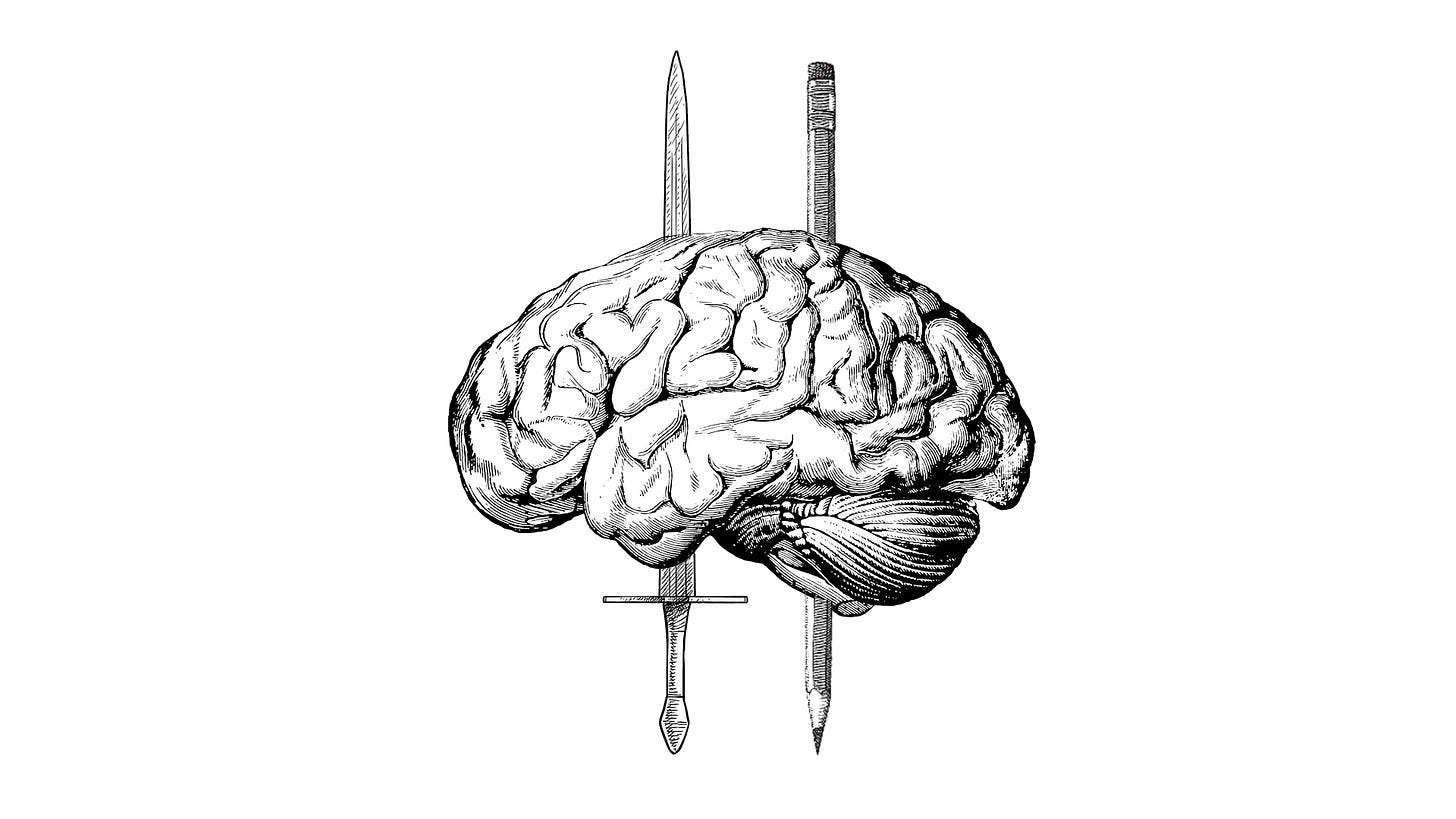
The Lance Corporal’s Pack: An Operational Approach to Robotic Warfare
Thomas Schueman
The defense tech industry has answered the call to equip our warfighters with American-made robotics. Yet, the proliferation of unmanned systems (UxS), counter-unmanned systems (C-UxS), communication architectures, hardware, and software has outpaced our ability to acquire, integrate, and employ these systems effectively. While our leaders are urgently getting these capabilities into the hands of deployed forces—a testament to their commitment to lethality and survivability—the Marine Corps is failing to develop a long-term approach to professionalizing robotics. These ad hoc solutions, while acceptable for today, are insufficient for the future. To prepare for that future, the Marine Corps must develop the doctrine, organizations, and training required to build a professional robotics community.
The Flaw of the Incidental Operator
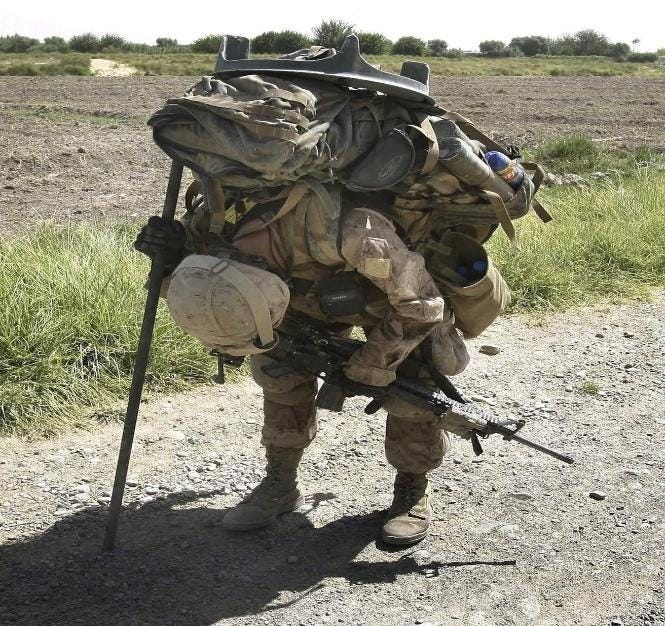
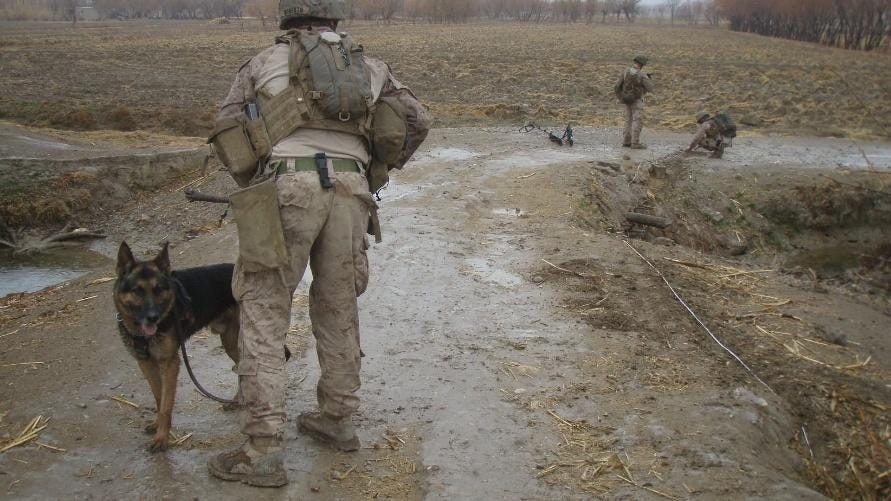
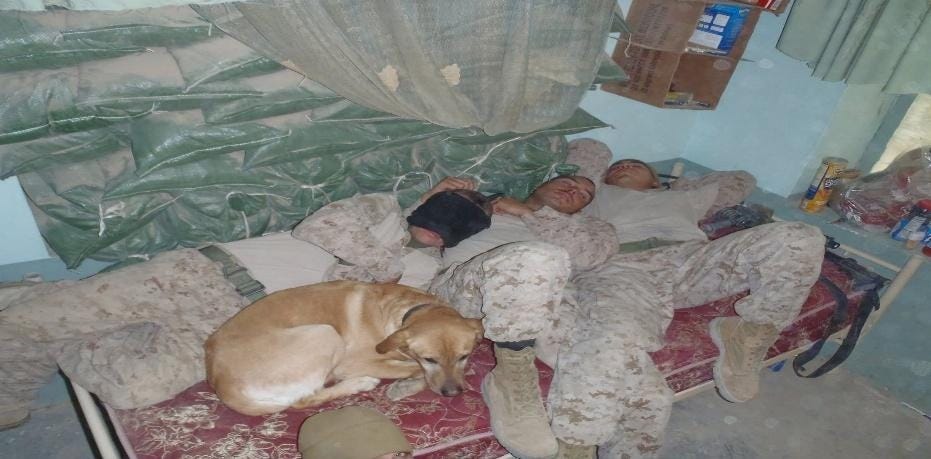
The current strategy relies on an “incidental operator” model. Marines whose primary duties involve operating machine guns or clearing objectives now carry collateral responsibilities as ISR operators, FPV pilots, and counter-UAS gunners. We continue to treat the infantry Marine like a Swiss Army knife, adding more and more stuff into the lance corporal’s pack. This approach mirrors past mistakes. For instance, the Marine Corps applied a similar method during the Global War on Terror (GWOT) to counter the IED threat. Anyone from that era can attest that the trust and confidence felt when patrolling through a minefield are vastly different when the Marine on point is a professional minesweeper as opposed to an incidentally trained one. The same could be said for the IED detection dogs employed by incidental operators. There was a dramatic difference in IED detection efficacy when a professional K-9 operator employed a military working dog.
Beyond Stopgap Solutions: The Need for Force Design
Similarly, the current model of using regional hubs is an acceptable interim solution, but if we are still approaching robotics this way in five years, we will have failed. These hubs are doing incredible work, holding things together with limited resources, but a central hub with a small number of Marines providing oversight is a temporary fix, not a serious robotics capability for a warfighting organization. While small robotic systems with minimal cognitive load and power requirements are appropriate at the squad level for assault fires or close-in protection, the infantry squad needs to be enabled by more capable UxS/C-UxS operated by trained personnel.
Observations from the modern battlefield confirm that integrating new technology effectively demands structural change. Michael Kofman, a senior contributor at War on the Rocks, recently noted from his time in Ukraine: “You can make it [robotics] much more autonomous and reduce the manpower requirements for it. You will never get this technology into the force without force structure allocations. It’s not going to happen. There needs to be some kind of drone unit. There needs to be people whose job it is to use these systems... If you look at any Western military, you cannot fight in this way or adapt it to how you currently fight without force design changes.”
A Doctrinal Void: Finding the ‘Pete Ellis’ for Robotics
To realize these force design changes, the Marine Corps must first address its doctrinal gaps. In the years before World War II, Major Earl “Pete” Ellis tackled a problem most had accepted: the United States could fight on land or at sea but not move decisively between the two. Ellis developed the concepts that became amphibious warfare doctrine, institutionalizing a new way of fighting. A similar doctrinal void exists today. We lack a unifying doctrine that connects the multi-domain capabilities of robotic systems and the functions they perform. The “institutional vetting and compilation of fundamental principles...by which Marine Corps forces guide their actions” (MARADMINS Number: 070/18) is missing for robotics. The systems to fight in a multi-domain environment exist, but the concepts to employ them, the operators to use them, and the formations to integrate them do not. The Marine Corps needs a visionary in the spirit of Pete Ellis to develop a comprehensive multi-domain robotics doctrine that ties together aerial, maritime, and ground systems across all warfighting functions.
A Historical Blueprint: Lessons from the Machine Gun
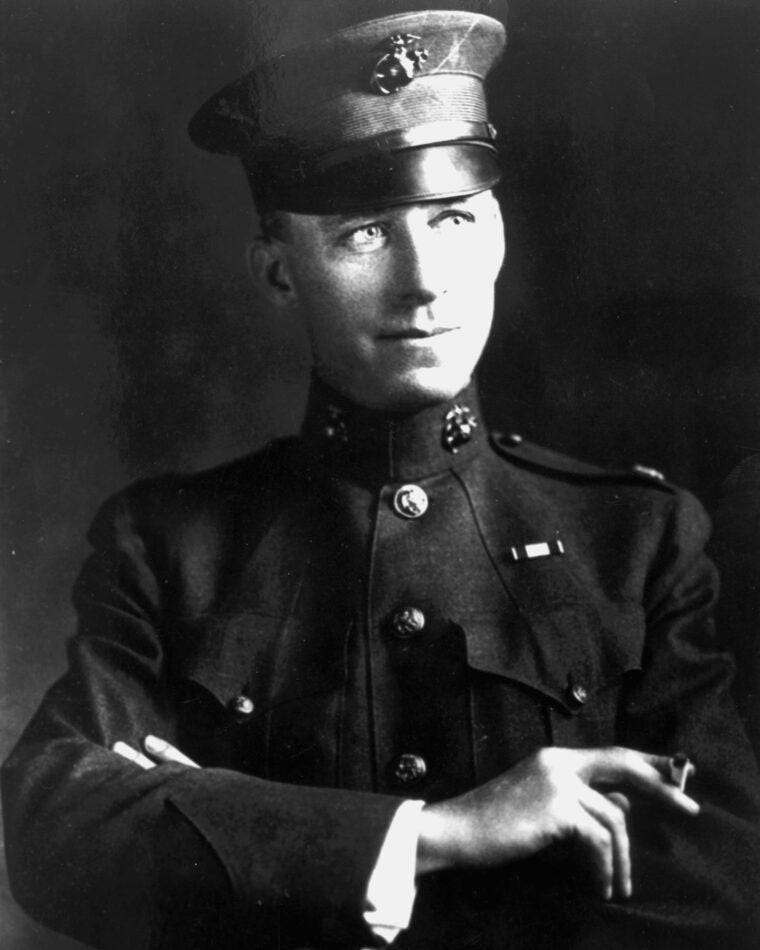
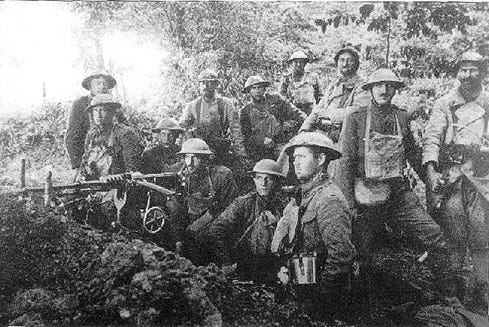
For the organizational framework, we can draw a direct lesson from how the Marine Corps adapted the machine gun during World War I. Initially, armies underestimated the weapon’s significance, and early attempts to distribute machine guns to infantry units failed because the weapons required specialized crews and coordinated fire planning. The Marine Corps solved this problem by first centralizing expertise. It stood up the 6th Machine Gun Battalion, which allowed commanders to benefit from specialized training while maintaining close integration with maneuver forces. Only after this period of concentrated expertise did the Corps distribute machine guns more widely. Notably, the battalion’s commander, Major Edward Cole, published the Field Book for Machine Gunners, providing the Corps with its first comprehensive manual for machine gun operations.
Forging Robotic Formations for Modern Warfare
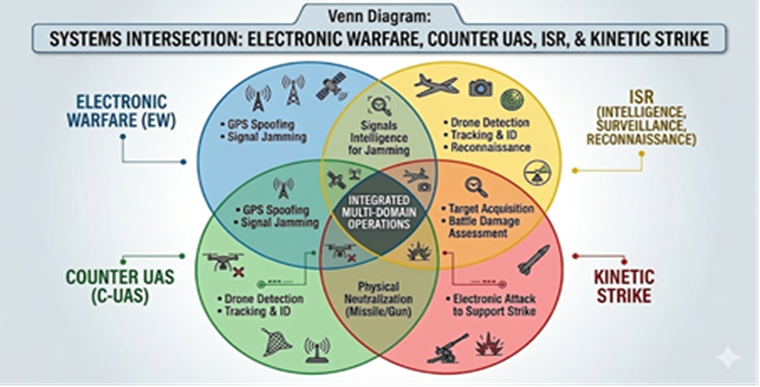
Following this historical blueprint, the Marine Corps should form multi-domain robotic units task-organized around electronic warfare, ISR, counter-UAS, and kinetic strike. When confronted with the need for dedicated robotic formations, a familiar response emerges: “We are not Ukraine.” Critics argue that the Marine Corps is a maneuverist force, not an attritional one, and that our combined arms capabilities make us different. But the reality is that future combat will include positional and attritional phases where “robotic engagement zones” will develop, and we will not want to commit Marines to them. To ignore this is to echo the pre-WWI French army’s flawed belief in élan vital—the notion that offensive spirit can overcome material reality.
Critics will also argue that we fight differently from Ukraine, that we have different capabilities, and that Ukraine was forced to adapt its units due to an existential threat. These arguments are true, and Ukraine’s 80,000-man unmanned systems force is not a model the Marine Corps should pursue; however, that does not mean the Marine Corps should not allocate structure toward robotic units. Dedicated robotics battalions within divisions, MIGs, MLGs, and MAWs would provide each formation with a specialized unit capable of enabling operations at the appropriate echelon. A 2,000-man investment in robotic units does not risk over-indexing on the Ukrainian model or compromising the foundation of the MAGTF. The real risk to the force and the mission is deploying these formations into harm’s way without a serious robotics capability.
Conclusion: An Obligation to Our Warfighters
Finally, we need a professional schoolhouse to train these operators, who would then report to robotic battalions, and composite with units ahead of deployments, just as other enablers do today. This would apply the same model the Marine Corps uses for every other combat-credible capability. The Marine Corps prides itself on being most ready when the nation is least ready. Being ready requires using interwar periods wisely to make difficult decisions. A common refrain is that the ingenuity of junior Marines will carry the day. That is true, but we owe them better. We owe them the doctrine, training, and formations that match the immense responsibility we are placing on them. We have the opportunity now to deliberately build a robotically enabled MAGTF—one that can do what Marines have always done: win battles.
The Network is the Weapon: Forging the Robotic-Tactician and Collapsing the Kill Chain
GySgt Ryan M. Welch
Small-unit formations across the Fleet Marine Force are collecting more information than ever before, but they are not decisively more lethal because of it.
At the platoon and company levels, Marines operate an expanding array of sensors, unmanned systems (UxS), and communications platforms capable of generating real-time data. Despite this, information remains fragmented across incompatible systems and trapped within proprietary networks. The result is a paradox: units are information-rich but integration-poor. Data exists, but it does not move fast enough to create a tactical advantage.
In time-sensitive engagements, this gap becomes operationally significant. A reconnaissance asset identifies a target, but the information must be passed over voice, interpreted, and relayed again before a shooter can act. Each step introduces a delay, increases the risk of misidentification, and degrades tempo. In a contested environment, that delay is the difference between exploiting an advantage and a missed opportunity.
As outlined in MCDP 1: Warfighting, success in combat is derived from generating a faster tempo than the enemy and acting inside their decision cycle. Robotic integration allows small-unit commanders to probe enemy surfaces relentlessly and rapidly identify gaps without committing human capital to the initial reconnaissance effort. By passing this data instantaneously across the network, commanders can violently exploit those gaps before they close. When Marine rifle platoons cannot rapidly translate information into action, they surrender that advantage.
The issue is not a lack of capability. It is a lack of integration, and increasingly, a lack of specialization and adaptability at the tactical edge.
The Marine Corps currently relies exclusively on an “incidental operator” model in which infantry Marines inherit robotics, ISR, network management, and counter-UAS responsibilities as collateral duties in addition to their primary warfighting tasks. While effective as an interim solution, this approach places unsustainable cognitive and technical burdens on small-unit leaders already responsible for maneuver, fires, and command and control. The result is not merely inefficiency—it is degraded tactical performance at the point of contact. The long-standing “jack of all trades, master of none” approach to capability employment requires fundamental reconsideration. Modern warfare no longer rewards generalized familiarity across countless disciplines; it demands technical expertise paired with tactical mastery. The future force must produce Marines who are experts in their trade and masters of employment in combat.
Modern warfare is rapidly demonstrating that robotic combat systems are not supplementary capabilities. They are becoming fundamental components of maneuver warfare, reconnaissance, fires integration, survivability, and battlefield adaptation. If the Marine Corps expects small-unit leaders to maintain disciplined initiative in contested environments, it must professionalize the capabilities required to enable that initiative.
The Platoon-Level Kill Chain
Modern conflict demands a compressed and distributed kill chain: Sensor ➔ Decision ➔ Shooter ➔ Confirmation
At the MAGTF or MEF level, this process is enabled through integrated networks, operations centers, and dedicated personnel. At the platoon level, it is often executed manually through voice communications and individual interpretation. This creates persistent friction points:
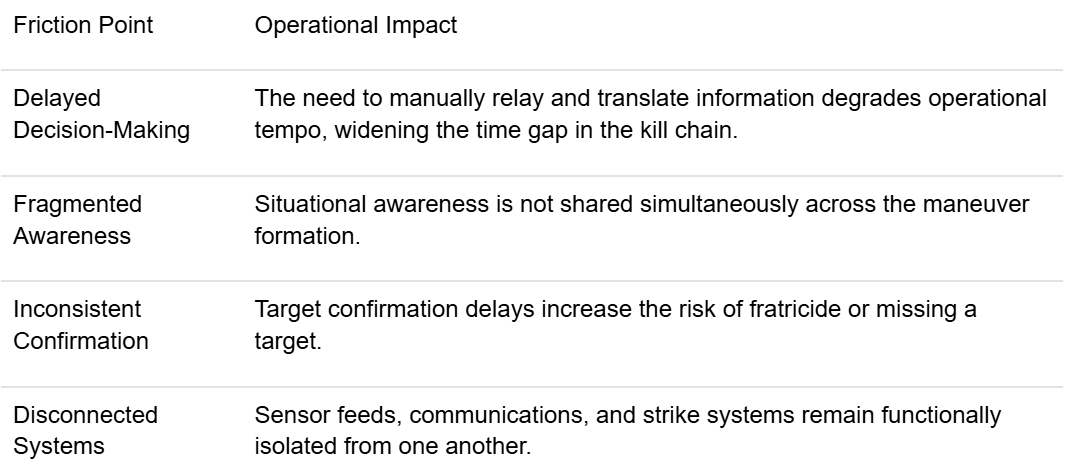
These shortcomings directly conflict with the principles outlined in MCDP 1-3: Tactics, which emphasizes decentralized execution and rapid decision-making. Furthermore, manual processing of target data at the tactical edge fails to meet the efficiency requirements of MCWP 3-31: Fire Support Coordination in the Ground Combat Element. To clear fires effectively and exploit fleeting opportunities, target mensuration and communication must be near-instantaneous.
If Marines are expected to fight with disciplined initiative, they must be equipped to see, decide, and act simultaneously, NOT sequentially.
The Network as the Weapon System
Closing the gap between sensing and shooting does not require a new multi-million-dollar platform. It requires integration.
Future robotics doctrine must recognize the network not merely as an enabler, but as the connective tissue that synchronizes reconnaissance, decision-making, and fires into a unified combat function. A resilient mesh-enabled communications architecture, paired with a shared digital operating picture such as ATAK, allows sensor feeds, target locations, positional data, and command-and-control information to be distributed across the formation in real time.
In this model, a small UAS identifying a target does not pass information through a chain of voice transmissions over fragmented radio networks. Instead, the information is immediately visible across the formation. The assault force sees the same feed. The platoon commander sees the same picture. The shooter sees the same target confirmation. Decision and action occur nearly simultaneously.
This collapses the traditional kill chain and allows small units to operate inside an adversary’s OODA loop, generating dislocation while maintaining tempo. By distributing sensor feeds and targeting data instantaneously across the formation, the mesh network realizes the highest form of implicit communication outlined in MCDP 6: Command and Control. Small-unit leaders no longer need to explicitly describe the battlespace over VHF radios; they share a common, immediate understanding of the threat, allowing them to execute Mission Command at machine speed. Without integration, even the most advanced unmanned platform becomes isolated and tactically irrelevant. The network itself becomes the weapon system that transforms disconnected sensors and shooters into a cohesive combat capability.
The survivability and effectiveness of this capability depend on the establishment of a resilient mesh network in which every node functions not only as a user but also as a relay within the larger combat system. MCWP 3-32: Electromagnetic Spectrum Operations (EMSO) dictates that forces must maneuver and survive within a contested spectrum. Traditional communications architectures rely on centralized retransmission sites and command posts that create predictable points of failure, that make them highly vulnerable to detection and jamming. Robotic warfare cannot rely on fragile communications structures that collapse when a single node is degraded.
Instead, future small-unit formations require distributed, self-healing mesh networks capable of dynamically rerouting information across multiple pathways throughout the formation.
Within this architecture, every Marine, unmanned system, vehicle, and shooter contributes directly to the survivability and extension of the network itself. A rifleman equipped with a mesh-capable radio becomes a maneuvering retransmission node. A small UAS extending beyond terrain masking becomes an airborne relay. An FPV strike team operating forward of the main body simultaneously functions as a reconnaissance asset, strike capability, and network extension node.
Every shooter becomes a relay.
Each UxS platform within the formation simultaneously serves as a node within the larger network architecture. A reconnaissance drone identifying targets extends the mesh while feeding ISR directly into the shared digital operating picture. An FPV strike platform functions not only as a shooter, but as a forward reconnaissance and network extension asset. Ground, aerial, and maritime robotic systems similarly contribute to the network’s resiliency, depth, and survivability.
Likewise, every Marine equipped with a mesh-capable radio becomes more than a communicator. He becomes a sensor, relay, and potentially a shooter within the larger kill web. Information no longer flows vertically through rigid command hierarchies before action can occur. Instead, data moves horizontally and instantaneously across the formation, allowing commanders and small-unit leaders to visualize, decide, and employ assets in real time.
This transforms dispersion from a vulnerability into an advantage.
Expeditionary and distributed operations force small units to operate across extended distances, complex terrain, and degraded communications environments. A resilient mesh architecture allows dispersed formations to maintain a shared digital operating picture while preserving low-signature maneuver and decentralized execution. As formations disperse, the network itself deepens, increases redundancy, and improves survivability.
This concept directly supports Expeditionary Advanced Base Operations and stand-in force operations, where low-signature formations must persist inside contested battlespace geometry while remaining digitally connected across distributed maneuver elements. The future platoon will maneuver as a mobile network itself. In this environment, every sensor becomes a node, every shooter becomes a relay, and every maneuver element contributes directly to the survivability and lethality of the larger kill web.
From Operator to Builder
Integration alone is insufficient. The modern battlespace rewards forces that adapt faster than the traditional acquisition cycle can respond. Future force design must produce Marines who are not merely operators of unmanned systems, but builders and integrators of capability at the tactical edge.
As highlighted in Expeditionary Advanced Base Operations concepts, low-signature forces operating persistently within contested environments cannot rely on centralized logistics or prolonged depot-level repair timelines for attritable systems. They must generate and sustain capability organically.
This shift represents a revolution in tactical logistics as defined by MCDP 4: Logistics. In a contested littoral environment, units cannot wait for depot-level maintenance or external supply chains to replace attrited platforms. The builder-tactician essentially becomes their own localized supply chain, generating and sustaining robotic combat power organically at the point of friction.
This requires a shift in training philosophy. Marines must understand not only how to operate a drone, but how it is constructed—power systems, control links, payload integration, electromagnetic signatures, and network architecture—and how to modify those systems under austere operational conditions. Using compliant, commercially available components aligned with Blue UAS standards, Marines can assemble, repair, and adapt systems at the point of need.
This is not about turning infantrymen into engineers. It is about developing tacticians who understand their systems deeply enough to adapt them in combat. A force that can rebuild and modify its systems organically will always outpace one that must wait for a resupply flight or software update.
Professionalizing Robotic Combat Power
The unification of multiple lines of effort will establish this “theory” into a reality.
The Marine Corps has historically adapted to transformational battlefield technologies by institutionalizing specialized expertise rather than relying on incidental proficiency. Just as machine guns evolved from supplemental infantry weapons into dedicated formations requiring specialized doctrine, training, and organizational structure, unmanned systems now demand the same professionalization across the MAGTF.
While MCWP 3-20.5: Unmanned Aircraft Systems Operations provides a baseline for traditional MAGTF aviation integration, the realities of attritable, platoon-level mesh robotics require an entirely new approach that diverges from traditional aviation constructs.
The Marine Corps’ foundational ethos is “Every Marine is a Rifleman.” This principle establishes a baseline of lethality and shared identity across the force. However, the Corps has historically recognized when capability demands dedicated specialization. We do not expect a 0311 rifleman to master the complexities of the 81mm mortar, the Javelin weapons system, signals intelligence, or joint fires integration as collateral duties. These functions belong to dedicated occupational specialties because they require focused, sustained expertise to employ effectively under combat conditions.
Treating robotic combat power as a collateral duty for junior Marines is no longer simply inefficient; it is operationally dangerous. Expecting a squad leader or rifleman to simultaneously maneuver under fire, manage a mesh network, troubleshoot a flight controller, conduct target correlation, monitor ISR feeds, and execute counter-UAS tasks creates unsustainable cognitive overload at the point of contact.
The Fleet Marine Force requires dedicated unmanned systems formations and occupational specialties structured around complementary functions; it is implied that each discipline incorporates air, ground, and naval UxS:
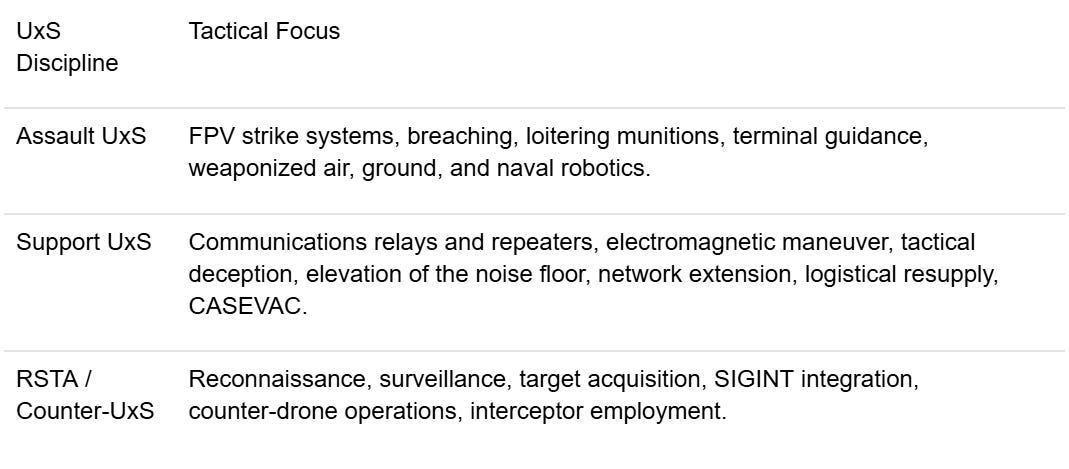
This structure reflects how robotic systems are employed in combat. It builds technical proficiency, distributes cognitive load appropriately, and enables integrated effects without degrading the rifle squad’s primary responsibility: close in and destroy the enemy.
MCDP 1 defines combined arms as the full integration of different arms in such a way that to counteract one, the enemy must become more vulnerable to another. Today, unmanned systems, electronic warfare, and network manipulation must be treated as formal arms within that equation. By synchronizing kinetic maneuver with offensive UxS and EW, the robotic-enabled platoon forces the enemy to choose between unmasking to kinetic fires or remaining hidden and being dismantled by attritable robotics.
The Defensive Imperative: Counter-ISR and Interceptors
Modern platoons cannot remain focused solely on offensive sensing and strike capabilities. Adversaries increasingly employ their own RSTA drones, FPV systems, loitering munitions, and ISR architectures to identify and target dispersed formations. Preserving the platoon’s survivability now requires the ability to actively disrupt the enemy’s sensor-to-shooter cycle.
This necessitates an organic counter-UxS capability nested within the reconnaissance and targeting architecture.
Stand-In Forces cannot survive inside contested weapons engagement zones if they lose the Reconnaissance/Counter-Reconnaissance (RXR) fight. Equipping RSTA elements with fast, maneuverable interceptor drones provides the organic capability required to blind the enemy, win the RXR fight at the tactical edge, and preserve the platoon’s low-signature maneuver.
Additionally, ISR operators are already monitoring the battlespace and airspace; they are often the first to detect enemy drone activity. Equipping these elements with interceptor drones provides an immediate defensive capability that can disrupt enemy ISR networks before they complete their kill chain. Following the principles of MCRP 3-32D.1: Electronic Warfare, whether employing kinetic interceptors, net systems, or localized EW payloads, these systems allow platoons to execute electronic attacks to blind enemy reconnaissance, preserve freedom of maneuver, and maintain operational security.
This capability also reinforces the importance of the builder-tactician. Marines capable of constructing and modifying systems at the tactical edge can rapidly adapt interceptor designs based on the threat environment—altering propulsion systems, payload configurations, or flight profiles to counter evolving enemy systems.
Fixing the Procurement Gap
Even highly trained operators remain constrained by current acquisition processes. Small units are expected to operate attritable systems but lack the authority to rapidly procure replacement components, modify systems, or adapt configurations based on battlefield feedback. Centralized acquisition timelines cannot keep pace with the speed at which systems are expended and modified during modern conflict.
To sustain robotic capability at the tactical edge, the Marine Corps must adopt decentralized, vetted procurement authorities that allow commanders to rapidly acquire compliant components using unit-level funds.
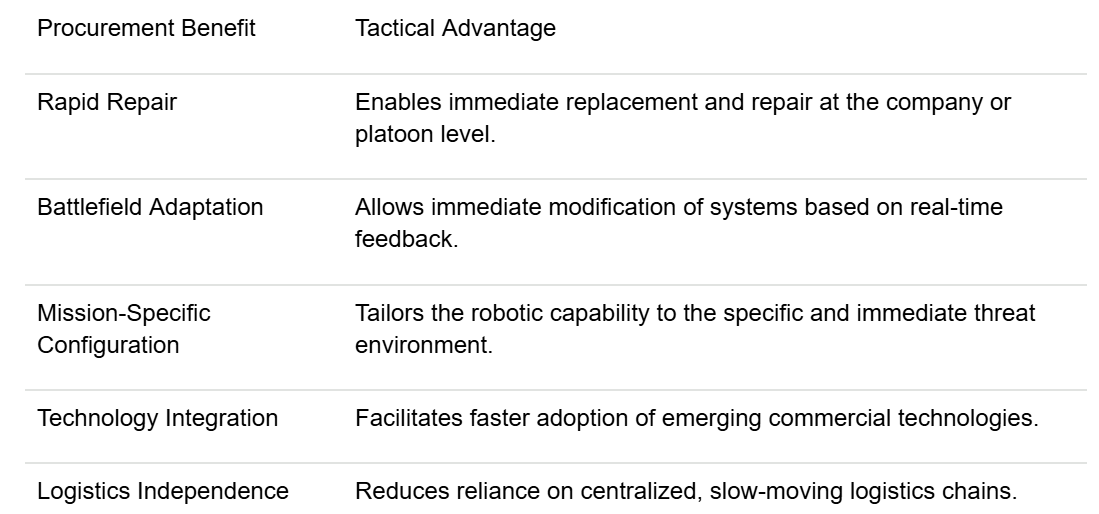
Without this agility, forward-deployed units remain anchored to processes fundamentally incompatible with the speed of modern warfare.
Training for Integration, Not Familiarity
The decisive point for this capability is training. Entry-level instruction should focus on baseline proficiency, but advanced training must shift toward integration, adaptation, and collective employment. Robotic warfare cannot remain an additional skillset taught incidentally across unrelated MOSs. It requires professional schoolhouses, dedicated instructors, advanced integration exercises, and the establishment of formal Training and Readiness (T&R) standards within the NAVMC 3500-series manuals.
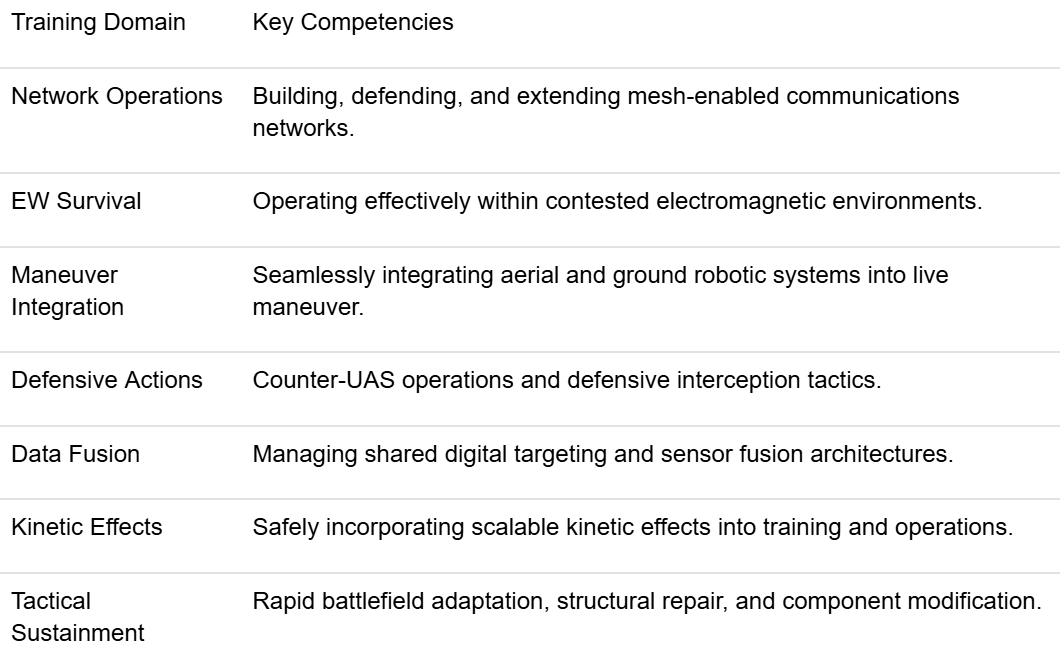
Most importantly, training must remain system-agnostic. Consistent with MCDP 7: Learning, our training pipelines must produce Marines capable of continuous adaptation. Because commercial and adversary technologies evolve in weeks, not years, training must remain strictly system-agnostic. We are not teaching Marines to memorize a vendor’s interface; we are teaching them the underlying architecture of robotic warfare so they can outlearn and outadapt the adversary in real time. This reinforces the doctrinal emphasis on adaptability and disciplined initiative. Marines are not trained for a single system. They are trained to solve tactical problems in a changing battlespace.
Closing the Gap
The character of warfare is evolving toward speed, dispersion, robotics, and adaptation. The Marine Corps cannot afford to approach robotic warfare as a temporary adaptation or boutique capability. The demands of modern conflict require deliberate force design decisions that institutionalize robotics as a professional warfighting function across the MAGTF.
Small units must be capable not only of sensing, deciding, and acting faster than the enemy, but of sustaining and adapting those capabilities independently in contested environments. Closing the kill chain at the platoon level is no longer sufficient. The force must close the gap between operator and builder, between platform and network, and between sensing and action itself.
Victory will not belong to the force with the most advanced technology. It will belong to the force that professionalizes, integrates, adapts, and executes faster at the point of contact.
Gunnery Sergeant Ryan M. Welch is a career Infantry Marine and instructor at the Advanced Infantry Training Battalion’s Infantry Unit Leaders Course at the School of Infantry-East. As a founder and lead developer of the Marine Corps Attack Drone Operators Course and Attack Drone Instructor Course, he helped establish the Marine Corps’ first institutional attack drone capability. He trained the Corps’ first generation of dedicated attack drone operators and instructors.
A recognized leader in tactical robotics, attack drones, network-enabled warfare, and reconnaissance-strike integration, Welch has been at the forefront of transforming how modern militaries identify, target, and destroy threats on the battlefield. His accomplishments include designing and teaching the Marine Corps’ first FPV Attack Drone Course, certifying the first Attack Drone Instructors, executing pioneering kinetic FPV strike events, and integrating advanced communications, tactical mesh networking, ATAK-enabled command and control, and robotic systems into infantry training and operations.
Through instruction, experimentation, operational demonstrations, and international engagement, Welch has helped expose emerging reconnaissance-strike concepts, robotic warfare, and resilient network-enabled kill chains to personnel from every branch of the U.S. Armed Forces as well as NATO and partner-nation forces. His work has influenced leaders, planners, instructors, and operators across the Department of War, helping bridge the gap between rapidly evolving battlefield technology and combat employment. By transforming lessons learned from contemporary conflicts into practical warfighting capabilities, he has played a role in accelerating the adoption of robotics, attack drones, and human-machine teaming across the Joint Force and allied militaries.
Focused on the future character of war, Gunnery Sergeant Welch continues to drive innovation in autonomous systems, weaponized networks, and distributed reconnaissance-strike operations, helping shape the next generation of warfighters and ensuring U.S. and allied forces maintain a decisive battlefield advantage in an increasingly contested and technologically driven battlespace.
RECLAIMING THE NIGHT: Coordinated Illumination as a Modern Infantry Offensive Tool
Lt. Zach Henderson
“Own the night.” The phrase is a cornerstone of Marine Corps identity — a declaration that darkness belongs to the trained, the disciplined, the technologically superior. For decades, that identity was earned. Western conventional forces held a disproportionate technological edge in reduced visibility. That psychological dividend compelled generations of enemies to choose not to move, not to attack, not to resist. The night belonged to us.
That advantage is now a critical vulnerability. The proliferation of cheap thermal optics, night-capable sUAS, and AI-enabled targeting systems has collapsed the barrier to entry that once protected U.S. forces in reduced visibility. In eastern Ukraine, a $5,000 DJI Mavic 3T with a FLIR thermal sensor delivers accurate fires within sixty seconds of observation — without a trained forward observer, without radio coordination, and regardless of darkness. The veil that generations of infantrymen relied upon has not been lifted. It has been rendered irrelevant.
The central question is not rhetorical: if reduced visibility degrades your offensive tempo, your synchronization, and your C2 — while doing comparatively little to suppress a defender operating behind persistent thermal ISR — why attack at night? This paper argues the answer is not abandonment but reimagination. Coordinated illumination, properly planned and precisely executed, offers the infantry company commander a path to reclaim offensive advantage. The force that controls the light controls the conditions of the fight.
THE DEFENDER’S NEW ADVANTAGE
The democratization of thermal technology is not an emerging threat — it is the current operational reality. The Houthis, ISWAP, Hamas, and Hezbollah all employ commercial thermal UAS systems as standard practice. The DJI Mavic 3T carries a 640×512 thermal sensor with 20x zoom for under $6,000. The FLIR Vue Pro R bolts onto any commercial airframe for under $1,500. These are not near-peer threats. They are the floor — the minimum adversary capability a Marine company can expect to face.
The threat is not the device. It is what the device enables: compressed kill chains that require no trained observer, no clearance process, and no radio call. AI integration accelerates this further. Autonomous scanning systems can now cue fires across grid squares of terrain without a human in the targeting loop. Large-scale nighttime maneuver against a force employing these systems is not a degraded operation — it is a targetable event.
The institutional failure compounds the threat. The Marine Corps internalized GWOT-era night dominance as a permanent condition rather than a temporary asymmetry. Current training events, range packages, and marking plans rehearse night operations against an adversary who cannot see. The after-action review grades movement discipline and noise — but rarely asks whether the scheme of maneuver survives a $5,000 drone orbiting at 400 feet. Army doctrine devotes two pages out of 826 in ATP 3-21.8 to limited visibility operations. The Marine Corps has no better answer. The institution has trained as though it still owns the spectrum. It does not.
THE CRITICAL VULNERABILITY: DIGITAL VERSUS ANALOG
The exploitable asymmetry that drives this paper’s argument is technical and documented. As Marines, we operate on the AN/PVS-31 Binocular Night Vision Device — an analog Generation III image intensification system. The PVS-31 does not construct an image from sensor data. It amplifies the light that is actually present — moonlight, starlight, atmospheric glow — by a factor of 30,000 to 50,000 times with zero processing latency. Most critically, the Generation III tube is equipped with auto-gating technology: an electronic function that regulates tube voltage in real time when a sudden bright light source enters the field of view. When an illumination round fires overhead, the PVS-31 gates down, adjusts, and recovers within fractions of a second. Marine keeps fighting.
Adversary systems work on an entirely different principle. Digital night vision devices — the standard for PLA infantry and the commercially available systems fielded by non-state actors — use CMOS sensors that capture, process, and display images on an LCD screen. These sensors have no analog gate. When an illumination round fires, the CMOS sensor floods. The image whites out. The processor struggles to recalibrate. For critical seconds, the operator is blind.
The PLA’s most commonly issued goggle, the BBG-011A, uses Generation 2+ image intensifier tubes — below the Generation 3 standard. Its newer digital systems are performing so poorly in extreme low-light that PLA soldiers have reported preferring their Generation 2 devices. The PLA itself acknowledges its digital NVGs are not replacements for image intensifier tubes but cheaper navigation solutions. In short: a Marine rifle company operating PVS-31s under coordinated illumination retains full combat function. A PLA infantry unit operating digital CMOS systems does not. The light that clears the battlefield for one side blinds the other.
THE MAIN EFFORT: COORDINATED ILLUMINATION
Illumination as Combined Arms, Not Observation. Conventional doctrine frames illumination as a tool of observation — you fire a round to see the battlespace. This paper argues for a fundamentally different framing: illumination is a combined arms tool. The commander who controls illumination controls the conditions of the fight. Unlike indirect fire, CAS, or electronic warfare, illumination is entirely unpredictable to the defender — the enemy cannot anticipate the moment at which the attacker chooses to change the optical character of the battlespace. Thermal sensors provide persistent coverage of darkness. They do not protect against a sudden, attacker-controlled illumination event that resets conditions on the attacker’s terms.
Backlighting and Position Obscuration. Accurate illumination placement is not a new concept — it is a neglected one. An illumination round placed behind the objective silhouettes the defender against the light while the assaulting element closes from shadow. The geometry is straightforward: the defender is outlined, the attacker is invisible. The requirement for FDC proficiency is paramount. A round 200 meters long silhouettes the assault element. A round 200 meters short accomplishes nothing. Illumination fires are a perishable skill that has atrophied in a precision-strike culture. Rebuilding it is not optional.
Illumination as Deception. Every illumination round fires a reflex. Every sensor, every eye, every thermal device in the defender’s network orients toward the illuminated area. The commander who understands this can fix enemy attention on a secondary axis while the main effort penetrates on the opposite flank. Irregular illumination schedules throughout the shaping phase deny the defender the ability to distinguish the round that precedes the assault from the ten that preceded nothing. This is deception in its purest form — not a separate line of effort, but a byproduct of fires already planned.
Support by Fire Without IR Compromise. In a peer environment, IR strobes and IR lasers are a liability. Any adversary with basic night vision capability can observe them. The same IR marking that orients your SBF position also orients the enemy’s sensors. Coordinated illumination eliminates this dilemma. Under illumination, the SBF observes the maneuver element with unaided optics, tracks its progress against phase lines, and triggers fire shifts visually — without emitting a single compromising IR signature. Tying critical battle handovers to identifiable terrain features — tree lines, road intersections, ridgelines — creates a C2 architecture that does not depend on radio calls that degrade precisely when the fight is loudest.
THE KILLING BLOW: THE LAST 100 METERS
Everything in this paper builds to this point. Throughout the preparatory and approach phases, the attacking company employs coordinated illumination to backlight the objective, flood adversary digital optics, fix enemy attention, and establish psychological conditions of disorientation. The defender orients his defense to a lit environment. His digital systems cycle through their flood-and-recover sequence. His thermal sensors remain functional — but his fighters have been psychologically conditioned to a battle that happens in light.
Then, at a precisely calculated point in the timeline — engineered around the burn time of the final illumination round — the lights go out.
The maneuver element covers the last hundred meters in total darkness. The defender’s digital systems, having just recovered from the previous illumination cycle, recalibrate into a dark environment their operators have been mentally trained out of. The thermal sensors still function — but the fighter behind them has lost his psychological anchor. The well-trained platoon, trained explicitly for this transition, closes the objective with practiced confidence.
The technical requirement is not complicated — it is neglected. A 60mm illumination round burns approximately 25 seconds. An 81mm burns 60 seconds. A 120mm burns 90 seconds. A 155mm provides approximately 120 seconds of usable light. A trained FDC and fire support coordinator can engineer the final illumination cycle to expire precisely as the maneuver element crosses its last covered and concealed position. The assault steps off in darkness, carrying every advantage the illuminated phase produced: a suppressed and disoriented defense, a silhouetted objective, degraded adversary optics, and an SBF that tracked every movement without a single IR compromise.
This is where C2 discipline separates concept from execution. The scheme of fires must be rehearsed. The assault element must know the timeline. The SBF must know which terrain features trigger which transitions. The FDC must execute on schedule. The burn time is calculated, the terrain feature is identified, the round is fired, and the assault steps off. The night closes behind them.
REQUIREMENTS FOR SUCCESS
Fire Support Proficiency. The entire architecture of coordinated illumination collapses without FDC accuracy, forward observer competency under pressure, and a FiST Leader who owns the illumination plan from the first iteration of planning. Rebuilding it requires range time, repetition, and institutional recommitment to treating the 60mm mortar as the combat multiplier it is.
Rehearsal. Illumination-integrated attack plans must become a core rehearsal requirement — not a supplementary event. Every element must know the illumination timeline. The SBF must know which terrain features trigger which transitions. The maneuver element must know when the lights go out and what is expected in the darkness that follows. A unit that encounters this transition for the first time on the objective will not execute it. A unit that has rehearsed it will.
Intelligence. The exploitable asymmetry described in this paper — digital CMOS vulnerability versus PVS-31 auto-gating resilience — is genuine but not universal. An adversary equipped with Generation III image intensification tubes does not present the same critical vulnerability. Intelligence on enemy NVD systems is a planning input, not a nice-to-have. In most likely threat scenarios, from PLA infantry to Iranian-equipped proxies to commercially equipped non-state actors, the asymmetry holds. Confirm it before assuming it.
Trust in the Plan. The decision to go dark at the last hundred meters is a calculated acceptance of risk — accepted because the conditions preceding it have degraded the defender’s ability to exploit it. This trust does not come naturally to leaders trained to maximize sensor coverage at every phase. It comes from understanding why the exposure is worth taking and from having rehearsed the conditions that make it worth taking.
CONCLUSION
The night is not lost. It is contested — and contestation has always rewarded the force willing to think more carefully about it than the enemy. The assumption that American forces will always hold overmatch in reduced visibility served the institution well for two decades. Carrying that assumption into a peer fight against an adversary equipped with persistent thermal ISR, cheap sUAS, and AI-enabled kill chains is not confidence. It is complacency. And complacency in a contested night environment is measured in casualties.
Coordinated illumination is not a workaround. It is a doctrinal evolution hiding in plain sight — validated every time a well-placed illumination round changed the complexion of a fight. The Marine Corps does not need to invent a new way of war. It needs to take what it already knows, apply it with precision and creativity, and train for the conditions that exist rather than the conditions that used to.
The well-trained infantry company that masters light discipline, fire synchronization, and the psychology of darkness will find that the night still belongs to those bold enough to own it — not because the technology says so, but because they planned for it, rehearsed it, and understood one thing the enemy did not: that in a world where sensors never sleep, the most dangerous force on the battlefield is one that knows exactly when to turn the lights off.
Lieutenant Henderson serves as a Platoon Commander with 2nd Battalion, 7th Marine Regiment, where he leads and develops Marines in one of the Corps’ most storied infantry units. A graduate of the University of Missouri, he commissioned through the Naval Reserve Officers’ Training Corps program.
Lieutenant Henderson has developed a keen professional interest in small unmanned aerial systems (sUAS) and their growing impact on the modern battlefield. He is a passionate student of warfighting doctrine and the broader evolution of warfare, consistently seeking to understand how emerging technologies and shifting operational environments will define the future of conflict.
The Written Word
Fiction and Nonfiction written by servicemen and veterans.
Yorktown: A New Beginning
Erick Huertas
As I sat in the uncomfortably large chair of the wizard’s office, I awaited their verdict on my case. “You already have so many injuries, and with everything that we’ve talked about, maybe it’s best that you don’t do this anymore.”
The room contracted around me as the words reverberated in my head. I knew this was coming; after all, it was the reason I was in Virginia. Yet, the unpleasant affirmation made it a reality that I had not prepared for. Twelve years, ending in a singular sentence from a Nurse Practitioner. I could not help but think, “What have I done?” I deployed a few times, sure, but I had never seen combat. I earned my campaign medal on a technicality, and I failed to earn the coveted FMF pin through another series of the technicalities that plagued the past decade of my life. I was just a reservist; no matter how much active-duty time I accumulated, the label never changed: Reservist. Now, I sat in this chair, recently returned from my fifth deployment, sidelined by injuries and a mind that I could no longer keep steady.
I walked out of the appointment and sat in my vehicle, still in my driver’s seat as I gazed into an ethereal abyss over the rooftops of Naval Medical Center Portsmouth. The reality was that I was nearing my limit, and I recognized the signs shortly after Allies Refuge, signs that all my seniors exhibited when I was just a boot. This had been my profession for the past twelve years. It was never something I loved, but something I committed to on every level. I built myself around the expectations set forth by my first Senior Line Corpsman and, ultimately, strived to live up to the twenty-three names that I saw on the wall every time I walked into a Navy medical facility. Yet now, sitting on this rooftop, I felt like none of it had amounted to anything.
I drove back to my hotel in complete silence, with an overwhelming anxiety about what would unfold over the next several months. What comes next? What kind of marketable skills do I actually have? I had some low-level medical certifications, but no marketable degree. The year before, I had been rejected by fifteen Physician Assistant schools despite exceeding their standards, and the sting of failure was far from a distant memory. I began to take stock of all my failures. Sure, I had some notable side-quests over the years, but I never really succeeded at anything. In weightlifting, I hovered just above average. My photobooks never turned a profit. My manuscript from the TransAmerica Trail sat untouched in my cloud. No failure was ever catastrophic, but success was far from my vocabulary. Instead, I was the king of almost.
On the drive home, my lack of accomplishments repeated in my head. I am just a poor kid from Pennsylvania who, despite my best efforts, will never amount to anything. No amount of hard work, dedication, or resilience would change that. To quote the fictional character Blu Venturi, “Dreams for poor people are just illusions.” I had become disillusioned with the person I wanted to be, and I became so obsessed with beating the odds that I forgot the odds would never be in my favor.
I walked back into my heatless hotel room at the NGIS, sat on my bed, and stared at the wall. The vicious cycle of failures sprinted through my mind, and I concurrently began thinking about the numerous people I have failed. So many people had told me that they looked up to me. I had always strived to be the SNCO who cared about my juniors. Someone steadfast and reliable, always ready for the mission ahead. As I sat there, I could not reconcile with that version of myself; instead, I was a man who couldn’t finish a career and couldn’t let go of the events of my 2020 mobilization and 2021 deployment.
These events were constantly on my mind, and no matter what I did, I always found a way to relate to them. My normally calm demeanor slowly shifted into a constant rage, where even the smallest inconvenience would become an oversized reaction. I stopped training, and my body, already worn down, began to crumble in ways that I could no longer ignore.
In times of great distress, I typically find myself needing to “touch grass.” Although it has never served as a “cure-all” remedy for my despair, it has aided in my ability to stop my racing thoughts. This time, I required something greater. Something akin to my travels on the TransAmerica Trail. Something that required direction, focus, and something that would force me out of my own head. If I couldn’t control what was next, I could at least control where I went.
The next day, I drove to Yorktown. The small coastal town in southern Virginia where America solidified its new beginning. The place where historical greats like George Washington, Alexander Hamilton, and the Marquis de Lafayette defeated the virtually undefeatable Lord Cornwallis in a brilliant, deceptive strategy. The military victory that prompted peace talks with Great Britain and forced all of Europe to recognize the resilience of the American people. On paper, the story has a poetic ending, but it was far from over.
As I walked through the grounds of the battlefield, I observed the redoubts and other earthworks that, even when reclaimed by the earth, remained a staple of the landscape. The distant sounds of traffic from the Coleman Bridge were drowned out by the lazy, yet ever-rushing waters of the York River crashing against the shore. The breeze danced through the grass, creating a serene backdrop for this somber place of battle.
I navigated the earthworks and found myself amid Redoubt #9, where Vicomte de Viomenil led 400 war-weary soldiers to victory under the cover of night. I then climbed to the top of the redoubt, looking down upon the minuscule rooftops of the town below the hill, and the colonial buildings just a few hundred yards away. I glanced over at Redoubt #10, where Alexander Hamilton led his famous charge, but what remained was only remnants, as the mighty river reclaimed her territory.
I continued to wander through the former siege lines and, inevitably, the town of Yorktown itself. I imagined the overwhelming emotions of success after conquering insurmountable odds. I imagined our great foundational leaders achieving their victory, solidifying the glorious cause, and prompting the new beginning that would become the United States.
What does this mean to me? I asked myself. Naturally, I understood the historical and cultural significance. However, the victory at Yorktown was far from the last obstacle for the young United States. The Articles of Confederation would fail, and the country would be fractured over what “All men created equal” really meant. We would wage war over land with our Native populations, eviscerating them in the process as we danced with the hypocrisy in our adherence to our founding principles. The most difficult parts were still ahead.
That is when it hit me. The new beginning did not mean the story started or even ended here. It was simply a new act in the feature. Just because this act was coming to a close did not mean I lacked the opportunity to continue pursuing my happiness. The next phase did not mean that I would be free from adversity, but rather that I would have more opportunities to prove to myself that I could achieve my illusions. Whether I was ready or not, it was here, and I had to carry it forward. This was my new beginning.


Rope and Choke
Benjamin Van Horrick
When the door locks, I have three minutes.
Since the First Sergeant said he was weighing us in on Monday, I planned this out.
I like this bathroom: 10 x 10, single-use, sturdy lock, a changing table, and the toilet as far as possible from the door.
I don’t want a mom or MP asking questions after I leave.
The sink actually has good water pressure.
I put my supplies on the changing table — gum, mouthwash, baby wipes, a change of shirts, hand soap, and a washcloth in a sandwich bag.
Yeah, a packing list. First Sergeant should be proud.
I turn on the water.
Thirty seconds down.
My mouth is already watering.
I lift the seat. The larger the target, the better.
My $40 of Taco Bell is digested just enough.
Forty-five seconds.
I fuse my pointer and middle fingers.
I lean forward at the hips, drawing my mouth eight inches from the bowl.
The splatter is minimal.
The running water muffles the gagging.
Once the two fingers get past my teeth, it is a matter of will. I keep going, shoving aside my tonsils, forcing my fingers down my throat.
Then the burn starts at the base of my stomach.
Once my fingers feel the bile, I pull as fast as I can.
Then the contents of my last meal—in their half-digested form—surge into the toilet.
Maybe I get a second wave, or, if I’m lucky, a third.
Those successive waves mean more cleanup.
I catch a glimpse of the blown blood vessels around my eyes.
Snot drops from my nose.
This blast is not bad. I press the handle with my foot.
This water pressure is good. Evidence gone.
I run the water. I scrub my hands and forearms like I’m getting ready for surgery.
I catch a whiff. Bile. Now familiar.
I scrub harder.
One minute left.
I grab ten feet of paper towel. I dry my hands, but they still smell like Fritos and beans.
Fuck it.
I wipe my mouth. I unscrew the mouthwash and chug it.
My cheeks work the mouthwash.
I spit it in the sink, now three inches from the drain.
First Sergeant will put that rope around my neck and waist. He will make his snide remark. He will do his math. I’ll pass.
In two weeks, we will be on patrol, and a 240 will rest on my traps in Now Zad.
I’ll see if I measure up.
June 9th
Heather O’Brien
I wake up to a series of booms and then sirens; neither fazes me until the call, “All Medical Personnel Report to the TIF.”
It’s going to be a bad day.
Nineteen years later, I still feel that heat. My insides are baking. My stomach gurgles, threatening instant expulsion if I even think about food. The heat so bad that I daydream about getting blown up in the next rocket attack. Or at least I think it is a daydream, trudging the mile to the TIF made me delirious in seconds.
Iraq is always hot, but today is the hottest. Not a single sand particle moves; the constant breeze is nowhere to be found. Not even when the rockets land on base and in the compounds does a whiff of air stir. I don’t worry that I might die from the explosions because I am certain I am slowly baking from the inside out.
June 9, 2007, redefined what my body and brain understood about heat and death.
I still taste my sweat running down my lip.
The strap of my helmet still chafes my chin.
My M-4 bangs against my chest, and my M-9 grip is wet with sweat.
No air moves, not even in an outdoor prison filled with 20,000+ people. As the gates clang shut behind us, it feels like walking into an open grave. How can so many people be utterly silent?
In this moment, I am more afraid than during all the riots I had been in, even the ones where I was almost set on fire. The sulfurous, cordite smell hangs thick in the middle compounds, sitting like a haze over a row of dead bodies.
The iron tangy smell of blood travels from my nose to my mouth, leaving an odd coppery taste. The gore is all over the Mile from one side clear to the next compound.
The few detainees I do see look terrified. For a split second, I almost feel for them, but I shake the feeling away.
I look for my friend in charge of the rocketed compound with growing worry; she is nowhere to be found. Later, when I see her, the concussion and brain injury have already begun.
June 9 fused the smells of explosions and fear in my brain forever.
But we were alive, and no Americans were injured. Well, that’s what official reports say; my good friend’s brain injury and concussion say otherwise. The sight of Airmen sitting around in shocked silence, their faces frozen in a daze, speaks volumes. These hidden injuries were just beginning.
A shrapnel wound or a lost limb are terrible, but how does one heal a scrambled brain or a shattered soul?
These people were casualties, even though it would take them a long time before they realized it. It took me over a decade to realize I was one too.
June 9 forever changed the way I understood trauma, but it doesn’t define my friends or me.
It’s been 19 years.
Except on June 9th.
Poetry and Art
Poetry and art from the warfighting community.
“Decision Point”
Dan Grimm

Trapped. Textbook.
Led unknowingly to the place of our deliverance
by a woolen wolf,
running now,
his mission complete.
Running from the roadblock.
And the fuel truck.

Option 1.

The vacuum created by burning air.
Sucking the breath from our lungs
before the flames could even touch our skin.
Ten thousand gallons of gasoline
becoming demon,
violating every opening,
feeding on the flesh of the righteous.
But only if a crack should appear –
an open hatch beckoning relief from
prolonged agony.


Like Option 2.

The death of a thousand degrees.
Safe from the orange tongue of the Devil,
but not his wrath.
Heat that melts metal and man slowly enough
to feel every panicked moment.
But only if the hatch is closed,
to keep Hell from swallowing us whole.

Like Option 1.

Hand on the latch,
better decide quickly.

Our misery depends on it.
——————————
This ends Volume 47, Edition 1, of the Lethal Minds Journal (01JUNE2026)
The window is now open for Lethal Minds’ forty eighth volume, releasing July 1, 2026.
All art and picture submissions are due as PDFs or JPEG files to our email by midnight on 20 June 2026.
All written submissions are due as 12 point font, double spaced, Word documents to our email by midnight on 20 June 2026.
lethalmindsjournal.submissions@gmail.com
Special thanks to the volunteers and team that made this journal possible.
I believe in the military and when i go throught the drive through and see a potential candidate, i recommend joining the Chair Force. I give them advice and tell them about the oportuntities they can take advantage of in detail. Things i didnt know about until i got out. like choosing your mos based on your asvab. I learned that my GT score related to each MOS and 113 was the highest that was needed for any MOS and mine was 123 or something. If i would have know that i would have joined the Chair force and not have the injuries i have today. Though all the mountain climbing, fast roping, casting and all the cool stuff was a lot of fun. I didn enjoy the Marines, but couldah wouldah shouldah i guess. im not gonna what if it to death, but if i could go back in time I would have been a seal or PJ. I did have some good time though. I was in 1st Recon from 95 to 06. I didnt like the transition to BN from company.
It's interesting how a knowledge of history often leads to the same places or at least similar ones. In similiar conversations of the topic of drones I recalled the history of the British Army's Machine Guns Corps - which made a great contribution during the First World War - and then disappeared from the rolls.