

Letter from the Editor
I am not much of a joiner. Except for the Marine Corps. And the Boy Scouts before that. And some conservation organizations. And the North Carolina Veterans’ Writing Alliance. And the North Carolina Writers’ Network, on whose board I serve. And of course, Lethal Minds Journal. But only the Marine Corps was intentional; the other stuff kind of... happened. Someone asked. I hemmed and hawed. They said it wouldn’t actually require much of me. I said yes, and now I spend a bunch of time complaining that I don’t have any time.
Anyway, when Adam Wilburn, the Co-Captain of the Patrol Base Abbate Book Club, asked me if I was going to apply for the June 2026 Book Club Return to Base at Patrol Base Abbate in Thompson Falls, Montana, I gave a non-committal answer designed to give me enough time to avoid it and Adam enough time to forget about it. The thing is, he didn’t. And really, neither did I.
I have known Tom Schueman, the founder of PB Abbate, since 2021. We collaborated on a book as well as the Kabul evacuation. Then came Lethal Minds Journal, another Schueman vision, and I got shanghaied into volunteering as the Editor-in-Chief for the last four years. All along, I have felt like I owed something to Patrol Base Abbate, even if it was just my enjoyment of watching what they’ve built. So, I asked my wife about heading to Montana, and she told me to go. I am deeply thankful I did.
Over four nights and three days, I got to know thirty fellow veterans and readers, many of them fellow writers. And by the time I left to go home, I had thirty new friends, though I told them I can only handle three to five close ones. That’s the kind of thing one says out loud during the deeply personal conversations that emanate from intentional hours around a campfire, an essential part of the PB Abbate experience. It’s part of the magic that transported me back to the moments I most loved about the military, with all the annoyance (and gunfire) removed.
Though there is a bunk house that feels like a cleaner, running- water-equipped version of places I slept in Norway or Okinawa or 29 Palms or Iraq or Afghanistan, I slept outside to keep my snoring from punishing my fellow vets or my being awakened by theirs. With the Big Dipper seemingly within arm’s reach in Montana’s expansive sky, it was too beautiful to sleep inside anyway. Still, the deployment vibes brought on by the familiar chorus of snoring dudes on cots was weirdly comforting when I slipped into the bunkhouse every morning before heading to the headquarters for a hot cup of coffee and quiet conversation before the rest of the world woke up. Thanks to volunteer cooks Matt and Alberto, the food was a damned sight better than MREs, and there was a lot of it, which mattered because we were not just sitting around discussing this year’s book, “Glorious Exploits” (one of many discussions ably led by Co-Captains Mike Plunkett and Adam Wilburn). I ran with my years-long running and lifting partner, author, and close friend John Dailey. We lifted weights under the eyes and tutelage of Mason Rodrigue. Then we got an hour of yoga from Nick Gonzalez of South Side Yoga Studio in Missoula. All of that came before breakfast. Nick led us in meditation before dinner as well.
Perhaps most importantly, I have not laughed as long, hard, deeply, or as often as I did at PB Abbate in years. Veterans often have dark, transgressive humor that is unacceptable in most environments, particularly with people you didn’t know forty-eight hours prior. But it was both understood and accepted at PB Abbate. We made the most of that, something I believe opened the door for people to share things they needed to share with people they knew would get it.
PB Abbate is more than another veteran’s 501(c)3. That’s not a backhanded swipe at the many great organizations out there offering great assistance to vets. But many are organized around “vets doing things,” and the experience, and the effects, only last as long as there’s something to be done. It’s a great start, but the difference I saw at PB Abbate lies in the connections made in moments spent simply talking and listening, something that only happens in unrushed moments offered by the three-day experience of a Return to Base program, fifteen of which are managed annually by only two full-time employees, in our case, Tiffany Aguiar.
The Book Club is the oldest, but PB Abbate offers multiple Interest-Based Clubs, many of which I am excited about. As I say each month about Lethal Minds Journal, it all starts with an email. Reach out.
Meanwhile, we’re here for you. Hit us up at lethalmindsjournal.submissions@gmail.com
Fire for Effect,
Russell Worth Parker
Editor-in-Chief - Lethal Minds Journal
Dedicated to those who serve, those who have served, and those who paid the final price for their country.
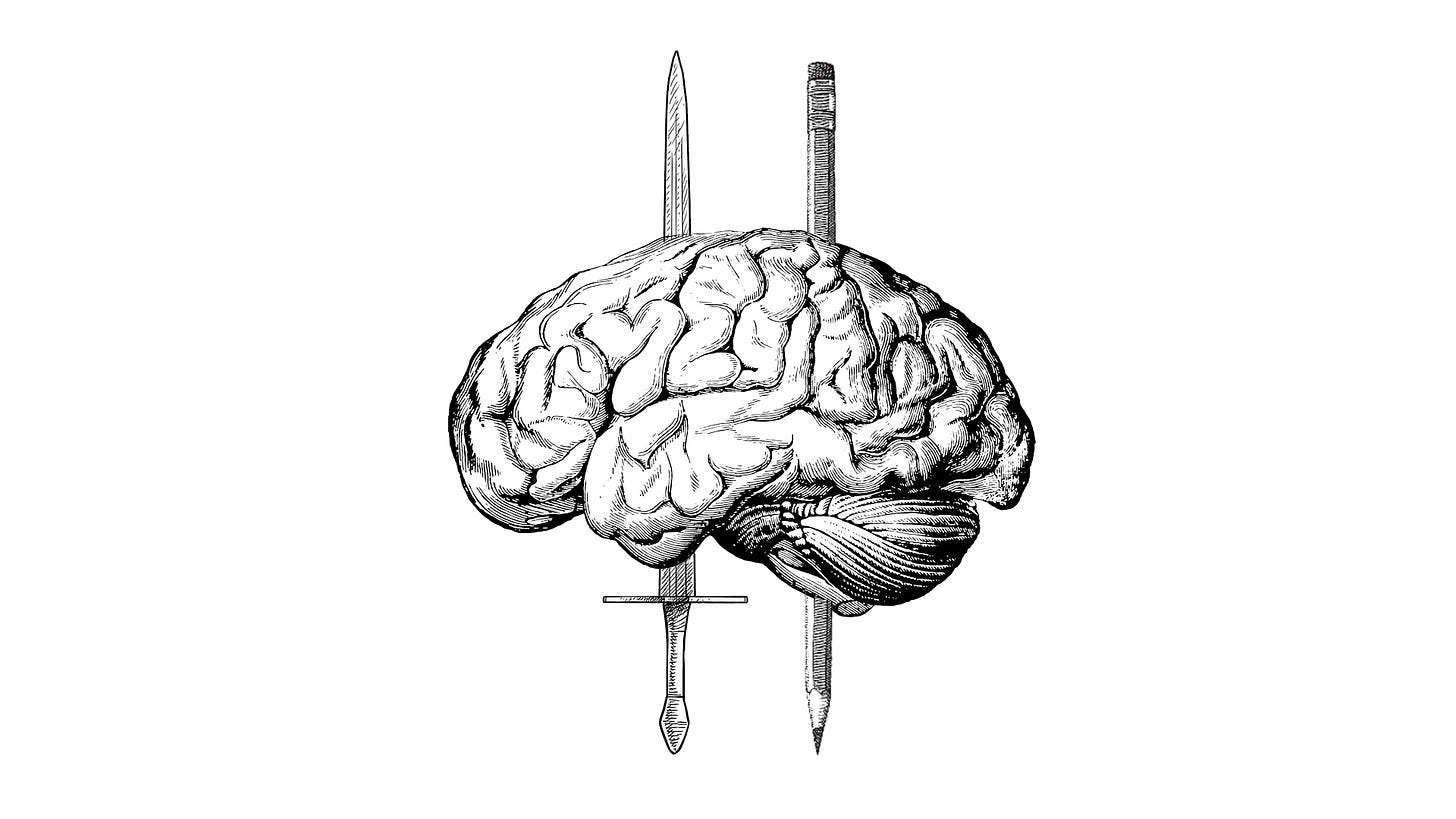
Lethal Minds is a military veteran and service member magazine,
dedicated to publishing work from the military and veteran communities.
Two Grunts Inc. is proud to sponsor Lethal Minds Journal and all
of their publications and endeavors. Like our name says we share a
similar background to the people behind the Lethal Minds Journal, and
to the many, many contributors.

Just as possessing the requisite knowledge is crucial for success,
equipping oneself with the appropriate tools is equally imperative. At
Two Grunts Inc., we are committed to providing the necessary tools to
excel in any situation that may arise.

Our motto, “Purpose-Built Work Guns. Rifles made to last,” reflects
our dedication to quality and longevity. With meticulous attention to
manufacturing and stringent quality control measures, we ensure that
each part upholds our standards from inception to the final rifle
assembly.

Whether you seek something for occasional training or professional
deployment, our rifles cater to individuals serious about their
equipment. We’re committed to supporting The Lethal Minds Journal and
its readers, so if you’re interested in purchasing one of our products
let us know you’re a LMJ reader and we’ll get you squared away.

Stay informed. Stay deadly.

-Matt Patruno
USMC, 0311 (OIF)
twogruntsinc.com
support@twogruntsinc.com
In This Issue
Opinion
The Merops Strait
The Written Word
Letter to the Combat Instructor
Zarka- The Medic Moves On
Fort Necessity + Valley Forge: Contrasts in Failure
How to Train and Organize for the Next War
Poetry and Art
Suffering
Opinion
Op-Eds and general thought pieces meant to spark conversation and introspection.
The Merops Strait
Hunter Keeley
Onshoring, scaling, and de-risking
Hitler infamously laughed in disbelief when he was first briefed on the estimated productive capacity of Ford’s automotive factories. The number of tanks rolling off repurposed Motor-T production lines across the Steel Belt was so great he thought his generals were pranking him.
One might hope that Vladimir Putin or Xi Jinping would have a similar reaction upon learning of the productive capacity of the factories producing the billions of dollars’ worth of drones currently entering service in the American military. The two dictators would in fact laugh in disbelief, though not at the quantity.
They would instead laugh in disbelief at the fact that the Americans are building their drone factories outside of the United States.
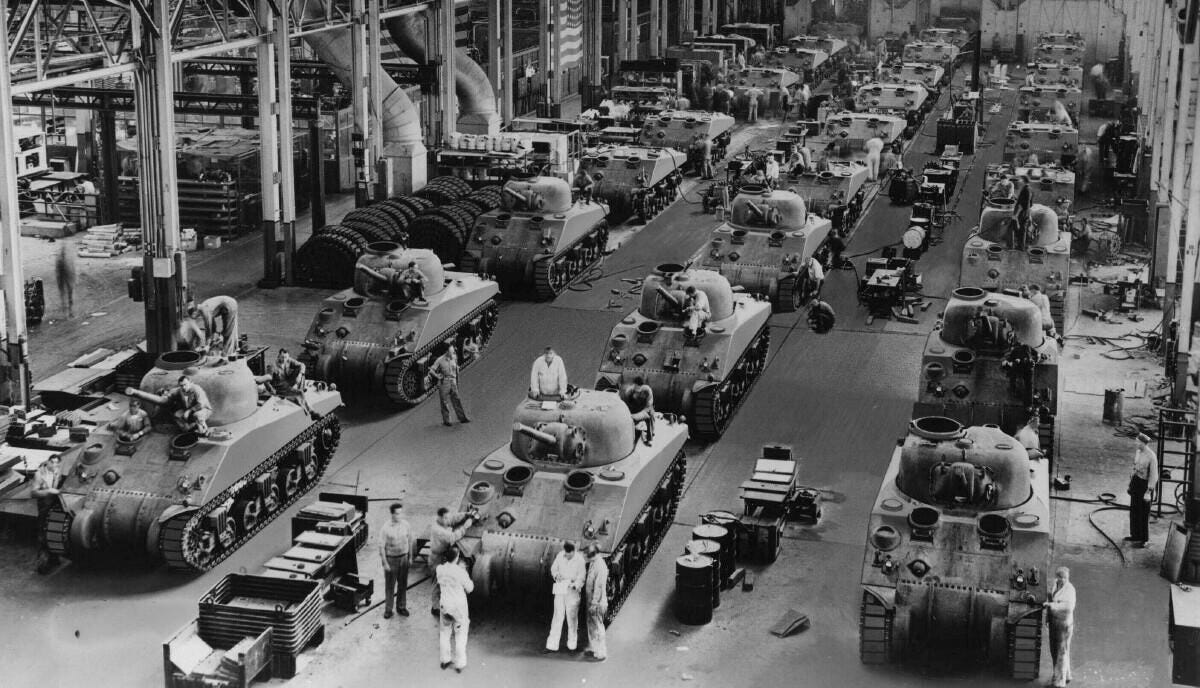
The Detroit Arsenal, 1942
Chinese Industrial Policy
Ukraine is today employing upwards of 9,000 drones daily in combat against Russia. Incredibly, nearly all of Ukraine’s drones are assembled domestically, in stark contrast to the situation just two years ago, when Ukraine imported the preponderance of its systems from China. However, despite purported export controls, China remains the dominant supplier of motors, engines, chips, and batteries to the Ukrainian drone manufactory, with only 5% of Ukrainian manufacturers claiming to not use Chinese subcomponents.
Watching Ukraine employ drones to ruthless effect against Russian formations- they are responsible for 80% of the 30,000 monthly Russian casualties- it is odd that China, a nominal ally of Russia, would not enforce its own export controls with more alacrity. And, given the Chinese Communist Party tends to be less laissez-faire than your typical government as regards regulatory discipline, it should not be inferred that Chinese subcomponent suppliers are simply unrestrained scofflaws chasing gently forbidden profits. Rather, the spilt blood of a Fenway Park’s worth of Russian boys is the monthly fee China willingly and deliberately pays to prevent Ukrainian demand for drone subcomponents from falling onto Western supply chains.
The decision to incur recurring costs at the societal level in order to dominate strategic industries is consistent with the economic policy pursued by the Chinese since the country entered global markets in 1978. In steel, auto parts, textiles, and more, the Chinese government has embarked on multi-decade subsidization programs that left foreign incumbents unwilling to make capital-intensive investments required to remain competitive, and displayed a commitment to those programs that dissuaded potential foreign entrants from entering these industries. Over the decades, Western industry atrophied, and developed economies simply forgot how to compete in non-service sectors. The differences today are that the check is cashed instead by their allies’ youth, and the resultant strategic edge is found in China’s enduringly singular capacity to produce subcomponents for drones at the rate required by modern conflict.

Shenzhen, China over the years.
On the other hand, American policy has deviated from its habitual reaction to Chinese industrial domination. Because the customer is the Department of War, and not Bechtel Construction or the Chicago Transit Authority, American policymakers have greater sway to induce the consumer of weaponized drones to behave irrationally, that is, to neglect cheap Chinese products in favor of expensive American products made with inefficient supply chains. Regimes such as the NDAA and Blue UAS list, which mandate that critical components be made in America, or at least not made or sourced in China, paired with massive budget outlays and novel procurement strategies, define the contemporary American approach to onshoring and scaling production of drones and robotic systems.
DAWG and the Afghanistan Lesson
The most notable of the aforementioned budget outlays is the Defense Autonomous Weapons Group’s (DAWG) allocation for the coming fiscal year, jumping from $225 million to $54 billion. That outlay, paired with a $1.1 billion demand signal from DOW’s Drone Dominance Program (DDP), the flagship competition based acquisition program, and others such as the Army’s Purpose Built Attritable Systems (PBAS), constitute a comprehensive institutional reorientation and have proven sufficient bait to compel a flurry of entrants into the unmanned systems space, evinced in the recent invitee list for the second Drone Dominance Gauntlet, featuring 23 more competitors than the first Gauntlet that took place in March of this year. Entrants in the intervening four months include;
General Cherry’s partnership with Wilcox to produce drones in New Hampshire;
Orqa, a Croatian manufacturer, incorporating an American entity
Perrennial Autonomy, formerly Project Eagle, alias White Stork, owned by former Google CEO Erik Schmidt which also produces the Merops interceptor.
Powerus, a drone company which recently reverse-merged with Aureus Greenway Holdings, the golf course holding company owned by Eric Trump and Donald Trump Junior.
Then, the DAWG/DDP/PBAS combination would seem to already be making strides towards the DOW ambition to onshore, scale, and de-risk American drone production. And, indeed, it is. Compared to traditional procurement cycles, the defense industrial complex is indisputably moving with remarkable speed and agility to provide warfighters with modern weaponry. As Colonel Cuomo of the Marine Corps Attack Drone Team recently phrased it, “a year ago we didn’t even have drones, now we’re using them to strike moving targets on water at night.”
However, it would be premature to declare victory, or even to declare that the existing programs in their current form will guarantee victory, over the Chinese stranglehold on critical components. The Department of War has a storied history of confusing galactic capital expenditures with problem solving, and the $54 billion pointed at autonomous weapon systems in the next year presents as much a risk as an opportunity for the American defense establishment.
Retired General David Petraeus recently cast a cautionary note into the chorus of cheers at the DOW’s ensemble of modernization efforts. He notes that industry is not prepared for the onslaught of capital DAWG represents, and that there are echoes of the Pentagon’s rapid procurement of Predator Drones decades ago. While some may scoff at his worry-mongering, General Petraeus does have firsthand experience with the consequences of flooding an unprepared system with capital, having commanded CENTCOM from 2008 to 2010 and NATO forces in Afghanistan thereafter.
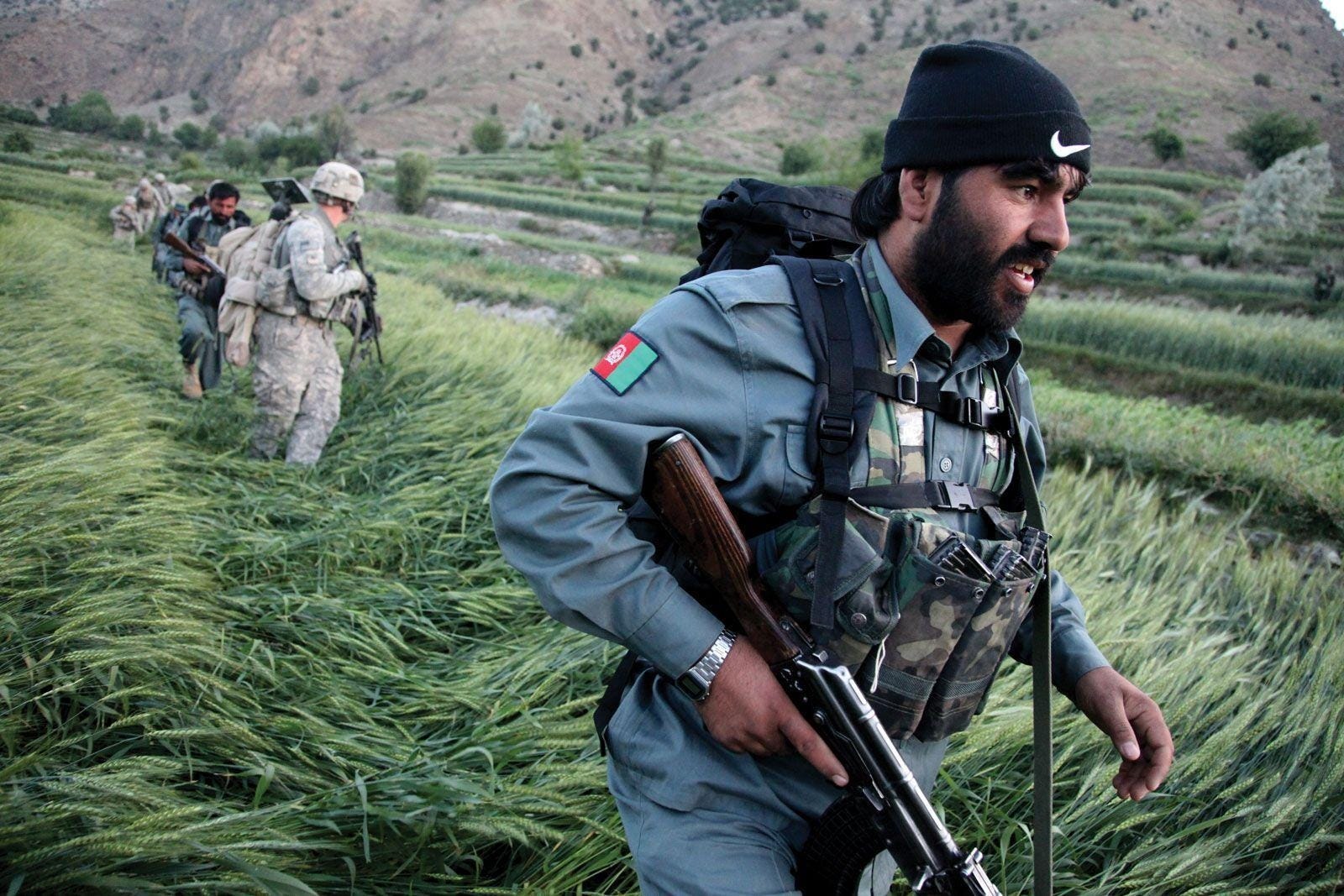
ANA Soldiers with US Forces
The Afghanistan Security Forces Fund may be the last American budget outlay to have jumped as suddenly as the DAWG Budget has, growing from $800 million in 2005 to $7 billion by 2007. Afghan society, like the American Drone Industry today, had few established institutions, a culture of infighting and tribalism, and a broad supporting cast of opportunists. Like a flood which follows a drought because farmland has dried and cracked and cannot absorb a sudden downpour of rain, what remnants Afghan society remained after decades of Taliban rule were in many respects swept away by the surge of American dollars into the country, despite their explicit allocation towards such noble pursuits as education and democracy.
The fact of the matter was, there just did not exist enough organizations in Afghanistan that actually gave a damn about any of those principles to allocate money to, and because the tap was turned on so aggressively, and the grant-makers were pressured to spend money as to achieve results, grotesque quantities of capital wound up in the pockets of organizations expressly opposed to the very principles the money was dedicated to in the first place. In his research, “Afghanistan Papers” author Craig Whitlock found reports indicating that “about 18% of the money went to the Taliban and other insurgent groups [and that] corrupt Afghan officials and criminal syndicates skimmed off another 15%.” At a minimum, and Whitlock believes these numbers underestimate the actual figure, over 33 cents of every dollar dedicated to Afghan aid was given to either the literal American enemy, or criminals. This outcome was not necessarily the result of poor judgement on the part of grant makers- in many instances there simply weren’t other choices.
Like the Taliban Mullah who temporarily reimagines himself as a principal of a girls school in order to relieve a harried aid worker of his $250,000 in cash that he must, no questions asked, spend on Afghan democracy by the end of the month, many of the market entrants who present themselves to DAWG, the DDP, and the DOW over the coming years will be, wittingly or not, wolves in sheep’s clothing. The risk is, because the sum of money is so large and the pressure on program managers to spend is so acute- move fast and break things, remember- that the DOW will award orders that, when all is said and done, fail to advance, and may even impede, the DOW’s stated goals to onshore, scale, and de-risk the American defense industrial base.
It could be that General Petraeus, for all his role in planning them, is nevertheless more attuned to the American military missteps in the Middle East, and the lessons we ought to learn from them, than are his skeptics across the Defense Industrial Complex. With $148 billion spent on Afghan democracy and institutions, we should not assume that the $54 billion assigned to DAWG in the next year will automatically address the underlying issues at hand.
Merops and the Messina Strait
The Merops Interceptor is the signature product of Perennial Autonomy, former Google CEO Erik Schmidt’s drone company. While the name Merops is derived from the Ancient Greek genus for an insect eating bird, the Army’s recent $140 million flash purchase and $500 million Indefinite Delivery Indefinite Quantity (IDIQ) order calls to mind the Ancient Greek genus of the mythological beasts Scylla and Charybdis.
Navigated by Odysseus on his winding journey home from Troy, the Strait of Messina was occupied to one side by Scylla, a many-headed demon creature, and the other by Charybdis, an unpredictable whirlpool. The impossible choice between exposing one’s ship to one or the other of these monsters is the origin of the idiom “between a rock and a hard place.”
At first glance, the partnership between Perennial Autonomy and the U.S. Army is an unequivocal success. In 8 days, Perennial Autonomy supplied 13,000 Merops to the Army in the Middle East, providing an urgent answer to Iranian Shahed volleys. The upcoming IDIQ will provide cost-effective depth against the 70% of Iran’s deep strike capability that remains since the start of the war. Procurement at this speed and quantity is unheard of. American lives were saved. It seems absurd to imply that such a successful pairing could possibly be anything less than definitively positive for American military might, and downright traitorous to compare the Army’s decision to buy $640 million worth of Merops interceptors to Odysseus’ decision to err on the side of Scylla vice Charybdis, permitting the hydra-like monster to devour six of his trusted sailors.
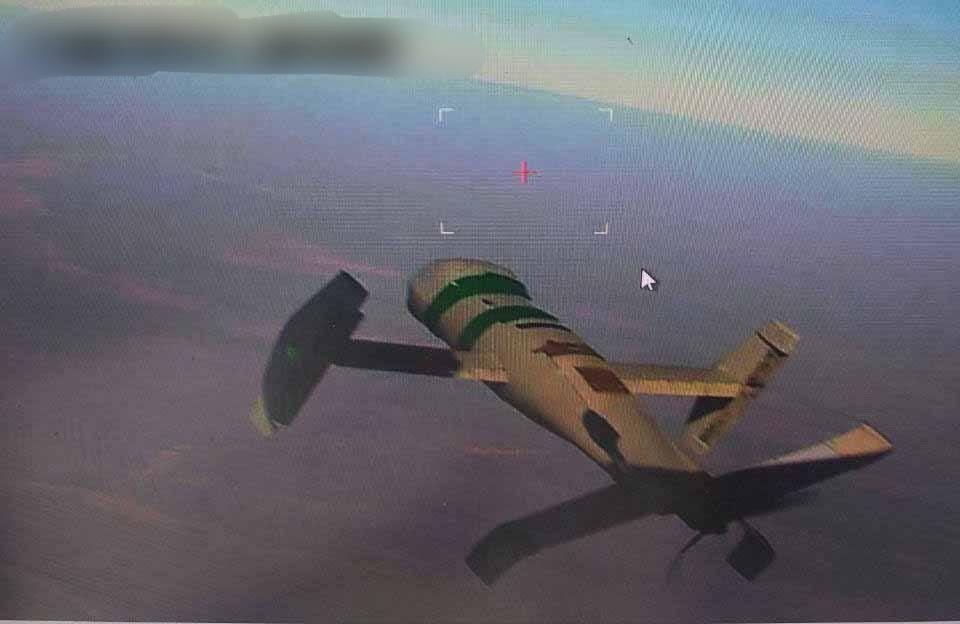
The Merops, airborne
However, consideration of Perennial Autonomy’s current posture indicates that the $640 million capital allocation towards the Merops interceptor may have ambivalent impacts on each of the DOW’s goals to onshore, scale, and de-risk the American defense industry.
Erik Schmidt’s drone consortium is notoriously secretive. Available statistics suggest that the Merops, the Hornet, and their little brother the BumbleBee, are the interceptors and midrange strike platforms of choice in Ukraine. The Wall Street Journal recently reported that “the Merops will be manufactured in Germany.” The Perennial Autonomy spokeswoman quoted in the Wall Street Journal article referenced production in Ukraine and other European countries, but did not provide specifics. Critically, they are certainly not manufactured at the Menlo Park business park address from which Perennial filed for a trademark.
It’s possible that the Merops interceptor, unlike most drones employed in Ukraine, is not reliant on critical Chinese subcomponents. However, for all Perennial’s secrecy, the Merops interceptor has been employed to resounding success in Ukraine, and therefore, as with all hardware used there, the open source intelligence (OSINT) community has chased after any shred of evidence to do with the weapon system. The following photos, scraped from the Russian Telegram channel “Useful Payload,” are purportedly of downed interceptors. Using artificial intelligence to assist in identification reveals a number of Chinese sub-components present.
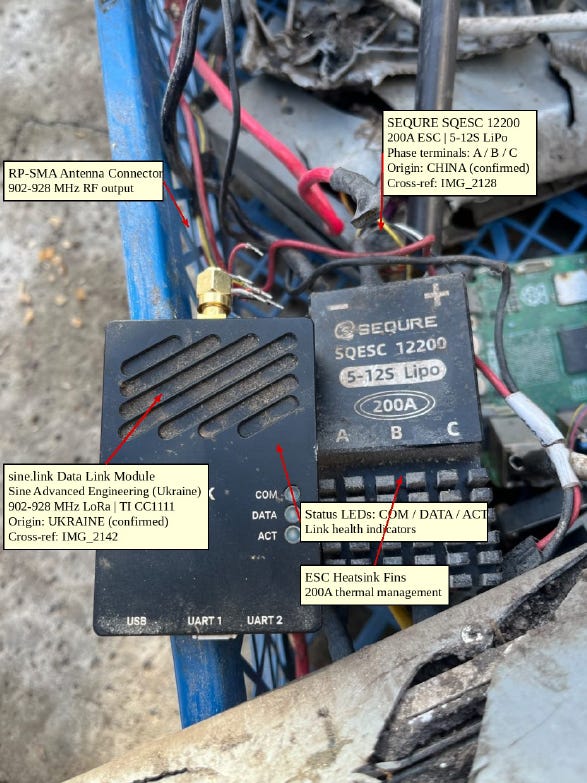
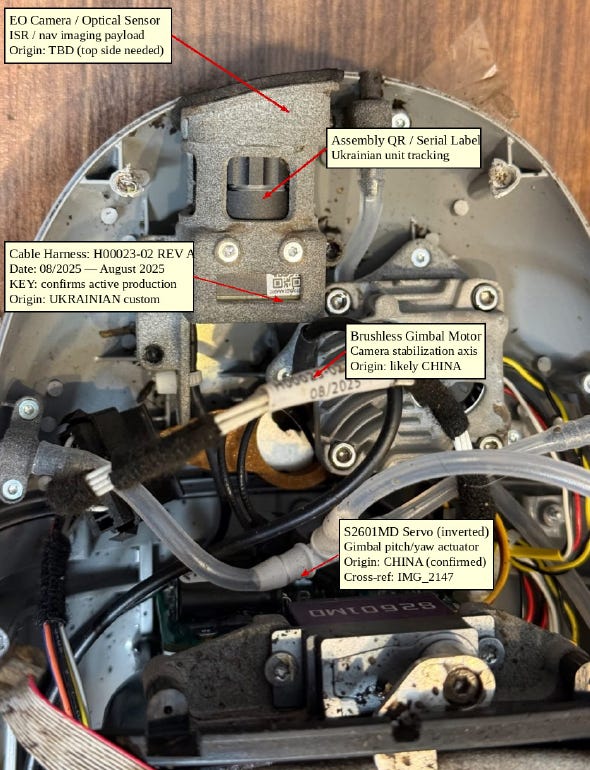
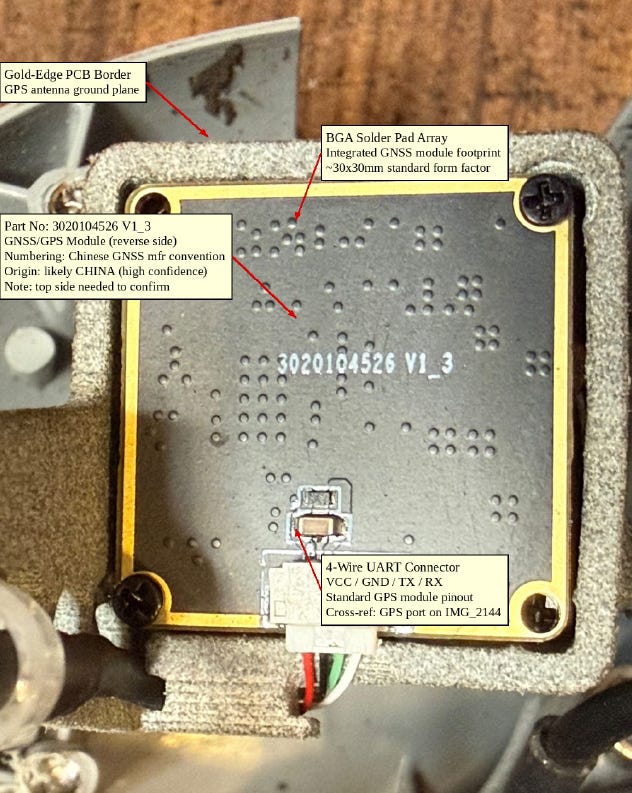
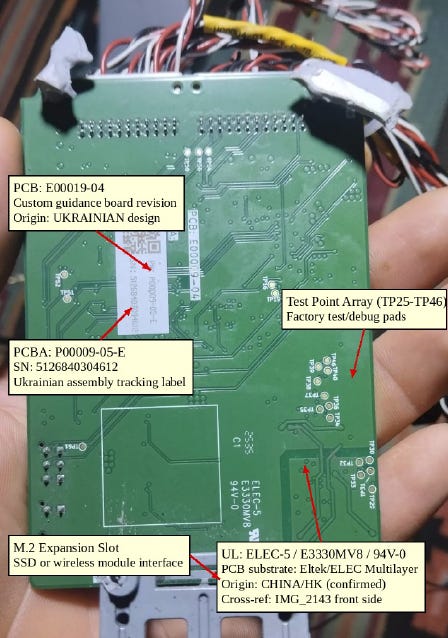
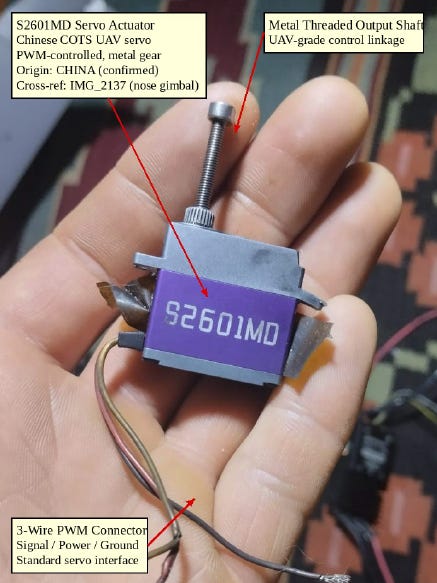

Hence the Messina Strait. The Army desperately needs quality interceptors to save its soldiers’ lives now. The premier interceptor on the market is the Merops, and through sheer force of will, the Army is able to rapidly field the Merops to its forces in CENTCOM, which undoubtedly saves lives. Yet, the $640 million the Army is dedicating to this end is pouring directly into, at best, a Chinese-contaminated supply chain ending in a hypothetical German interceptor factory. We have purchased the capability to intercept Shaheds today, at the cost of entrenching the Chinese capability to manufacture those interceptors tomorrow. We know which will matter more in a peer conflict.
This choice, between rapid procurement of capabilities that will save soldiers’ lives today but provide capital to Chinese supply chains and factories, and the patient development of productive capacity that will deny China a strategic advantage tomorrow but risk soldiers’ lives today, may play out again.
Take, for example, antennas for FPV drones. The radio frequency spectrum in the United States is tightly regulated, as many critical societal functions, such as search and rescue, health services, and air travel, would be obstructed by a free-for-all in the spectrum. American drones must fly on the ‘Industrial, Scientific, Medical’ (ISM) band, which stretches from 902 to 928 MHz, 2.400 to 2.4835 GHz, and 5.725 to 5.875 GHz, The issue is that, in Ukraine or against any number of hypothetical adversaries, these bands are completely jammed and nonviable.
Ukrainian drone operators now commonly fly telemetry (C2) in the 1-2 MHz range and receive video transmission (VTX) in the 6-12 GHz range, either of which requires different antennas than those which use 815-1000 MHz or 5-6 GHz. Discouragingly, the only providers of 1-2 GHz C2 antennae and 6-12 GHz VTX antennae are Chinese. If the American military went into combat against Russia tomorrow, what strike drones we have been able to field would be completely unusable within miles of the Zero Line. The Army, in a focused effort to save lives, would source alternate antennae. To do so would mean pushing capital into the Chinese market and supply chain that provides such antennae to the world. Once again, the decision to save lives and empower warfighters today has a second-order effect of funding Chinese manufacturers’ ability to do so tomorrow.
In Afghanistan, aid workers chased the end point- a democratic society- without regard for the fundamental building blocks that allow one to persist. Today, the DAWG and DDP will risk chasing an end point- the capabilities we see employed by Ukraine in modern combat- without regard for the fundamental building blocks that have allowed Ukraine to fight in this manner for four years- a robust and reliable Chinese supply chain. If DAWG repeats the same mistakes as the Afghanistan aid program, the outcome will be the same: our enemies will put on a theatre to convince us we are making progress towards our goals, and when it matters not a single Afghanistan National Army soldier will stay at his post, and for all the money in the world we will be unable to buy the $15 S6201MD Servo Actuator needed to build an interceptor drone.
Conclusion
The desired end state of the DOW as it pertains to American supply chains and productive capacity is for Xi Jinping or Vladimir Putin to disbelieve their own ears when, next year or the following one, their analysts brief them on American productive capacity. To put it mildly, resources have been allocated to this effect. The fundamental risk that the DOW faces as it pursues this goal is that the capital is allocated in such a way that reinforces adversary supply chains and production and therefore ultimately not only fails to promote, but actively impedes the onshoring, scaling, and de-risking of the American defense industrial base.
The Written Word
Fiction and Nonfiction written by servicemen and veterans.
Letter to the Combat Instructor
Thomas Schueman
Although my experiences at the School of Infantry were separated by more than a decade, the four years I spent there gave me a deep affinity and respect for the 0913. What began as professional appreciation transformed into personal friendships. The Marines I served alongside became family. Many of my closest friendships today, the men I consider brothers, were formed on long humps and around the ammo table.
After my first tour at SOI, I took company command at 29 Palms. When I arrived at 3/4, I was the only officer who sat in the SNCO manpower meetings to make sure Lima Company acquired at least a few 0913s to serve as our platoon sergeants. Two of them went on to become Marine Gunners, and one is now a Sergeant Major. I can tell you that every company commander and rifle platoon commander is hoping their platoon sergeant is inbound from SOI.
The grind these Marines endure is relentless. From pushing privates to making 0369s, you have to have 12 weeks of grit. It’s day on, stay on. It really is grunt life, where the armory draws are continuous, the ammo tables are stacked to the sky, and there are mountains of dunnage. The official diet of a combat instructor is the PX special: a random snack, a White Monster, and nicotine. His truck is full of Taco Bell bags and whatever other late-night drive-thru options were open when he finally headed home after all the gear was turned in and the students were secured.
Combat instructors are funny because if they didn’t have a sense of humor and find a way to laugh at all the madness, they’d lose their minds. The things you’ll hear during a line-out of the privates, or in the rear of a hike as some goober falls out, are the kinds of things you just have to laugh at to keep your sanity. During a line-out, you stand there in awe as what feels like a real-life Dr. Seuss scenario plays out in front of your eyes. Just when you think it is impossible for a private to have one more thing stuffed into his cargo pockets, he pulls out an entire MRE.
The home of the combat instructor is the highest concentration of infantry knowledge in the Corps. The Marines at AITB are the subject matter experts in their craft. They do not invent the standard, but they uphold it with deadly seriousness. From his first cycle to his final cycle, the combat instructor pushes. He gives it everything. He pays a toll. He lives outside in the swamps of Lejeune and the hills of Pendleton, all for the everlasting glory of the infantry.
When I saw Advanced Infantry Training Battalion on the command list, it was the obvious choice. I knew what a privilege it would be to serve alongside the finest infantry Marines in the world. These Marines are nightmare material for our enemies. The “no worse enemy” adage is backed and guaranteed by the men leading our Advanced Infantry and Unit Leader Courses.
I am sad to leave. Grateful for the opportunity. And I sleep well knowing that so long as the infantry has leaders like the men inside the ranks of AITB, we will fight and win our nation’s battles.
To the 0913s, thank you for allowing me into your world and for the humbling opportunity to fight alongside you.
Zarka- The Medic Moves On
Steve Thomas
Zarka glanced at the clock above the bar. It was 10:45, and he was halfway through his third Labatt. There was only one other patron, a dim silhouette at the far end of the bar. It was Tuesday night. Zarka wearily pushed his glasses back up his nose. It was probably time to get going. Nothing good could come of his interactions with the crowd that would be interested in the Anchor Inn that late on a weeknight. Besides, he needed to be on time for work tomorrow.
With a dramatic upward tilt of the chin, he drained his beer. Carefully counting three crumpled five-dollar bills, plus a couple of singles for tip, he settled his bill and stood up, involuntarily grunting from the pain in his knees and back. He moved to the door, flinging his hand above his head in a laconic farewell gesture to the bartender. Neither he nor the other patron noticed Zarka leave.
The heavy door opened into a short anteroom with a Michelob mirror on the wall, pastoral scenes of ducks in flight and a buck with a ten-point rack. Zarka turned briefly to adjust his hat in the mirror before pushing out into the frigid Lansing night. He peered critically at his reflection, a week’s worth of stubble and dark bags under his eyes. He smiled thinly. Everyone gets the face they deserve by forty.
The door to the street swung open as Zarka turned to go. A shadow, backlit by the streetlight, crowded him back into the anteroom. No words. Two short punches and Zarka crumpled to the floor. He caught a shit-kicker in the ribs as he lay on the cold tile. Who wears cowboy boots in the winter?
Back at his apartment, he painfully lowered himself onto his belly and reached his left hand under the bed frame. His first pass rendered two large clots of dust and a Pop-Tarts wrapper. On the second attempt, he felt the canvas handle of the duffel bag. Patting the dust from the bag, he could see the faded black stencils with his name (last, first, middle initial, last four). He ran his forefinger absently over the colored strips of tape used to denote company, platoon.
Zarka started packing. He cleared his dresser drawers with three expansive sweeps of his hands, dropping shirts, pants, and everything else onto the unmade bed. He’d be gone by six. Step one, pack your shit. Step two, get in the car and find 75 North. He could break his lease and quit his job on the road. Three hours and some change to St. Ignace, and Zarka could figure it out from there.
It was one in the morning, and by now any buzz from the beers was replaced by an ache in his ribs and a throbbing in his head, right behind the eyes. Picking up the duffel, he dropped it onto the linoleum floor, bottom first, to compress the contents, then secured the black metal latch across the opening. Grabbing a laundry basket, he threw a couple of pairs of sneakers and a pair of winter boots into it, then returned to the bedroom. Zarka neatly folded his comforter, placed his only pillow on top, and dropped them both into the basket.
Zarka pulled on his woolen hat with the outlandish pompom on top, slung the duffel bag over his shoulder, and stooped for the laundry basket. Down four flights of stairs and out into the hurtling wind, he made the short walk to his car.
Another parking ticket; that was about right. He put it in his pocket, shuffled through the slush on the curb to the rear of the Subaru, and popped the trunk. His fingers were already stiff from the cold as he dropped the bag and basket into the back, slammed the hatchback, and headed back into the building.
Upstairs, Zarka made a final sweep of the apartment. Pulling his backpack out of the closet, he filled it with two framed family photos and a plaque from his platoon. He rifled through the sparse cupboard, grabbing a bag of beef jerky and a box of protein bars. Belatedly, he remembered his toiletries. Grabbing his medication, a toothbrush, and a razor (which was desperately in need of a new blade), he dropped them into his toiletry bag along with a washcloth.
He stood on the threshold and thought, that will do. He would call his sister and ask her to deal with the mattress and sundry furniture left in the apartment. Put it on the street; makes no difference to me. He flipped off the lights, closed and locked the door, and patted his pockets. Phone charger. He opened the door, retrieved the charger, re-locked, patted the same pockets. Good to go.
Zarka hooked up with 127 and was closing on Houghton Lake as the sun creased the horizon. He rolled the window down a crack with his left hand, and, replacing it on the steering wheel, rooted around for cigarettes with his right. He was still looking when he steered the Subaru off at the exit, but found half a pack in the center console. He decided against smoking one before breakfast.
That morning cigarette had a certain ritual quality, marking the end of the day’s first trials, whether that was a long run in the Kentucky heat or just getting out of bed and letting his feet hit the floor. He remembered the first one he smoked on the fourth of July almost fifteen years ago. He had leaned out the timber-framed door with his face covered in soot and his pants covered in blood and inhaled deeply. It was the happiest he had ever been.
Zarka ate slowly now, methodically scooping scrambled eggs onto a heavily buttered piece of toast. He wasn’t terribly hungry; he was just eating to pass the time until he figured his coffee was cool enough to drink. Having sunk to cups, he paid his bill from a modest roll of bills in his pocket. Even though his job was gone, the VA still paid regularly and timely. Small mercies, he thought. He swung his legs off the stool and pushed through the door into the soft morning air.
The sun was fully up now, burning off the morning mist as he backed the Subaru out of the gravel lot. For the first time, he got a good look at the faux log cabin exterior of the diner and behind it, the gray-green expanse of northern Michigan lake country. Zarka slouched into the driver’s seat and lit the cigarette. It was good to have waited. Smoke curled through the crack in the window and whipped away.
The drive past Grayling was stark but beautiful, row after uneven row of lodge-pole pines stripped for winter, snow piles against their thin trunks. His mind locked into neutral, eyes fixed in the middle distance, replaying the same movie that never ended and never got old. Zarka’s stalking up and down the line in the dark. There’s no sound, just flashes of light. He knows it’s loud, incredibly loud, but he can’t make his brain register. But he still heard the call for a medic over his radio, and he’s flying. Even at full speed, he carefully sidesteps a metal stake in the ground he knows is there (for no apparent purpose other than to menace people in a hurry), runs by the wooden out-house sheds and into the fluorescent light of the interior. Just as quickly, he’s through the building, out the other side, and into the darkness, strings of colored lights whirling overhead.
Zarka is yelling now. He’s at the top of a mud-caked staircase, on a rooftop, and he can barely discern three stooped outlines peering intently, uselessly, at the supine figure on the ground. The man is relatively new to the platoon; nobody thinks he has been hit, probably just a concussion. A rocket-propelled grenade had splashed into the front of their position at head-height, but even now getting shot at seems to strain everyone’s credulity. It’s hard to accept the situation, to put it mildly. Actually, getting hit borders on the unbelievable. After his initial sweep of the body, Zarka raises his voice above the din he knows is there. “Somebody help me carry this fucking hoss.”
They get the man down the staircase and across the courtyard, kicking up clouds of fine dust with every labored step. Zarka is holding the man’s feet under his armpits, walking in front to lead the way to the aid station. Zarka can feel the tremors of outgoing mortars under his feet, but it is silent again. Nothing in his ears but the steady drumming of the blood from the constant exertion. He’s so exhausted by the time they get inside that he doesn’t bother going into the aid station; he just pivots around and dumps the man into a folding metal chair in what they charitably call the kitchen. Zarka helps the man out of his helmet and body armor, then methodically runs his hands over the man’s head, extremities, and torso. No blood. With a perfunctory nod to no one in particular, he turns on his heel and heads back into the night.
Now Zarka’s restlessly fiddling with the radio, trying to find the channel that will give him the conditions on the Mackinac Bridge. If the wind is too high or there is ice falling, he might have to lay up for a day in Mackinaw City. The static finally clears as he settles on the dial on AM 530. Clear skies and light winds; it’s all going incredibly well.
He’s down to the nub on a second cigarette, carefully tapping the ash into an empty Diet Coke can in the cup holder. The guy with the concussion was the second one that night, he thinks. My brain must be totally fried. How did I get that backwards? By the time I lugged that heavy fucker down the stairs, I’d already dealt with Mitchell.
He was moving through the makeshift kitchen again, and a litter was lying on the ground blocking his path. It was stretched diagonally across the doorway to the aid station. He remembered working his way around to the rough stone grate in the kitchen, a feature that probably drove the property value way up. It hadn’t occurred to him that a litter meant a casualty. When Zarka tipped the litter on its side and stacked it against the wall, he saw Mitchell. More precisely, he saw Mitchell’s feet; one Croc on, one Croc off. As he looked up, he could see his two junior medics, each holding one of Mitchell’s hands in both of theirs. They both looked scared shitless, but they were talking to Mitchell, trying to keep him calm. Mitchell was neither calm nor was he unperforated. A machine gun round had arced down from one of the ridgelines around them and pierced his thigh, missing all the bones and major arteries, and punched a nasty hole out of the back of his leg. Zarka, of course, didn’t know any of this at the time. In the movie in his head, he sees one Croc, six clutched hands, and a pair of trousers stained dark with blood. Mitchell, like most infantrymen of his generation, had watched Black Hawk Down and the gut-wrenching scene involving a severed femoral artery. In minor hysterics, Mitchell is explaining to his First Sergeant that he’s sure it’s the femoral artery and he’s a goner; his First Sergeant is actually calm, and Mitchell is patiently being told to shut the fuck up. Zarka works quickly and methodically, stabilizing Mitchell. The next time he looks up, the Mackinac Bridge looms ahead.
It was a beautiful, clear day; the portions of the lake that weren’t frozen were translucent blue, punctuated with steady whitecaps. Crossing into the upper peninsula was a real point of departure, a place wholly separate from what Zarka left in Lansing. He swung the car west, with only the vague notion that he would head towards Pictured Rocks. He could take Route 2 to Manistique, then cut north on 94 through the Hiawatha National Forest. Lots of road and open space between here and there.
He pushed his glasses onto his forehead and rubbed his eyes. The tiredness that dogged him for so many years was just starting to fade. It was a bone-deep tiredness, the chronic state of being for people who have worked hard at worthy work, then stopped abruptly. But now Zarka felt he was back in gear; he had stuff to do, he would need to make plans and see them through.
Maybe that was the big takeaway from that year of boredom and terror and pain. You see things through, he thought, even if the only reason for doing them is because you said you would. Maybe that’s the best reason.
Out towards Pictured Rocks, with several hours of dense green forest behind him, the road opened, and Zarka glimpsed the deep blue bay. He slowed as he pulled into town, parking at the Dogpatch Restaurant a couple blocks from the beach. Opening his phone for the first time that day, he saw the double-digit texts and missed calls. No use in delaying the inevitable. He called his boss and gave his notice, then called his sister about the detritus of his former life that needed tidying up. With an audible exhale, he closed the phone and dropped it into the passenger seat. Then he went for lunch.
His waitress was a pleasant young woman in her twenties. Without any indication he would be successful, Zarka took a chance and made some loose inquiries about work and lodging in the area. It was as good a place to start as any. She smiled kindly, took his order, and told him she would see what she could do.
A large man with a shaved head and bushy beard pushed out of the swinging double doors from the kitchen, drying his hands on a towel. Eagle, Globe, and Anchor tattoo on the thick forearm as Zarka shook the outstretched hand. That was promising. The owner of the restaurant, and the waitress’s father (as he introduced himself), asked Zarka what brought him north. Zarka told him he left the Army and was getting himself into too much trouble in the city. Could Zarka drive a truck with a plow on it? Of course, he could (though his experience was nonexistent). When could he start? Monday would be fine; it would give Zarka a week to get sorted and settled. The owner gave him a lunch counter ticket with an address scrawled on it and shook his hand again. Zarka half-stood in his seat, having failed to fully jettison the habits of formally recognizing authority.
In the Subaru, he grinned sheepishly, starting at his hands folded in his lap. He didn’t deserve this kindness. But it was a modest start, moving along well for being gone from home for less than twelve hours. He had contacts now, and a job, and a piece of paper in his pocket that represented good fortune favoring the brave. He uncrumpled the paper and smoothed it on his lap, carefully typing the address into Waze. Zarka hit go, carefully folded the paper in half, then in half again, before returning it to his pocket.
Twenty minutes west to a house on the edge of town, a gray ranch with sea grass growing in the front yard and a deep front porch wrapping around the side of the house. He could see the remnants of a garden spilling from the backyard beyond the porch. A good spring project. He put the car in park in the street.
A young man was in the front yard, wearing a weathered Carhartt jacket and knee-high thermal boots; he had a hammer in his hand. He was pulling the “For Lease” sign out of the frozen ground. Zarka was watching him work, but the movie was wrapping up in his head. He checked his concussion patient and sent him out to sit under some camouflage netting while they waited for the helicopters. He retrieved Mitchell’s errant Croc and took one arm of the litter to transport him down the steep, dusty trail to the packed dirt landing zone. The credits are rolling as he stands next to the lieutenant at three in the morning, passing the paperwork for combat awards and Purple Hearts back and forth. The lieutenant is certifying each man’s performance under fire (not an insignificant task for a twenty-three-year-old). Zarka, as the medic, is certifying their wounds.
Zarka watched the young man dump the sign on the porch and walk toward the Subaru, first blowing into his cupped hands, then rubbing them together. Zarka shakes hands again. “We heard you might need a place to stay for a little while. You won’t find any trouble here,” he said with a smile. Zarka met his gaze and returned the smile. Yes, a place to stay for a little while. A place where you could stay and see things through.
Fort Necessity + Valley Forge: Contrasts in Failure
Erick Huertas
The mountain breeze gently rustled the trees along the ridgeline, the collective sound echoing off the stone that formed a draw which led to the lightly babbling brook below. The distant echoes of birds could be heard, as well as the scurrying of small game. I glanced at the top of the ridge and envisioned the tactical posture that led to an overwhelming victory here 272 years earlier.
On the 28th of May 1754, George Washington, guided by the Half King Tanaghrisson, fired upon a French envoy, setting forth a chain of events which would set the colonial war on fire. The first shots of the Seven Years’ War had been fired by a 22-year-old junior Major in the Virginia Provincial Militia. George Washington, although inexperienced, understood that the French would retaliate, sending troops from the heavily fortified Fort Duquesne. With this in mind, he withdrew to his camp amidst a great meadow, gently tucked within the valley, and ordered his enlisted to erect a fort, which he would name “Fort Necessity.”
Absolutely pathetic were the first words to come to mind when I bore witness to the fort for the first time. I had read descriptions and seen diagrams in history books, but I was not prepared for the small, circular fort that was expected to house several hundred provincials and defend against a superior assaulting force. The earthworks surrounding the fort were still evident, yet much more minuscule as they had been partially reclaimed by the earth. I silently joked to myself that only a junior officer could have concocted such an abysmal design of a defensive posture.
From July 3rd to 4th, 1754, rain flooded the fort and degraded the earthworks as French and Native forces fired from the tree line just 100 meters away, first targeting the provincials’ provisions, then the provincials. The provincials under Washington became increasingly desperate as their drenched powder became ineffective. Just a few weeks before, George Washington felt the thrill of battle for the first time; now, he would feel the crushing blow of defeat. Late into the evening of July 3rd, the French offered capitulation to the junior commander. Washington did not speak French and had one of his junior officers, who spoke both French and English as secondary languages, to translate. Washington accepted the capitulation, not knowing the full breadth of the terms, only concerned with retaining the honors of war. The next day, he and his militia withdrew, as he hastily wrote to Royal Governor Robert Dinwiddie to prepare for more engagements. Little did he know that he had signed a document that charged him with the assassination of Joseph Coulon de Jumonville, and started the series of chain reactions that would lead to the Seven Years’ War.
Twenty-three years later, after a series of defeats, the fledgling Continental Army, consisting of 11,000 men, sought refuge in the hills of Valley Forge, Pennsylvania. The army, demoralized by defeat, lack of pay, famine, and disease, would lose thousands as they struggled through the harshest winter of the conflict’s second year. This winter at Valley Forge would go on to become a source of mythology in our national story. Valley Forge instills a romanticized idea that suffering created American resilience. This resilience imbued the Continental Army with a force and momentum to turn from habitual loss on the battlefield into a string of victories. These victories eventually led to the siege at Yorktown.
But how much of this is reality?
The legend of Valley Forge seems opaque, sanitized of the raw and unfiltered despair that befell these patriots. When George Washington knelt in the snow and prayed for salvation, a magical turn of weather and a cure of disease did not grace the failing army. It was the combined decision of the men and women of the encampment to forge themselves into something greater. A series of decisions that shifted the fate of the force. To combat disease, Washington, on the advice of Dr. Benjamin Rush, ordered the forced inoculation against smallpox, which drastically reduced deaths from the disease. One of many revolutionary decisions that the matured General would make to preserve force health and readiness. The Prussian Friedrich Wilhelm von Steuben was tasked with instilling discipline in the force. He would go on to publish the first drill manual for the American Military, which transformed the force from a fighting volunteer force into disciplined soldiers.
The myth dominates national memory and trivializes the work each individual performed. How many people in modern society can explain what happened on this ground just a few miles outside of Philadelphia? How many know where Valley Forge is? As warriors, we often proclaim that freedom is not free, a price that some of us are all too familiar with. How often do we, as individuals and a society, ignore the true cost of conflict and instead romanticize what lies ahead? What are sold as tales of honor and glory are really products of suffering that exact a toll for the rest of one’s life. Oftentimes, this is necessary, and we ask brave men and women to pay this toll, but for those away from the cost, is it just a trivial cost that will never be witnessed?
The plaques commemorating the respective regiments decorate the fields in the foreground of the Philadelphia suburbs. The recreations of the many huts, which were once bustling with troops, now dominate the landscape, filled with tourists and schoolchildren as park rangers fill young, inquisitive minds with knowledge. Individually, the stories of Fort Necessity and Valley Forge offer distinct narratives of failure and perseverance. Together, they represent the resilience of one man who took the lessons from his past and subsequently became the visionary who fathered our nation. The young, naïve junior officer transformed into the stoic leader of men that we mythicize today.
As I walked the grounds, I reflected on my own failures and what I had learned from them, if anything. As the self-proclaimed King of Almost, I resurfaced the thoughts of the weeks before that raced through my head. When I applied to Physician Assistant school, I thought I had no chance of being rejected. Not only was I a Corpsman, for whom the PA profession was created, but I was also a first-generation college graduate who pulled himself out of poverty and participated in the two largest humanitarian operations of the past several decades. I had worked and volunteered in clinics, hospitals, and ambulances. I had hobbies beyond medicine, and was going in with a working knowledge of French, German, and Arabic, and I was coming off a Sailor of the Year win and an Aerospace Medical Technician of the Year Runner-Up. I certainly knew that the application cycle would be competitive. A proctor had told me that only 6% of applicants were accepted. I was not frightened by these odds, as my mentors collectively told me that there was little chance that I would not be accepted.
I covered my bases and applied to 15 schools, evaporating my savings in the process. The application process is not short; applicants often have to wait several months for an answer. During this time, I prepared my paperwork for commission, as all I needed was acceptance into a school. My dream of becoming an Aerospace Physician Assistant was only one acceptance away, and there was no doubt in my mind that it was going to happen.
The first rejection arrived 6 weeks after applications were due. The second, third, and fourth shortly after. By month six of the application cycle, 12/15 schools had rejected me without an interview. Two members of my squadron, who had much lower GPAs and the bare minimum experience, had received acceptance letters to schools I had applied to. My nerves began to falter, and I began preparing for the reality of full rejection.
Finally, by the autumn of the application cycle, I was invited to an interview at my dream school. I diligently prepared for 10 days as my mentors drilled me with questions from their interviews. I had 5 stellar letters of recommendation, and I believed I was ready. When the interview came, all of the candidates introduced themselves, and I was the only one with any real experience. All of the questions came naturally: the medical questions with ease, and the personal questions with natural conversation. Finally, my dream was coming true. 72 hours later, I received the rejection. No reasoning, just a three-sentence letter, thanking me for my time and my application. Within the next 3 weeks, I received the final two rejections. I lacked the funds to apply to any last-minute schools, and with full rejection, my dreams for commissioning were also ruined.
I failed.
Everything I had worked for, every decision I made for my entire adult life, led to this moment, and I simply wasn’t good enough. My mind flashed back to my moments as a child, where my parents forced me to apologize for being born. My mind then flashed to the helpless stares of the people I watched die in the COVID-ICU. Suddenly, those eyes that haunted me every night now blamed me for their demise. A series of events that I reconciled with returned to haunt me and blamed me for everything. All the accolades never meant anything. The places I had been, the things I had seen, never mattered, because it was the dumpster fire that was all my fault.
Fearing unemployment, I hastily re-enlisted, knowing that I would be signing up for my fifth consecutive deployment. In my mind, it was all I was good for anyway. I saw everyone around me succeed while doing much less than I ever did, having gone through much less than I had. Maybe it would just be better if I weren’t around anymore. It would sure as hell be easier to end this all now.
I began to have an extreme breakdown over the next several weeks. For 12 days, I did not eat or sleep, while the world kept moving around me. I watched as my squadron mate looked at me with disgust, asking, “Are you good?” before asking for my help or advice, as they always did. In my mind, they did their part without ever truly inquiring; I truly did not matter. I reported to mental health and was placed on medication to curb the symptoms of my breakdown, which would eventually lead to the events at Portsmouth a year later.
I stood at the Valley Forge monument and gazed at the beauty that commemorated American resilience. I further reflected on the events of the past year and where I am today. In the eyes of some, I had bounced back and kept going. I pursued a different Master’s and was about to finish in half the recommended time. To me, this was attributed to confirmation bias, as I viewed myself as a failure.
The rejections from PA school had certainly been my Fort Necessity, but in my mind, my Valley Forge was yet to come.


How to Train and Organize for the Next War
Adrian Bonenberger
Raising my infant daughter, I’m often reminded of my own infantry training, especially an adage I heard repeated frequently, “crawl, walk, run.” Today, my daughter is working her way up to crawling. For her, it’s more like “sit up, low-crawl, crawl.” There are subtleties and nuances to the crawl-walk-run process. But by the time one’s 17 or 18 years old and entering Basic Training, one has a firm handle on the outline of the premise. To do a thing quickly, one must first do it slowly and grasp the fundamentals, building oneself up with individual proficiencies before moving on to small unit tactics and small unit leadership.
While this is true of the military’s current approach to training (and human development: do not try this with babies), I wonder if it’s actually necessary. What if you could train a unit to “run” before teaching the troops to crawl?
When I was in Ukraine in 2022, training civilians for small unit operations under the assumption that the city of Lviv would soon see Russian troops, we attempted precisely such an inversion, starting with the most complicated tactics and moving backwards into more similar premises. I was stunned to see how much more proficient these untrained civilians had become after two weeks than the average Army unit would have become over the same period of time.
Two other veterans (Matt Gallagher, Army Cav, and Ben Busch, USMC infantry) and I took fifty-five people who ranged in age from their late teens to their mid 60s with limited or no military background, and beginning with “enter and clear a room” progressed to “enter and clear a building” before bringing them outside to practice movement and patrolling. We started with the most difficult task deliberately — war inside a building is a series of split-second decisions made individually and collectively, whereas war outside can, on a tactical level, unfold over seconds or even minutes. This was where we started because we didn’t know how much time we’d have to train, and assumed that if these people were focused on partisan warfare, they’d be doing most or even all of their fighting inside buildings.
We were stunned to observe that our way of ordering training ended up being a remarkably effective way to condense principles. By the time our training was complete, the people who’d moved through it had a decent grasp on how to organize for resistance against all but the best-trained and most professional troops. All that remained was for them to learn how to use weapons, a task that can be taught in a matter of days and was beyond our expertise. This protocol became the basis for an NGO I co-founded along with Ethan Wilson and Dan Blakeley, “Citizens to Soldiers International, LLC.” To be frank, we haven’t done too much since besides podcasts about training. No money, no operations!
When I returned to Ukraine in 2023 in a personal capacity to help a unit prepare for the counteroffensive, I used the C2SI training protocol to good effect; the professional unit in which I was embedded found it useful, and it was essential for getting training to the squads and ultimately platoons for which I was responsible (if such a thing can be said to be useful within just a day of training with 40 men).
But we insist because of our familiarity with mechanized warfare, the great wars of the 20th century, on an approach to training that begins with the simplest tasks and progresses to more complex tasks.
There are good reasons for training this way. Part of it, especially basic training, involves replacing civilian identity and civilian culture with an identity as a soldier or Marine and military culture. This requires more time than a week or two. It’s a process. Furthermore, one is training troops to be interchangeable pieces that can be placed into units and then moved around, with a standard set of skills. Lastly, the assumption built into our system is that most recruits will be younger, with a limited set of skills; the ability of an eighteen-year-old to train is different from that of a thirty-eight or even forty-eight-year-old with a lifetime of learning and experience on which to draw.
I’m not suggesting that the U.S. military turn its training upside-down because a veteran of Afghanistan had some success training Ukrainians for their war of defense against Russia. But what I am suggesting is that different training protocols are possible — what we do is not the only answer to the problem of instilling in troops the skills they need to survive on a modern battlefield.
In fact — and this is a bit of a leap — this recognition that different people can be trained in different ways for various tasks underpins one of the key insights I had in Ukraine, which I’ve brought into the heart of a long-shot politically unaffiliated bid for governor of Connecticut: in a modern autonomous war, if one can mobilize a large part of one’s population quickly and bring it to bear on an enemy, the odds of tactical and strategic success increase dramatically. The inverse is also true.
If (as I believe) it is feasible to train basic tactical competence within two weeks, and provided there are resources to train marksmanship in another week, shouldn’t the U.S. do what it can to establish local structures at the town and city level by which to train folks for such an eventuality? In a war with a “near-peer” adversary, the U.S. military is not big enough to do more than win a handful of battles; as can be seen in Iran, we barely have sufficient munitions to fight a third-rate power like Iran to a draw using the most sophisticated weapons in our arsenal. And a few months of hard fighting, such as the Ukrainians and Russians endure, would cripple the current professional military, requiring a mobilization campaign or even possibly a draft.
Why wait? Why not prepare for calamity while the sun shines, and folks have time to learn and train at their leisure? The very worst time to train is when you have no other choice because the enemy is bearing down on you; the best time is when things are at their most peaceful and quiet.
By creating space for a military (let’s call it a militia, as this is the term the founders used in the Bill of Rights) that is not professional, that has no fitness or age requirements, that suits the needs and culture of various regions within individual states and is therefore familiar and comfortable to the inhabitants of those regions, America will allow new ways of fighting and innovating for war to grow on their own, far from the Pentagon, far from TRADOC. In the event those militias become necessary for war, we’ll be glad they exist. And even if they’re not, they’ll provide massive benefits to the states that field them.
In Connecticut, I hope to organize what I’m calling a large, voluntary (uncompensated) State Guard (or militia) along these lines. I think it’s feasible to expect 15-20,000 people to join. The promise of local control is resonant and provides its own incentive. More might ultimately show up. The future of war isn’t more expensive or inaccessible. It’s cheaper, and it lives next door. It could be me, it could be you — someday, it could be my daughter. Why not?
Poetry and Art
Poetry and art from the warfighting community.
Suffering

Grayson

When I was a boy, my mother kept me from you.
She didn’t know you’d sneak in and rip me away.
She knew you, but she didn’t understand you. She cared about control, and that gave you room to hurt her. She hated you, and you slept in her bed. You slept in her last bed.

You kept an eye on me, but I never had control of anything. I was afraid of you, and this kept me away from your house.

When I left home, I knocked on your door. You welcomed me in. You pretended that you were not a monster, but I knew you were hiding something. I watched other young men search your house for monsters. Some left through the front door, avoiding the gaze of us who sat waiting our turn. Some stayed with you in silence and left changed. Some never left.

One day, a man came and shoved me into your dark room. You were there, and you were a monster. I stayed and slept in your bed. You loved me for it. I loved you.

When I left, you let me go. You didn’t chase me, but sometimes you came to sleep with me again. I always let you in. I would let you in now, but you haven’t visited in years. Sometimes I think it’s you at the door, and when it’s not, I’m relieved, then disappointed. I still want to share the things you told me, but no one listens.

They don’t want to know you.
——————————
This ends Volume 48, Edition 1, of the Lethal Minds Journal (01JULY2026)
The window is now open for Lethal Minds’ forty nineth volume, releasing August 01, 2026.
All art and picture submissions are due as PDFs or JPEG files to our email by midnight on 20 JULY 2026.
All written submissions are due as 12 point font, double spaced, Word documents to our email by midnight on 20 JULY 2026.
lethalmindsjournal.submissions@gmail.com
Special thanks to the volunteers and team that made this journal possible.
Good morning from Kyiv and thank you for the inspiring content especially about Project Abbate and the Valley Forge story. The rockets red glare were fierce last night. This evening we go to attend our first 4th of July event. The spirit of America and what we fought for is still alive and well. Take care Devil Dogs, soldiers and corpsman. Happy Independence Day from the new War for Independence