

Letter from the Editor
Discipline is a word cited too freely in military service. It’s often cited by leaders risen beyond their competence as a rationale for either preventing or compelling something when what they really mean is, “I don’t like or understand what you’re doing,” or, “I want you to do something, but I don’t feel like explaining why, or I can’t.” But military service is also absolutely, inescapably, and critically predicated on discipline; one simply needs to be discerning in its application, whether positive or negative.
By positive application of discipline, I mean its application in building capable, focused, hardy units, ready to execute their missions with precision, focus, and dedication under challenging conditions. By negative application, I mean discipline used as a sanction disconnected from either an offense or a corrective intent-cruelty masked as discipline. Both get ignored by the institution at times.
As with many critical things, discipline is complex.
In June, I wrote you about pilots and Kid Rock and the Secretary of Defense and the screwdriver of fuckery wielded by suits in Washington, DC. I told you I was concerned about the effects of bypassing seven levels of command to disregard standards and training; about the effects on military discipline and how the nation views us.
Turns out, all my fears were misplaced. You can actually do whatever you want as long as it is sooooooo fucking badass, dude!
When South Carolina National Guard Apache pilots buzzed a beach on July 4, the old, lame response would have been to bench them, determine if they broke regulations designed to prevent tragedy, and, if so, impose sanctions designed to improve unit discipline and compel compliance with established procedures.
But the Secretary of Defense shut that shit down, bro!
When a Blue Angel, one of the best and theoretically most disciplined pilots in the world, did the same thing on Pensacola Beach two weeks later, the SecDef again grabbed the 963-mile-long screwdriver, sponsored by Brawndo, and wrote, “The flyovers will continue until morale improves.”
No investigation needed, homie. Just throw up the devil horns and crank up the Butt Rock Playlist—beer pong to follow.
I spent much of a twenty-seven-year career training to use diving rigs that will kill you if you descend below fifty feet; and to parachute from heights demanding supplemental oxygen before jumping. I executed precision raids that saw us shooting within arm’s reach of one another against enemies who were sometimes at the same distance. We operated small boats in heavy seas and took long walks through jungle, desert, and tundra, places where simply existing courted death. Standards mattered. Discipline mattered.
Now I guess I am just Walter Sobchak. “Smokey, this is not ‘Nam. This is bowling. There are rules.”
One guy agrees with me though. Captain Adam Bryan is the Blue Angels Commanding Officer and empirically one of the best fighter pilots in the Navy. He’s a product of a system that venerates ruthless after-action review, adherence to exacting standards (and modification of same after rigorous testing), and absolute competence in the execution of incredibly high-risk operations. You might call him...disciplined. Bryan called the fly-over “unsafe.”
Meanwhile, Acting Secretary of the Navy Hung Cao, once a Navy diver and the Commanding Officer of the Naval Diving and Salvage Training Center, home to the Marine Combatant Diver Course from which I graduated and a place known for exacting standards and unyielding adherence to safety regulations, said, “No reprimands. No firings. No problem.” Leadership by Tweet is apparently now a thing, so I am waiting to see Captain Bryan relieved by Tweet for...doing exactly what he was supposed to do.
So, to hell with it.
To hell with good order and discipline.
To hell with small unit leadership.
To hell with the authority of command.
To hell with not doing whatever the hell you want because it’s bad for the larger unit.
Just crank up the shitty bro-country, get some girls in daisy dukes and bikini tops, launch the Roman candles and let ‘er rip, boys! Hopefully, the Chinese are content to limit great power competition to cornhole, professional wrestling, and Jäger shot competitions on the beach. And may the Secretary of Defense always be available to address squad-level issues.
With all my talk about discipline, I would be remiss in ignoring the case of Graham Platner. Why do I bring up a failed Senate candidate from a state in which I cannot vote? Because he traded so publicly on his identity as a veteran, and thus all of ours, and because when we talk about discipline, we are also talking about accountability, something we should demand from ourselves and everyone in our number, whether actively serving or a veteran.
With Platner, accountability was lacking for a long time.
I am not politically aligned with Platner, so I was not philosophically invested in his campaign, but I am part of the problem. Because looking at Platner, I thought, “This guy is one of us,” and I so want “one of us,” or really, about “one hundred of us,” blue, red, and purple, to get to DC, work together, and save the nation from its worst instincts.
I ignored Platner’s ever-heaping faults and our political differences, because I’ve known and loved plenty of Platners, or at least the Platner I perceived, during my career, most of it around the infantry from which Platner sprang and cited as reason for his worst excesses. Watching Platner speak, I was transported to barracks, and squad bays, and austere deployed locations where privacy and “personal space” were laughable concepts, our only surplus time together, so we talked about everything under the sun. We argued and laughed, and called each other names, and then we fist-bumped and headed out to take on all comers, unified, because who gives a shit about your politics when you might be dragging me out of a burning vehicle in the next few hours? So I looked at Platner and, instead of his politics, I saw guys who put a hand on my shoulder, squeezed, and said, “With you,” before we went through a door.
I want that ethos leading our nation in such a complex world, rightward or leftward slips of policy be damned. We can work out the details. We always did.
These days, like Platner, many of us have an infrequent relationship with a razor. Our senses of humor are so dark we sometimes need a flashlight. We argue about the role of the government in our lives, have no fear of the F-bomb, and own more than a few guns. Platner traded on that identity to the exclusion of accountability. Whether to the totenkopf tattoo or the Reddit comments or the sexting with women not his wife, his answer was always, “The PTSD made me do it.” And I let it slide because, well, he’s one of us. To my discredit, it took the credible claim of sexual assault, to which he again cried, “But muh PTSD!” to get me to say, in the language of the identity Platner traded upon, “Fuck that.”
I know plenty of people with PTSD, something I was blessedly spared. They are functional, productive, regular folks who, like many people, wrestle with bad things and keep moving forward. We need those people to come forward and lead. Platner made it harder for them to do so, a violation of the trust upon which he built his movement. It’s an insult to the collective identity of the 1% of Americans who literally stood up to be counted, politics aside. So again, “Fuck that.”
I do have more positive notes to offer about the people who actually do the fighting.
I was at a unit change of command recently, one I’ll leave unnamed for fear of tarring them with my heresy against the prevailing stupidity in our nation. It was a joy to be in a place for serious warfighters, one that venerates rigorous training and exacting standards, where that “with you” ethos exists at the cellular level, as much a part of the people there as their blood. At all levels, it was the kind of unit that makes me want to jock up again, to do dangerous and hard things, because there is joy in being a member of a disciplined formation of toughened people, both passionate and serious; willing to give it all to be the best.
A week later, I stood at attention at an invite-only retirement, a detail I note only because the Marine retiring, a Sergeant Major, career infantryman, and veteran of some of the worst combat of the post-9/11 wars, specified he’d only invited people with an impact on him. It meant the world to me that our brief interaction earned me that status.
Standing at the podium that day was a genuinely hard man choosing to soften. That’s not easy. It does not mean one cannot call upon the iron will and spirit required to move forward into the worst conditions when that’s what is demanded. It simply means a man has chosen to, as Walt Whitman wrote, “contain multitudes.”
The person at the intersection of those capabilities is who we need when everything is on the line. That’s who we need leading us. Maybe that’s you.
I welcome you to tell me why I am part of the problem at lethalmindsjournal.submissions@gmail.com.
Fire for Effect,
Russell Worth Parker
Editor-in-Chief - Lethal Minds Journal
Dedicated to those who serve, those who have served, and those who paid the final price for their country.
Lethal Minds is a military veteran and service member magazine,
dedicated to publishing work from the military and veteran communities.
Two Grunts Inc. is proud to sponsor Lethal Minds Journal and all
of their publications and endeavors. Like our name says we share a
similar background to the people behind the Lethal Minds Journal, and
to the many, many contributors.

Just as possessing the requisite knowledge is crucial for success,
equipping oneself with the appropriate tools is equally imperative. At
Two Grunts Inc., we are committed to providing the necessary tools to
excel in any situation that may arise.

Our motto, “Purpose-Built Work Guns. Rifles made to last,” reflects
our dedication to quality and longevity. With meticulous attention to
manufacturing and stringent quality control measures, we ensure that
each part upholds our standards from inception to the final rifle
assembly.

Whether you seek something for occasional training or professional
deployment, our rifles cater to individuals serious about their
equipment. We’re committed to supporting The Lethal Minds Journal and
its readers, so if you’re interested in purchasing one of our products
let us know you’re a LMJ reader and we’ll get you squared away.

Stay informed. Stay deadly.

-Matt Patruno
USMC, 0311 (OIF)
twogruntsinc.com
support@twogruntsinc.com
In This Issue
Across the Force
Stop Letting the Tools Steal the Plan
The Written Word
Harpers Ferry + Fort Monroe: Defining Moments
Phanatics
The Train Ride
Poetry and Art
What They Don’t Know
Across the Force
Written work on the profession of arms. Lessons learned, conversations on doctrine, and mission analysis from all ranks.
Stop Letting the Tools Steal the Plan
Fundamentals first, friction never: an argument for purpose-built planning tools at the tactical edge
1stLt Max Steinbach and 1stLt Collin Bergstrom, U.S. Marine Corps
The Friction Tax
Walk into any company office the night before an order is due, and you will see the same picture. One platoon commander is hunched over a map sheet with a protractor and a fine-tip pen. Another is fighting a general-purpose mapping website, trying to force it to produce something that resembles a doctrinal overlay. A third is rebuilding a concept-of-operations slide in PowerPoint for the third time tonight, because the scheme of maneuver shifted and the screenshot on slide four is now wrong.
Meanwhile, at the top of the force, planning has been supercharged. Combatant commands and higher headquarters now run AI-enabled planning and targeting systems that compress staff work from days into minutes. That investment is real and appropriate; the joint force should push its best capability where it does the most damage. But the capability curve does not bend evenly, nor should it. At the company and platoon level, where plans become action, most leaders are still planning with roughly the same toolkit they had a decade ago: pens, acetate, handwritten grid lists, and software that was never designed for how infantry leaders actually plan.
None of that is broken because of a lack of skill or effort. It is broken because of friction, and friction has a bill. Every hour a company commander, platoon commander, or squad leader spends plotting points, measuring azimuths, redrawing geometries, transcribing grids, and reformatting slides is an hour not spent on the things that decide fights: understanding the enemy, wargaming the plan, rehearsing it, and preparing the Marines and soldiers who will execute it. The friction tax is paid in the one currency a small-unit leader cannot make more of, which is time, and it lands hardest on the people at the bottom of the chain, who receive their piece of the plan late and get less time to do their own troop leading.
We are Marine infantry officers. We built Scheme O because we got tired of paying that tax.
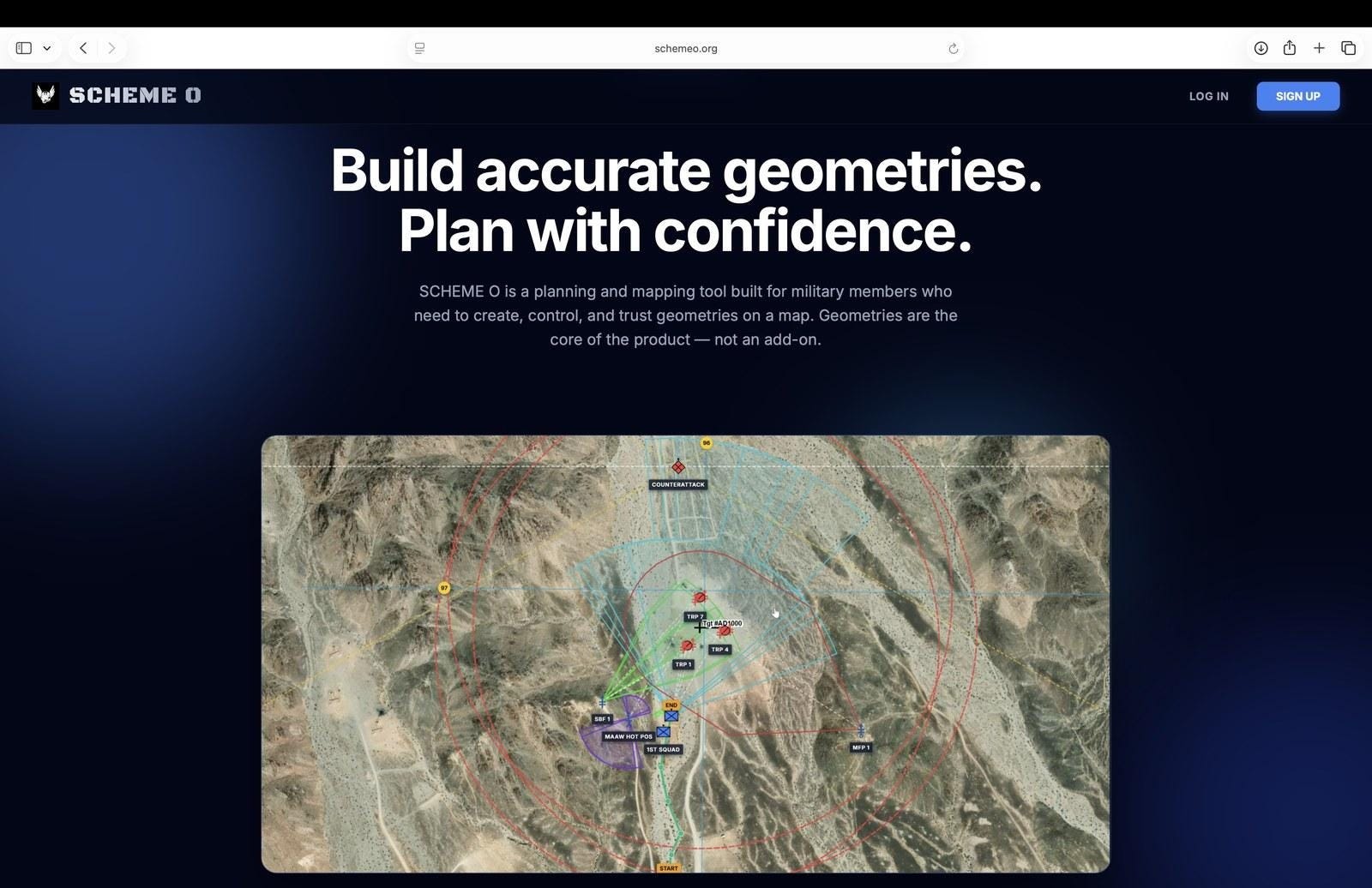
Scheme O on desktop: a company scheme of maneuver built with MIL-STD-2525 graphics, control measures, and battlespace geometries.
Learn It by Hand First
Let us be clear about what this argument is not. It is not an argument against map pens, protractors, compasses, acetate, or handwritten planning. Those are not quaint traditions; they are fundamentals of the profession. A leader who cannot read a map, plot a grid, shoot an azimuth, account for declination, and build an overlay by hand should not be trusted with software that does those things for him, because he has no way to recognize when the output is wrong and no way to function when the battery dies, the screen cracks, or the network drops. Degraded operations are not hypothetical. Analog skills are the fallback, and a fallback only works if it has been trained.
The right frame is basic math and the calculator. We make students learn arithmetic by hand not because the world lacks calculators, but because a person who does not understand the operations cannot recognize a wrong answer or reason about the problem. Once the fundamentals are in place, though, nobody demands that an engineer do long division on paper for virtue’s sake.
The calculator does not replace mathematical understanding. It removes mechanical repetition so the mind can work on the actual problem. Tactical planning deserves the same logic.
Learn the map. Plot the grids. Measure the azimuths yourself, and understand why grid north and magnetic north disagree. Build the overlay by hand until it is second nature. Then, once judgment is trained, stop spending three hours a night on mechanical tasks that purpose-built software can complete in minutes. There is no virtue in repetition for its own sake. The virtue is in the plan, the rehearsal, and the brief. The mechanics are the price of admission, and that price should be driven as low as possible.
General-Purpose Tools, Purpose-Built Problems
Many leaders who move past hand-drawing land upon tools like CalTopo. That is a rational choice, and this is not an attack on those platforms. They are genuinely good at what they were built for. But what they were built for is general-purpose mapping: recreation, land management, search and rescue. They were not built around gun-target lines, minimum safe lines, MIL-STD-2525 symbology, tactical control measures, time-space analysis for a movement under load, or the production cycle of an operation order and a confirmation brief. So the infantry leader who uses them ends up doing translation work, bending a general tool toward a specific profession: improvising symbols, exporting screenshots, and rebuilding products by hand in PowerPoint. The tool helps, but the friction remains, because the tool does not know what an infantry leader is actually trying to produce.
That gap, between general-purpose mapping and the specific, repeatable work of small-unit tactical planning, is the gap Scheme O was built to close.
What Scheme O Actually Does
Scheme O is planning software built around the small-unit planning cycle, by people who live inside it. Everything below exists because it used to cost us time. None of it thinks for the leader: Scheme O does not pick the support-by-fire position, sequence the assault, or decide where the casualty collection point belongs. It does the measuring, plotting, drawing, and rebuilding, which is exactly the work that was eating the hours.
Battlespace geometries in seconds
The foundation of the platform is its ability to generate battlespace geometries from three inputs: a friendly position, an enemy position, and the gun-target line that connects them. Pick the weapon system you intend to employ, and Scheme O calculates the azimuths, builds the minimum safe lines, and lays the geometry on the map. Custom geometries can be built once, saved, and reused, whether they reflect range regulations, specific ordnance, or different levels of fire support control, so recurring planning never starts from scratch. Declination between grid and magnetic north is handled automatically for wherever you are operating, and azimuths update continuously as units move.
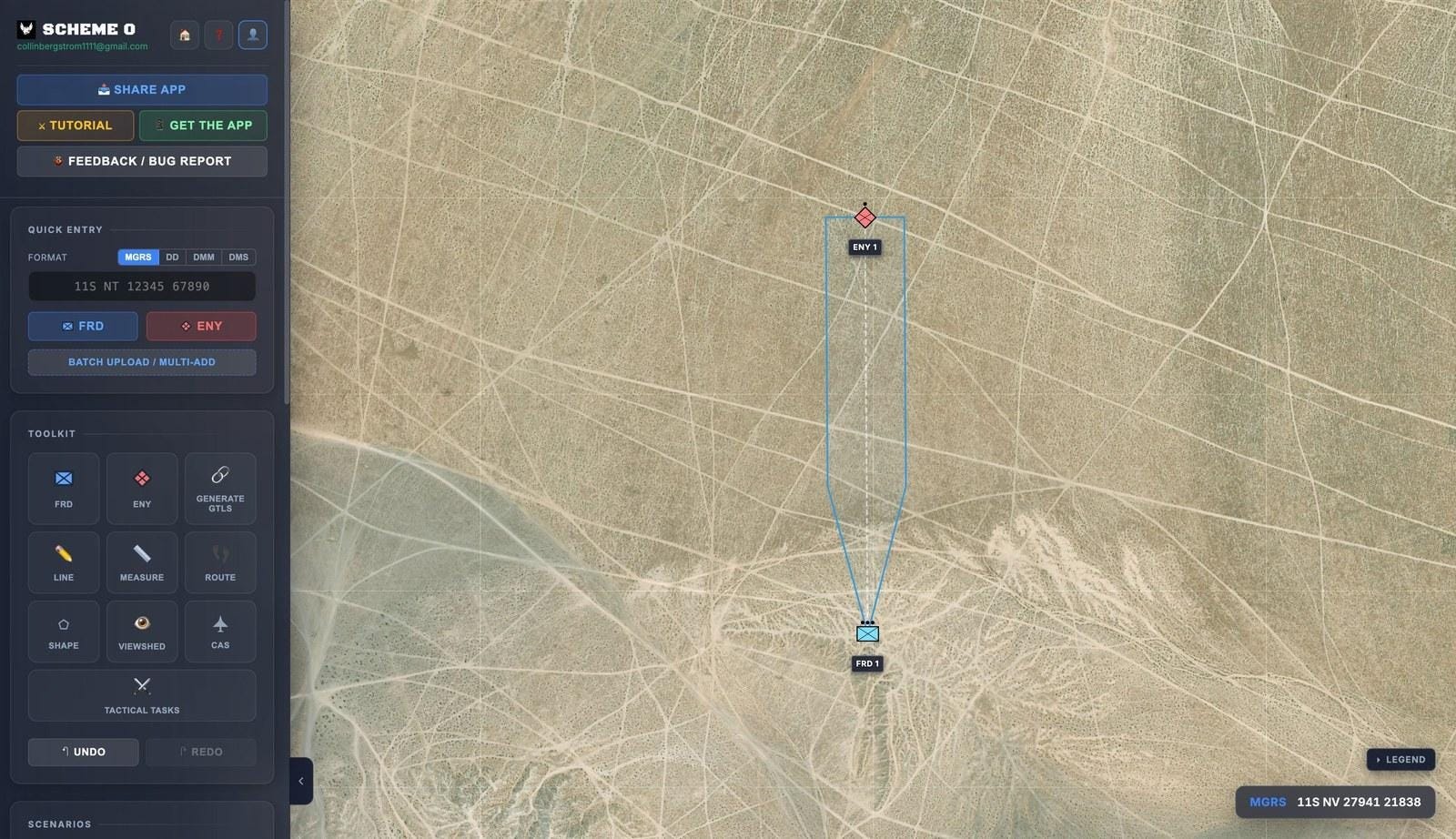
Building a battlespace geometry: gun-target line, minimum safe lines, and azimuths generated from three inputs.
Map work without the grind
Plot a single grid or batch-upload dozens straight from a written order, and every point lands on the map with its azimuths calculated in both grid and magnetic references, no protractor math required. Phase lines can be generated from simple northing inputs or snapped to exact grids when they have to match guidance from higher. Boundaries and multi-point lines organize the battlespace; shapes define engagement areas and range boundaries while generating grids for every point, and a built-in tape measure returns distance and direction between any two points instantly.
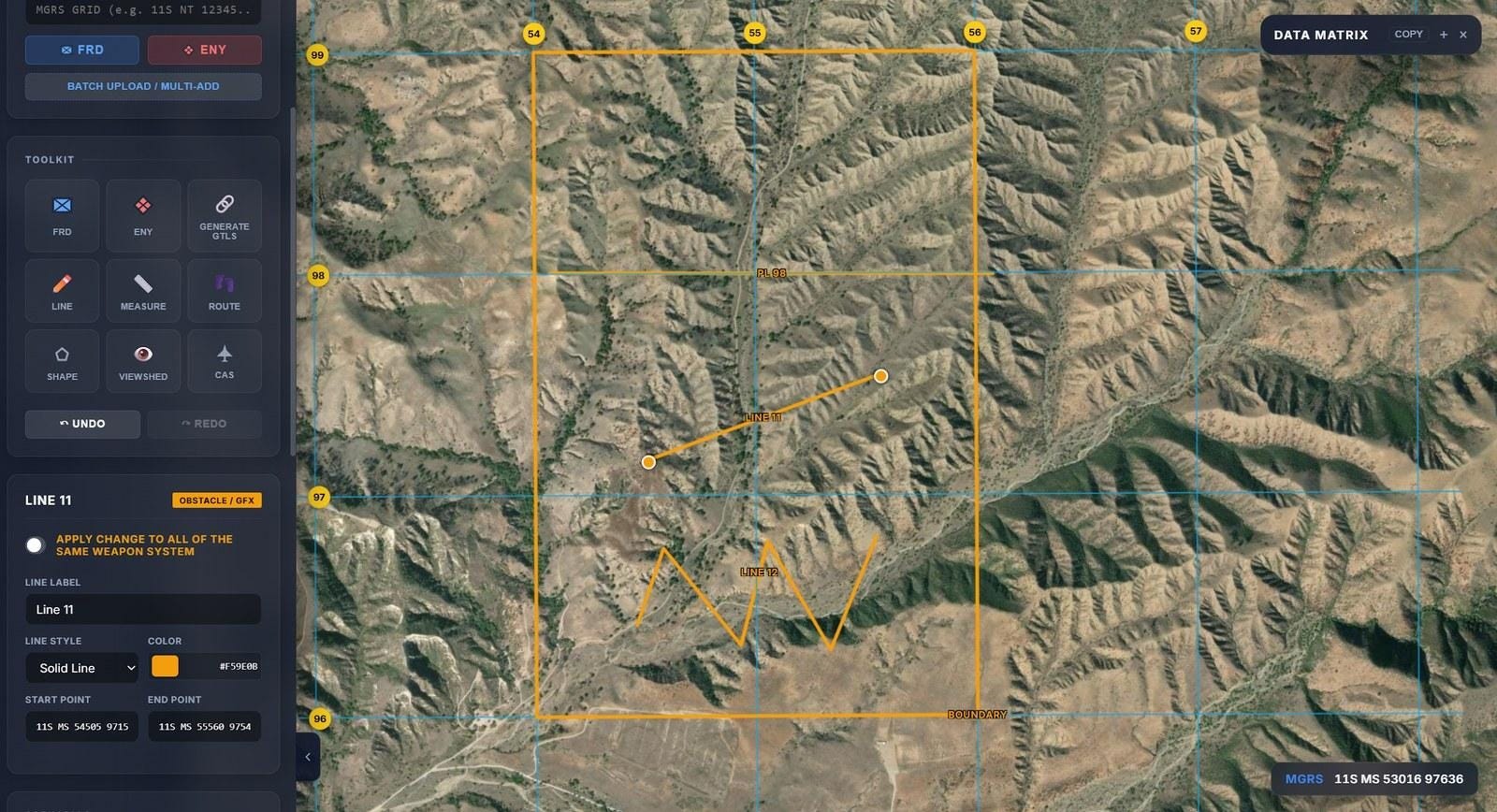
Lines, boundaries, and control measures, drawn fast or snapped to exact grids to match guidance from higher.
Routes and time-space analysis
Trace a route by clicking along it and Scheme O assembles it in real time: waypoints land on their own, checkpoints take a single click, and the numbering sequences itself. Every leg reports grid and magnetic azimuths and distance in meters, feet, kilometers, or miles. Enter a pace and a start time, and the tool returns total movement time and an ETA at every checkpoint. Or work the problem backward: give it a no-later-than time and Scheme O calculates the pace required to make the timeline, with a departure time to match.
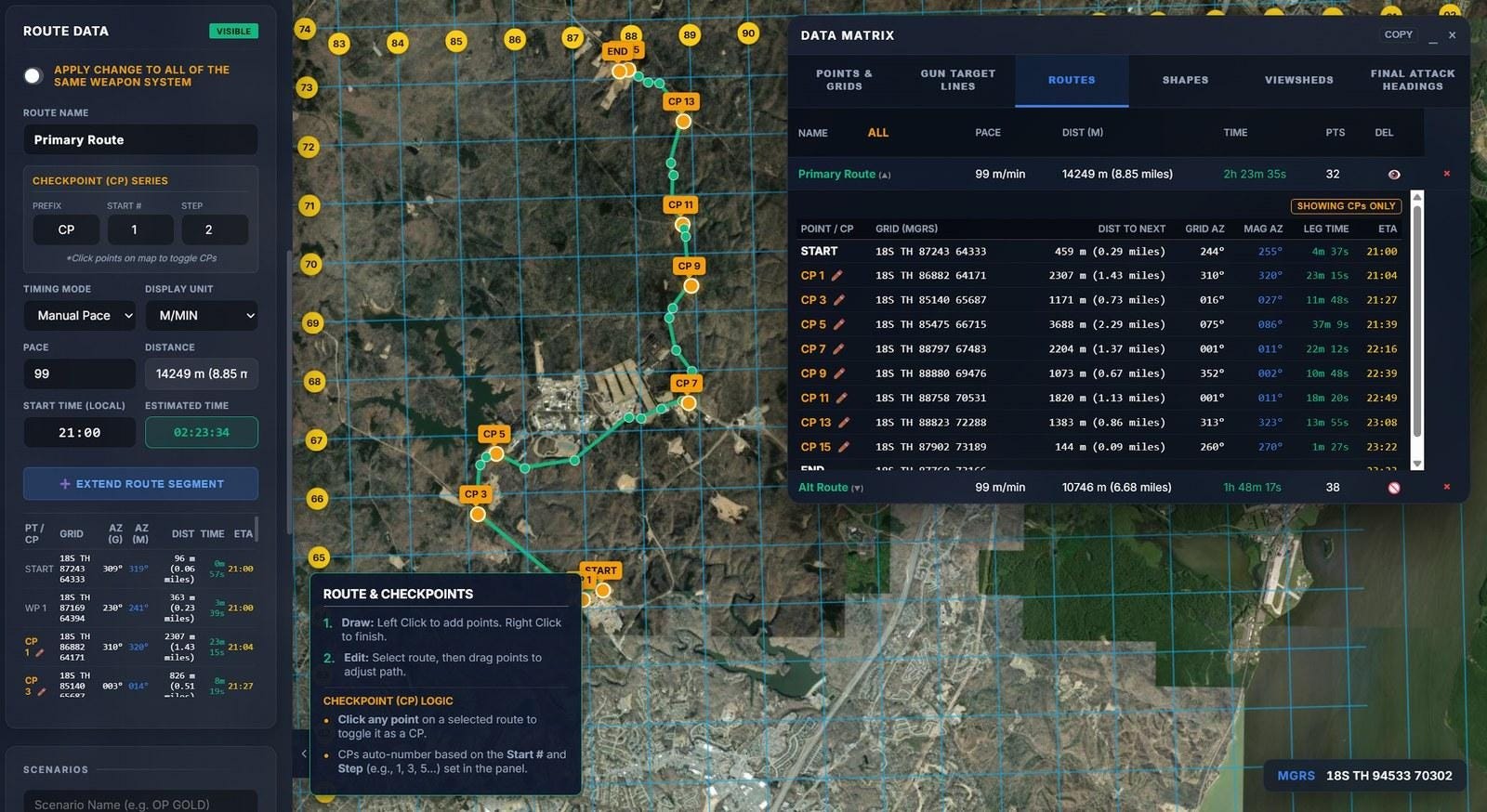
Route planning with automatic checkpoint sequencing, per-leg azimuths and distances, and time-space analysis.
Graphics that read correctly
The operational terms and graphics catalog is built on exact MIL-STD-2525 assets rather than approximations, so every friendly, enemy, weapon-system, and tactical control measure symbol carries the correct frame, affiliation, and echelon and reads correctly to anyone trained on the standard. No hunting for a hard-to-find symbol or improvising it from shapes. Select an enemy position and generate range rings tied to it for enemy analysis, so engagement areas and threat envelopes are visible the moment the enemy picture goes on the map.
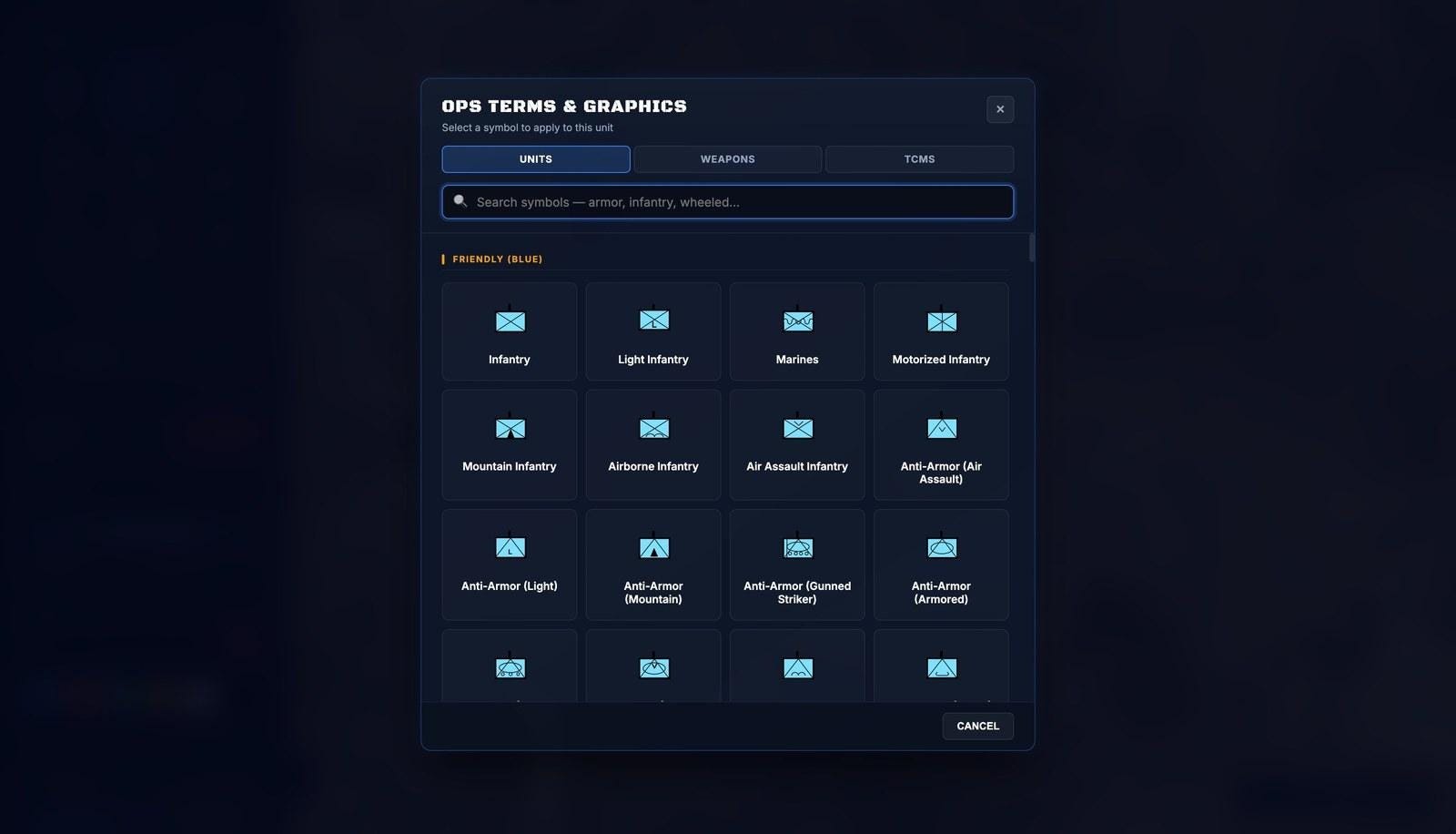
The Ops Terms and Graphics catalog: exact MIL-STD-2525 symbology for friendly, enemy, and weapon-system graphics.
Seeing the terrain before you walk it
Switch between high-quality map layers to match the terrain and the mission. Run viewshed analysis from any position at a specified observation height to see what terrain is visible and what is dead space, for your forces and the enemy’s. Then drop into 3D Recon mode and study how the plan actually sits on the ground before anyone steps off.
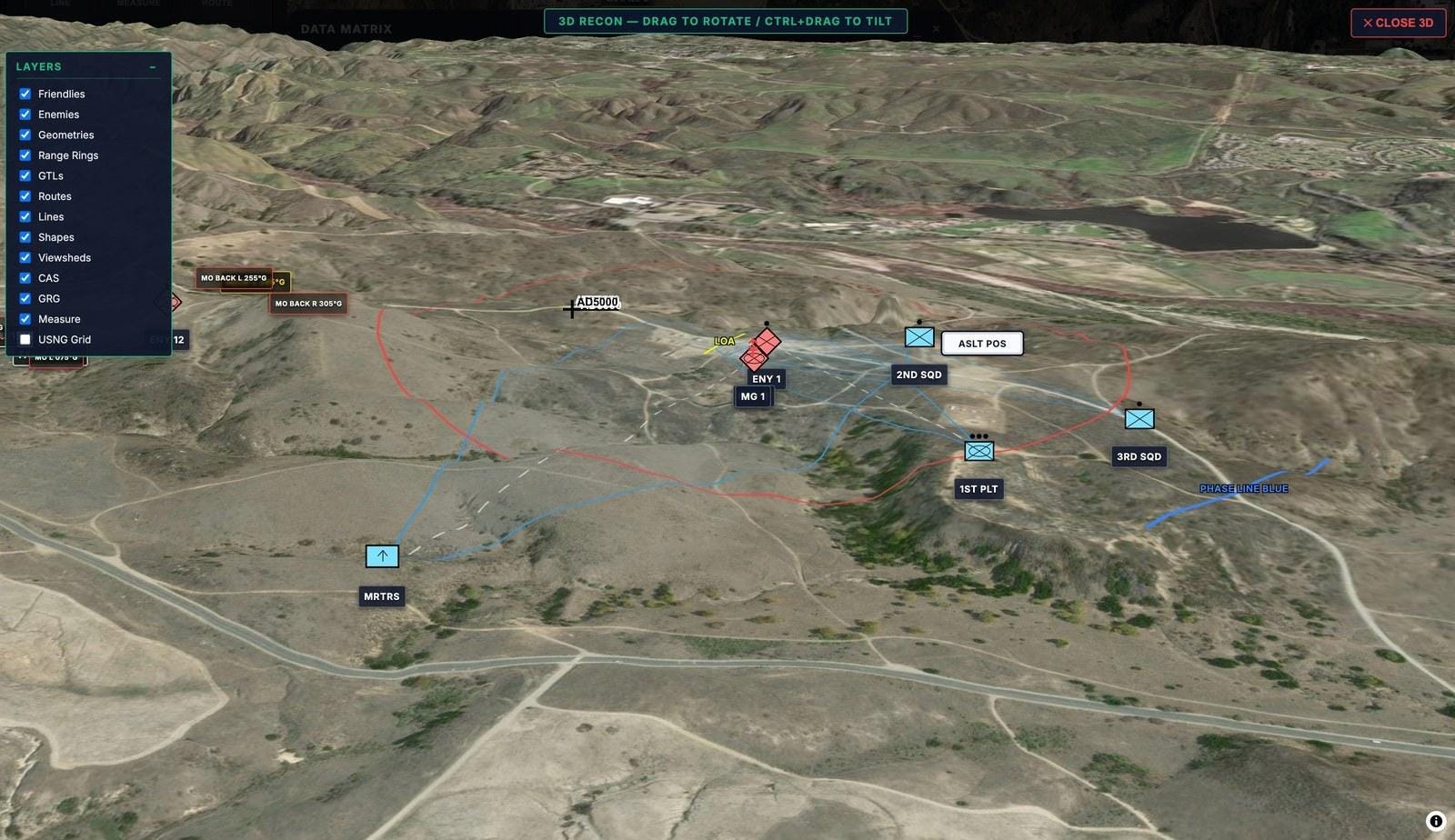
3D Recon mode: assessing terrain and the plan from ground perspective.
Fires and close air support
Select an enemy position and Scheme O generates final attack headings, reciprocals, maneuver buffers, and minimum safe distance rings, all adjustable in length and visual weight so the air integration picture stays clean and briefable.
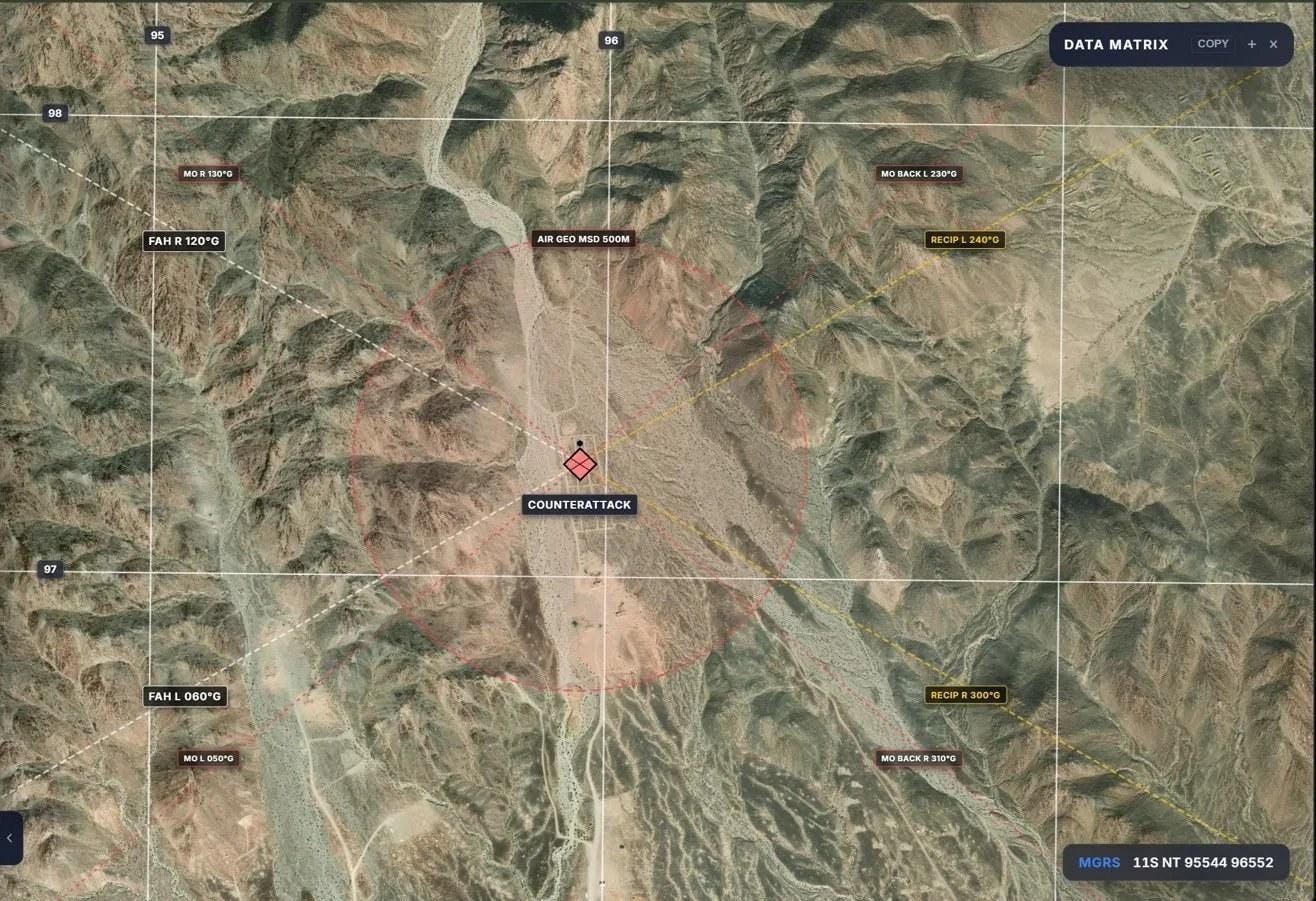
Final attack headings, reciprocals, and a minimum safe distance ring generated off an enemy position.
From map to order to brief
The data matrix consolidates everything behind the plan, including positions, grids, routes, geometries, control measures, and final attack headings, into one organized set of tabs, ready to copy straight into an operation order so the visual plan and the written one stay in step. When it is time to brief, the plan exports directly to PowerPoint: every unit symbol, route, and control measure arrives as a native, movable object rather than a flat screenshot, and because the file is generated locally, it works on the government laptops where PNG and PDF exports fail. The concept-of-operations slide stops being a separate production effort; the plan you built is the slide.
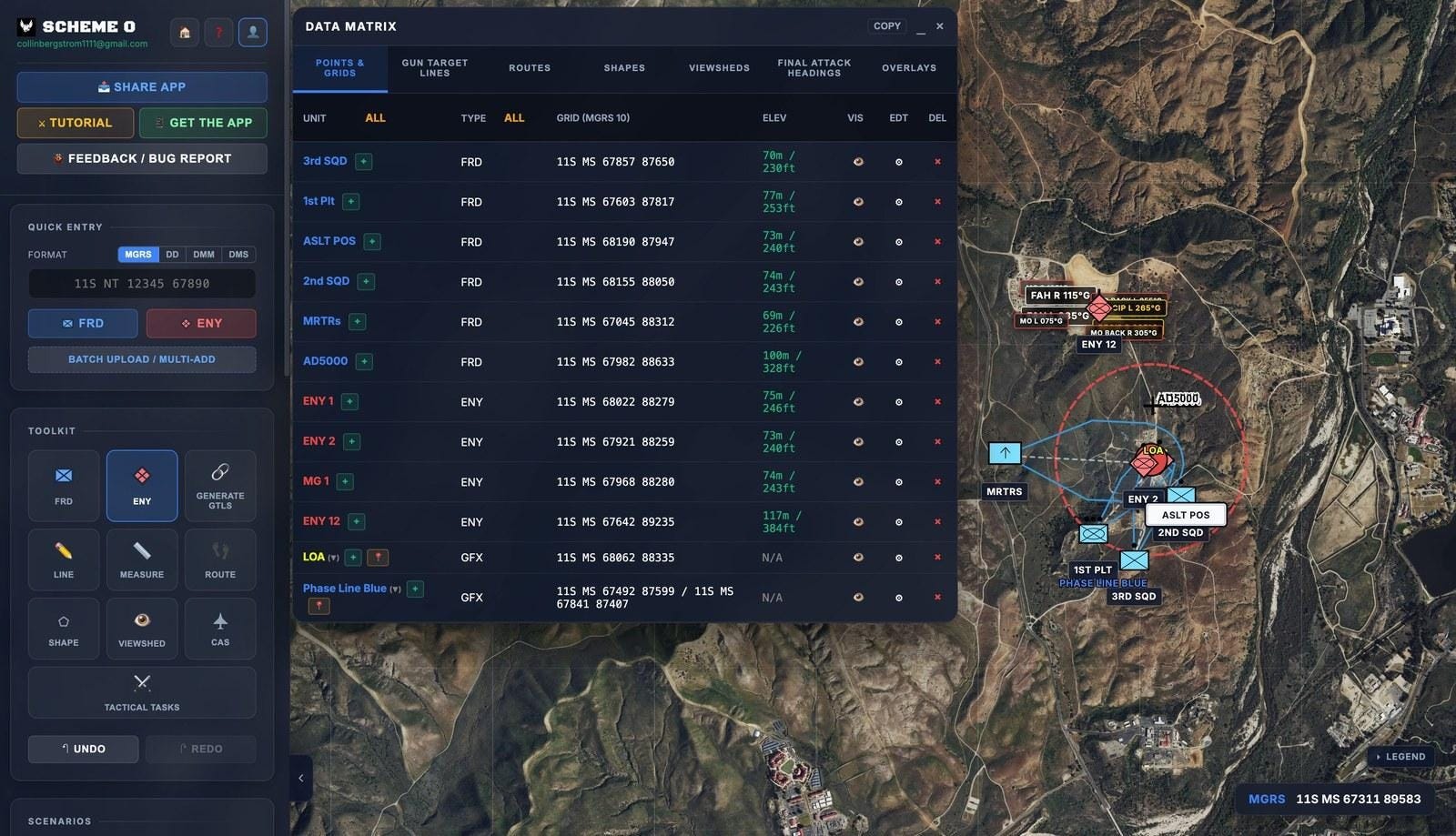
The data matrix: every position, grid, route, and geometry in one place, ready to drop into the order.
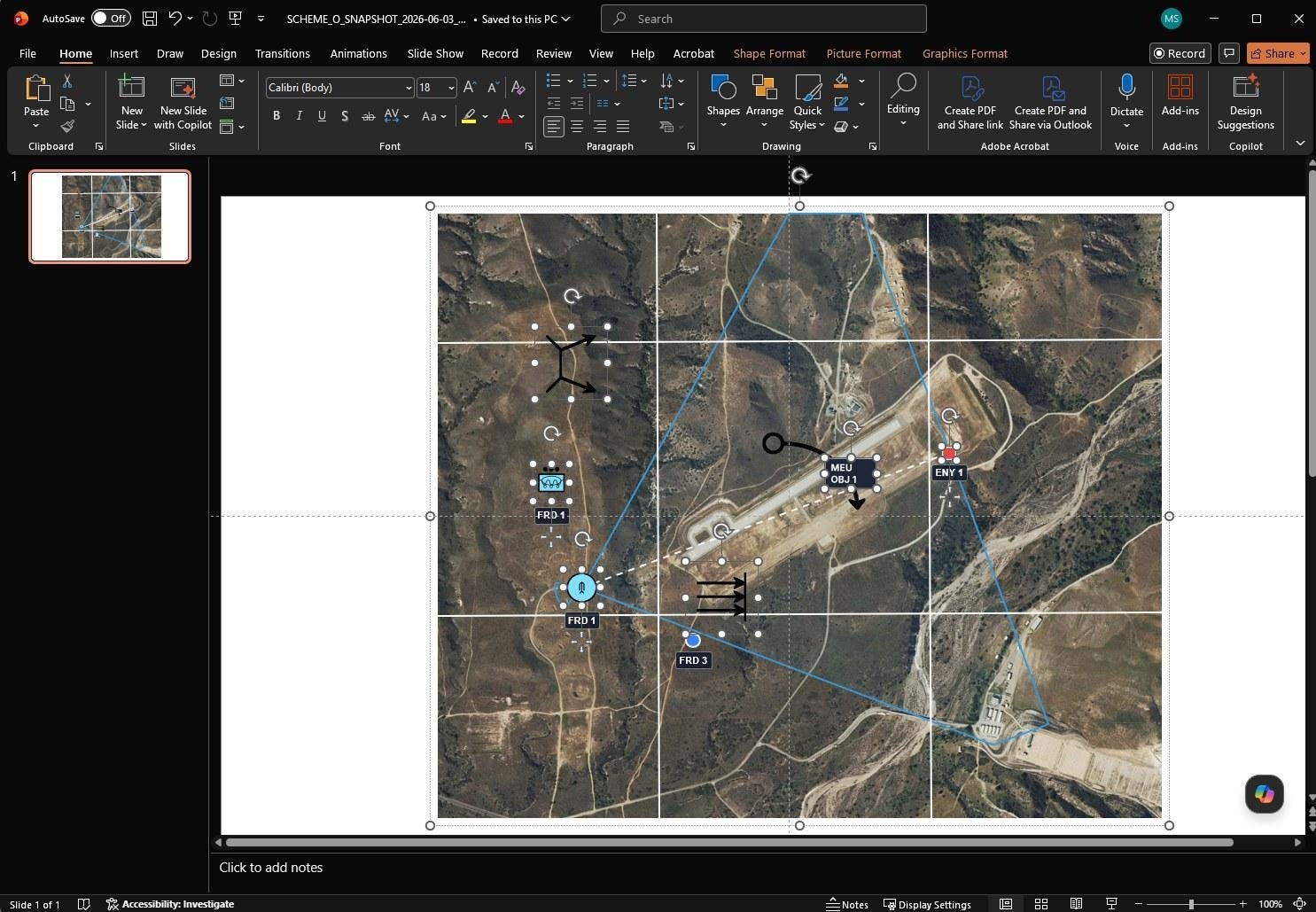
The same plan exported to PowerPoint, where every symbol, route, and control measure is a separate, movable object.
Because the analog products still matter, Scheme O also prints protractor-ready overlays at 1:25,000 or 1:50,000 for paper or acetate, alongside built-in screenshot and PDF export for rapid dissemination. A growing template set covers recurring needs, generating gridded reference graphics for urban terrain and pulling weather data, including illumination, first and last light, and precipitation, in a format ready for the orientation paragraph. And every scenario saves and syncs across devices, and can be exported for someone else to open and work in, so plans hand off without anyone redoing the effort. Scheme O is currently free, runs on both personal and government laptops, and has a mobile app on the App Store. It is built and actively refined by infantry leaders who use it for their own planning.
What It Looked Like at PMINT
This is not theoretical for us. We recently used Scheme O during PMINT, PHIBRON-MEU Integration Training: the first at-sea period of the Marine Expeditionary Unit workup, when the MEU embarks aboard the amphibious squadron’s ships and the blue-green team learns to plan and operate together. It is a deliberately compressed environment: planning happens in shipboard spaces on shipboard timelines, orders turn fast, and the rapid response planning process leaves little slack for wasted motion, which makes it an honest test of any planning workflow. We used Scheme O there to support company-level planning and order production. In past evolutions, that work meant hours of hand measurements, handwritten grid lists, manually constructed geometries, and slide decks rebuilt from scratch every time the plan changed. This time, the mechanical layer compressed: geometries were generated instead of constructed, grids populated instead of transcribed, and briefing products exported instead of rebuilt. Across the planning cycle, that saved the company and its platoons multiple hours.
It is worth being precise about what those hours mean, because the software did not produce the scheme of maneuver and did not make a single tactical decision. What it did was give the time back. The company spent that time on higher-level tactical thinking, refinement of the plan, rehearsals, and communication. The platoons received products earlier and spent their time preparing their Marines and building their own materials instead of waiting on higher or reconstructing graphics from scratch. That is the whole argument in a single evolution: when the tool removes friction, leaders get time back, and time is the raw material of good planning.
Give the Time Back
The argument here is not that technology replaces leadership. Nothing replaces a leader who understands the enemy, the terrain, and his people, and no software will ever carry the responsibility a commander carries. The argument is narrower and, we think, harder to dispute: friction is not a rite of passage, and time spent on mechanical repetition is time stolen from judgment, rehearsal, and preparation. Master the fundamentals by hand, keep them sharp, and then refuse to let the tools steal the plan.
Scheme O exists because two lieutenants got tired of losing that time and decided to build the tool they wished existed. It gets better the same way plans do: through contact with people who will tell you what is wrong with it. If you are a servicemember or veteran with an opinion about how small-unit planning should work, especially our brothers and sisters in the Army, we want to hear from you. Tell us what is missing, what is broken, and what would make your planning faster and cleaner. Reach us at contactus@schemeo.org. Help us build a tool that gives the time back to the platoon.
ABOUT THE AUTHORS
First Lieutenant Max Steinbach is a Marine infantry officer serving as the Company Executive Officer for Echo Company, 2d Battalion, 4th Marines, and a co-creator of Scheme O.
First Lieutenant Collin Bergstrom is a Marine infantry officer serving as a Rifle Platoon Commander for Echo Company, 2d Battalion, 4th Marines, and a co-creator of Scheme O.
Disclaimer: Scheme O is a privately developed tool and is not an official system of, endorsed by, or affiliated with the Department of Defense, the United States Marine Corps, the United States Army, or any government entity. The opinions expressed are those of the authors alone and do not reflect the views of the Department of Defense, the United States Marine Corps, the United States Army, or any other government entity.
The Written Word
Fiction and Nonfiction written by servicemen and veterans.
Harpers Ferry + Fort Monroe: Defining Moments
Erick Huertas
The sun glistened off the water as I gazed at the rocky hills along the confluence of the Potomac and Shenandoah rivers. A unique geographic location, as three states conveniently met at “the point” along the Appalachian Trail. The fatigued footsteps of hikers lagged behind me; joyous conversation filled restaurants in the historic streets. I turned around and faced the small town and stared at the old firehouse before me. It was much smaller than expected, an absurdly modest building of brick and mortar. Without the crowd gathering around it or its associated signage, it would be hard to identify exactly what transpired within its walls a century ago.
On a mid-October day in 1859, John Brown, accompanied by 21 abolitionists, marched into the town of Harper’s Ferry, West Virginia, with the intent of seizing the Federal Arsenal and igniting a slave revolt that would eradicate the institution of slavery. Just 36 hours later, 88 Marines, with the Virginia and Maryland militia, under the command of Colonel Robert E. Lee, rammed the doors of the firehouse where John Brown and his band of abolitionists dug in, leading to their defeat. Not a single enslaved person was freed, but the societal fractures tearing the Union apart were cast in stone, permanently changing the course of history. John Brown was tried for treason and hanged on December 2, 1859, in the audience of Thomas Jackson, John Wilkes Booth, and Edmund Ruffin, names of men who would go on to have their own moments that would solidify them in history.
I stood in front of the firehouse, cane in hand, and tightened the brace restricting the movement of my leg in the wake of my recent operation. The solemnity of the site seemed to be overtaken by restaurants and tourists searching for the novelty of the park and their next souvenir. Several important events of our national history occurred at this intersection of rivers and states. The most poignant being the events of October 16-18th, 1859. John Brown was tried and put to death for treason, but would go on to have songs regaling in his exploits during the Civil War. He was hanged for a vision that his own government would ratify four years later. The consensus among 19th-century Americans did not change, but as abolition became common thought, the national narrative shifted, transforming the then-proclaimed terrorist into a visionary. The same institution that killed him absorbed his noble cause and finally fought against the great contradiction that plagued the early United States. Two years later, on the Southeastern tip of Virginia, General Benjamin Butler would be forced to confront the great contradiction, despite his personal beliefs in the defense of “Freedom’s Fortress.”
The drive from the Shenandoah Valley to the lower Chesapeake Bay offers a gradual descent from the illustrious Blue Ridge to the coastal marshland of the state. As one drives closer to the coast, the stagnant, swampy air is briefly resolved by a light ocean breeze. As I arrived at the historic Fort Monroe, I parked between the decrepit air station, a remnant of the Second World War, and walked through the drawbridge that offered passage over the murky waters of the moat surrounding the hexagonal walls of the fort itself.
In May of 1861, three enslaved men escaped bondage and presented themselves to the Union Garrison under the command of General Benjamin Butler, who was tasked with defending the mouth of the Chesapeake. General Butler was not an abolitionist; he was a staunch supporter of Jefferson Davis during the 1860 presidential election. Yet when confronted with these three individuals, he made the defining decision not to honor the Fugitive Slave Act, enacted in 1850 and upheld by the US Supreme Court in 1859, and retain them under the doctrine of war. For Frank Baker, James Townsend, and Sheppard Mallory, this meant some semblance of freedom; for General Butler, it was simply a logistical decision to employ more laborers to defend the Union Garrison in the heart of the enemy. The Confederate battery at Sewell’s Point was just a few short miles away, and Butler needed bodies to further entrench his troops. Were these men truly free, or had the very institution fighting for their freedom retained them as property, just reclassified for narrative and convenience? Nevertheless, word spread throughout the Confederate states, and many a slave would escape and make haste for Fort Monroe, as it became a shining light of freedom, and a symbolic representation of the ideals that the Union was fighting to maintain: all men are created equal.
As I hobbled along the inner walls of the casemate, I asked myself: did these individuals know that these were their defining moments? What is the pivotal moment that defines someone? What was the pivotal moment that defined me? When a door opens or closes, does it matter why it happens?
I reflected on the first of two pivotal phone calls I received in late July of 2021:
“Doc, we are going to help with this thing in Afghan. We are down a Corpsman, and would love it if you could join us. It should be a pretty skate gig, just screening for det and getting these people on the planes. We have the funding, and we could have you join us in a few weeks. You’ll be a little late to the show, but better late than never.”
These were my Marines, asking for my help, even after several years of being apart. It was an honor and a concrete illustration of the camaraderie that I had always hoped to gain from military service. Naturally, I accepted. Like most things in the Reserves, the wait for orders dragged on. I anxiously watched the news and mentally prepared for what I was about to encounter. Early one morning, nearly a month later, I was jolted awake by the nonstop vibration of my phone from an unrecognized number. I wearily answered:
“Doc, it’s Gunny. Real talk, can you run MEDEVAC like you did back in the day?”
“I don’t know, man, it’s been a while, I haven’t done medicine like that since the COVID-ICU. I’ve been at Navy Bootcamp-”
“This isn’t the time for a stacked Doc answer that you love to give. I need a real, no-shit answer. Can you do it? Yes, or no?”
“Yes.”
“Dope, the bullshit with your orders should be fixed sometime today. We aren’t there, but we are going to send you to the MAGTF in [Sigonella]. We already stepped off, but we’ll figure it out once you get there. Text me your itinerary on Signal.”
“Rah. Why are you asking this anyway? Did something go down?”
“You’re going to see it on the news later. Text me your itinerary. I’ll talk to you later.”
Little did I know that the events that would transpire within the barracks of travelers incoming from Afghanistan would continue to be at the forefront of my mind for years to come. It would be the second time in two years that I would witness grand human suffering and be confronted with the situation’s moral ambiguity. I had seen the end of a conflict that started when I was in the 1st grade. I remembered why we went to war. I knew people who fought in it, and I knew a few who fell, making the ultimate sacrifice. For a few short weeks, I would witness firsthand the effects of war on multiple generations of families fighting for their freedom. Yet, I could not help but think that the institution provided them refuge merely for a narrative of thanks, not true gratitude for the sacrifices they had made over the past two decades.
My mind returned to the present as I peered out at the mighty Chesapeake Bay, a body of water that had seen so much conflict but largely remained the same. The theme from the confluence of the Potomac and the Shenandoah to the waters surrounding Fort Monroe was not whether John Brown was right or if General Butler was just. It was that the moment that defines us will often not be recognizable in the moment.
John Brown’s Raid was not the beginning of the Abolition movement; General Butler’s decision was not the full emancipation of enslaved Americans. Both of these moments started as difficult decisions. For both individuals, these were the moments when the great contradiction became unavoidable. Two independent decisions, two years apart, where the institutions governing them disagreed with those decisions. The importance of these moments lay not in the decisions themselves, but in what they represented. They were the moments when the inevitable truth became impossible to ignore, where the objective and consistent failures of the institutions were laid bare, and where these men were forced to decide whether to ignore the reality in front of them or align themselves with the often-uncomfortable truth.
I had spent enough time within institutions to recognize that change does not often happen because the institution wants it; change happens because it has to happen. This is often true at the individual level as well. No matter how hard we train or what we do to maintain our self-image, there will be a moment when one is forced to confront their mind, body, spirit, and ethos to preserve oneself or help change the world around them. It often happens in times when we least expect it, and we will be forced to decide how we react and what our legacy will be in the annals of history. When that moment comes, and we have to decide, do we follow the path of least resistance, or do we help shape the future?


Phanatics
Benjamin Van Horrick
Staff Sergeant Delarosa finally had Barnes’ Warrior Wish in hand.
“SSgt Barnes wants to meet the Philly Phanatic.”
“What?” — replied Captain Ryan Ingram.
“He wants the Philly Phanatic.”
“That’s it? He wants a walking neon green shag carpet that fuels nightmares to visit him in hospice?”
“That’s his Warrior Wish.”
Monday mornings at Wounded Warrior Battalion meant no DUIs, no suicide watches, no emergencies to chase down.
But now a Warrior Wish threatened to derail his morning.
“I got to talk to the CO on this Delarosa.”
“Because of Byrum?”
“Fucking Byrum.”
LCpl Peter Byrum’s Warrior Wish was to drive the Monster Truck Grave Digger.
Delarosa slow-rolled the request.
Byrum requested mast.
He drove Grave Digger.
After Byrum’s wish, every request to a veteran service organization went to the CO for vetting and approval.
Two weeks later, Byrum died on the operating table.
“I’ll go to the CO about the Phanatic. No promises,” said Captain Ingram.
Within five minutes, Ingram walked into LtCol Lee Kennedy’s office.
“Sir, SSgt Barnes has a Warrior Wish.”
“Ryan. What is it, NASCAR?”
“Sir…”
“What is it, Ryan?”
“He wants to meet the Philly Phanatic.”
“Ryan, what the fuck is happening with your company?”
“Barnes is in hospice, and he wants to meet a mascot. It’s not my wish, it’s his.”
“Shit.”
“So we are on the clock.”
“No,” said Kennedy, “he is on the clock.”
“We are on the clock.”
“Approved. No guarantees.”
“Nothing is a guarantee for Barnes.”
“Why does this matter to him so much?”
“Barnes grew up on the Phillies. He enlisted right after the towers fell. Never made it back for a game.”
“Why not a ballplayer?”
“He sees the end. He wants something from before Ramadi and Sangin. He wants the Phanatic.”
“Barnes survives Sangin with 3/5, comes home, then gets terminal cancer. Jesus. Cruel.”
The Warrior Wish people talked with the Phillies, and after three weeks of going back and forth, the Phillies agreed.
On Friday morning, the man who would grant Barnes his wish arrived at Walter Reed with two large black suitcases.
The man who would become the Philly Phanatic did not offer his name to the staff.
He requested a room to change, a short walk from Barnes’ room.
“You do this often,” Ingram asked the man.
“First time for this. You?” asked the man.
“No, man. So do you talk as the Phanatic?”
“The Phanatic is all physical. No talk.”
Five minutes later, the man emerged as the Philly Phanatic: a radiant electric green in a sea of calming earth tones.
Barnes was having a good day. He was alert, and his pain was managed.
Blankets and quilts covered Barnes’ legs. Two pillows propped up his back. His OD green hooded sweatshirt hung slack on his upper body, with his collarbones poking out. A new catheter bag hung on the railing of his bed. The room remained stuffy and sterile.
“Staff Sergeant, we have someone to see you,” said Ingram.
The door opened, and the green glowing figure marched into the room.
Barnes’ eyes adjusted from the grey of the room and fixed on the green guest.
The Phanatic’s size and manic energy filled the room, backing everyone else to the walls.
Barnes’ eyes lit up, and he chuckled as the Phanatic’s pantomime turned the hospice room into a ballpark.
Barnes reached for the Phanatic and pulled the green creature closer.
The two posed for pictures. Barnes and Phanatic hugged goodbye.
Barnes looked at Ingram — both of their eyes were wet.
“Thank you, sir.”
The Train Ride
Thomas Schueman
It was like being on a train, and most of your friends were on it; the mass rapid transit type of train, the subway or the metro. You’re underground, and everyone on board is going to the same concert or show. It’s a lot of fun. People were partying, drinking, and having a good time. The people on the train would tolerate almost any behavior or belief so long as you were kind, tried to be nice, and really tried to avoid hurting people’s feelings. Your favorite shows were playing. The onboard entertainment had all the most popular music and movies. The train was really full, but we were all too distracted to notice.
If people started to get a little uneasy, as if they were stuck on this train, the conductor would play some Taylor Swift over the loudspeaker, and people would dance. For the very few who weren’t Swifties, he would turn on the game and offer the guys a few cold ones.
I was having fun on this train. Although I wasn’t aware of the destination, it didn’t really matter. I never thought too much about it, because I was always engaged in eating and drinking and debating the latest thing. The people all seemed so interesting, smart, and successful that it never fully occurred to me or anyone else that we were all headed somewhere, and no one knew exactly where.
And if the thought ever did begin to surface, it never lasted long. There was fast, unlimited Wi-Fi on the train. Whenever you needed a break from thinking about where the train might be going, or why you couldn’t get off, or why, despite having so much fun, you felt so sad, or why these people didn’t have any children, like I was saying, when you needed a rest from all the fun or intrusive thoughts, you could read tweets or, depending on your age, Facebook posts. But when reading became too tiresome, you could watch 15- to 30-second clips on an endless loop on an endless train headed somewhere that you meant to find out about, but never got around to asking.
Of course, there were some signs that it might be worth knowing where you’re going. It started to get so dark that even the bright LED bulbs on the train strained to create some form of artificial light, and when the AC went out for a minute, it did seem oppressively warm, but the AC kicked back on a minute later, and thankfully, the Wi-Fi signal wasn’t interrupted, and these darn reels just hook you back in with a silly dance, a funny joke from your favorite comedian, or some breaking news; so you keep your ears plugged and eyes peeled until it’s time to get to the next thing, which promises to be so fun, and really what could be better than having fun?
One of the best parts of this train is that there’s no fun police. It’s just “good vibes only” and a whole lot of “be kind,” and while there seem to be a lot of people who aren’t very kind and do some pretty downright unkind things, we don’t like to dwell on that too much, and just briefly wonder why can’t everyone “just be a good dude?”
There was this one guy on the train who seemed to have missed most of the announcements about kindness, positive energy, and keeping the vibes light. One day, he flipped on this girl and really let her have it. It is possible that she had not been giving off good energy, but it still seemed pretty scary. In the aftermath, the event was explained in the usual way, and the conductor pushed out a message through the train-wide notification system reminding everyone that therapy, yoga, breathing exercises, and other wellness resources were complimentary, encouraged, and widely available on the train. Everyone appreciated the conductor’s wisdom when it came to stuff like this, and after a little while, we all went back to whatever we had been doing before.
The conductor always went out of his way to make sure everyone was comfortable, and as a result, I dozed off fairly regularly. But one day, I awoke from another long slumber, and when I opened my eyes, I had to shield them from the light. It took a long time for my eyes to adjust to the brightness. It was a different kind of light from the one I had become habituated to. It was real.
Someone whom I had never seen on the train before asked me, “Who woke you up, and how did you end up on this train?”
I thought about a passage from The Aeneid:
The gates of hell are open night and day;
Smooth the descent, and easy is the way:
But to return, and view the cheerful skies,
In this, the task and mighty labor lies.
And when I finally spoke, I said, “I don’t know, but I must have been asleep for a long time. And now I see that I am on a different train, and while I was pleased to be on the other train, I can plainly see this one is better. The other train was filthy, but I had become so accustomed to being unclean that I didn’t even notice how desperately I needed to be clean.”
When the conductor passed through my car and stopped at my seat to collect the fare, he told me the fare for the ride to the train’s final stop.
I said, “Sir, I have no money to pay my fare, and I am afraid I could never earn enough to secure my transit. In fact, I’m not quite sure how I even came to be on this train.”
He answered, “I brought you here. I chose you while you were a captive to another conductor and claimed you as my own.”
I thanked him but asked if he knew of the Man of Infinite Worth, who could pay my debt so I could remain on this train.
Then he said, “I am. You have seen Him, and it is He who is speaking to you. I have paid your debt in full.”
He then asked, “Do you believe?”
I said, “Yes. I believe.”
He told me that my faith had made me well and to go tell my family of all the Lord had done for me and how He had mercy on me.
This is amazing grace. For I spent decades on a dark and descending train, and by no means of my own, I have found myself in my right mind, on this train, made clean, ascending toward the light.
Poetry and Art
Poetry and art from the warfighting community.
What They Don’t Know
Karl Winar
They don’t know what the Afghan bazaar smells like at noon in May.
They don’t know what the local police chief looks like when he found a forty-pounder.
They don’t know the impotent rage at bad leadership.
They don’t know the green hell of stumbling through the Verona Loop.
But they also don’t know the rush of the ramp opening at 25,000 feet.
Or the boys in the bricks on a Friday night after a month in the field.
They don’t know the joy of American soil after seven months gone.
They don’t know, and that’s ok.
——————————
This ends Volume 49, Edition 1, of the Lethal Minds Journal (01AUG2026)
The window is now open for Lethal Minds’ forty-ninth volume, releasing September 01, 2026.
All art and picture submissions are due as PDFs or JPEG files to our email by midnight on 20 AUGUST 2026.
All written submissions are due as 12-point font, double-spaced, Word documents to our email by midnight on 20 AUGUST 2026.
lethalmindsjournal.submissions@gmail.com
Special thanks to the volunteers and team that made this journal possible.